
How many units in a cc of botox: Essential Guide 2025
Decoding Botox Measurements: Why Units Trump CCs
How many units in a cc of botox depends entirely on how your provider dilutes the product. This seemingly simple question reveals a common source of confusion that can impact both your treatment results and your wallet.
Quick Answer:
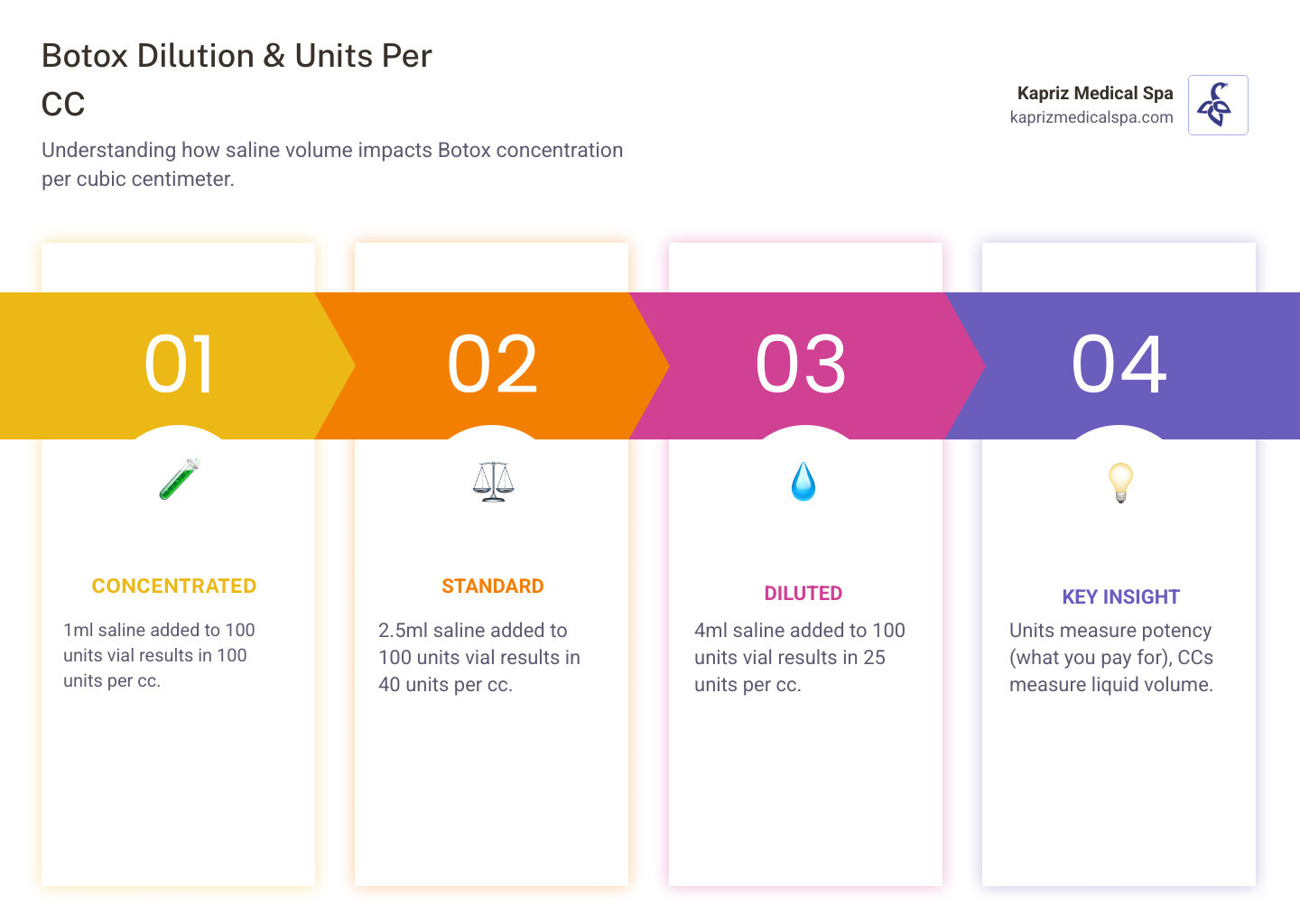
- 25-100 units per cc – depending on dilution method
- Standard dilution: 40 units per cc (2.5ml saline added to 100-unit vial)
- Concentrated dilution: 100 units per cc (1ml saline added)
- Diluted approach: 25 units per cc (4ml saline added)
Here’s the key insight from our research: “A vial of Botox cost all physicians about the same and contains 100 units of Botox. This means you could be getting anywhere from 25 to 100 units of Botox per cc if you paying buy the cc.”
The confusion stems from how Botox is prepared. Unlike other medications with fixed concentrations, Botox arrives as a powder that must be mixed with saline. Your practitioner chooses how much saline to add – and that choice directly affects how many units you get per cc.
This matters because units measure potency (how strong the Botox is), while CCs measure volume (how much liquid you receive). You’re paying for the therapeutic effect, not the liquid volume.
Understanding this difference empowers you to ask the right questions and ensure you’re getting exactly what you pay for.
How many units in a cc of botox vocab to learn:
- how many units are in a vial of botox
- how many units are used for botox
- how to know how many units of botox you need
What is a Unit of Botox?
When we talk about Botox, the term “unit” is thrown around a lot. But what exactly is a unit? It’s not a measure of volume, like a drop or a teaspoon. Instead, a unit of Botox is a very specific measurement of its biological activity or potency. Think of it as a measure of its strength – how much “muscle-relaxing power” it has.
Our research tells us that a Botox unit is “an arbitrary unit of measurement derived from animal studies” that serves to “standardize its ability to relax nerves.” This means that the potency of Botox is consistently measured, regardless of where it’s manufactured. Each unit represents a fixed number of botulinum molecules, ensuring that when we say “10 units,” we’re referring to the same amount of active ingredient every time.
Botox, specifically the brand name Botox Cosmetic, is manufactured by Allergan, and they define these units. A standard vial of Botox contains 100 units, though some may come in 50 or 200 unit vials. This unit measurement is crucial because it’s what determines the effect on your muscles, not the amount of liquid it’s dissolved in. For a deeper dive into how units are used in treatments, you can explore our guide on How Many Units are Used for Botox?.
What is a CC of Botox?
In contrast to units, a “cc” (cubic centimeter) is a standard unit of volume, exactly equivalent to a milliliter (ml). When we talk about a cc of Botox, we’re referring to the volume of the liquid solution that the powdered Botox is dissolved in. This liquid is typically sterile saline.
Imagine it like this: Botox arrives at our medical spa as a tiny amount of freeze-dried powder inside a sterile vial. To make it injectable, we must reconstitute it, or “bring it back to life,” by adding a specific amount of sterile saline solution. The saline acts as the delivery vehicle, allowing us to draw the solution into a syringe and precisely inject it into the targeted muscles.
So, while the units tell us how much active Botox is present, the cc tells us how much liquid volume that active Botox is contained within. The crucial point, as we’ll explain, is that the number of units in that 1 cc can vary wildly depending on how much saline was added during the reconstitution process.
How Many Units in a CC of Botox? The Critical Role of Dilution
Here’s where things get interesting! The answer to how many units in a cc of botox isn’t a simple number because Botox doesn’t come ready-to-inject. Instead, it arrives at our medical spa as a freeze-dried powder that needs to be mixed with sterile saline solution. This mixing process, called reconstitution, is where your practitioner has some creative control.
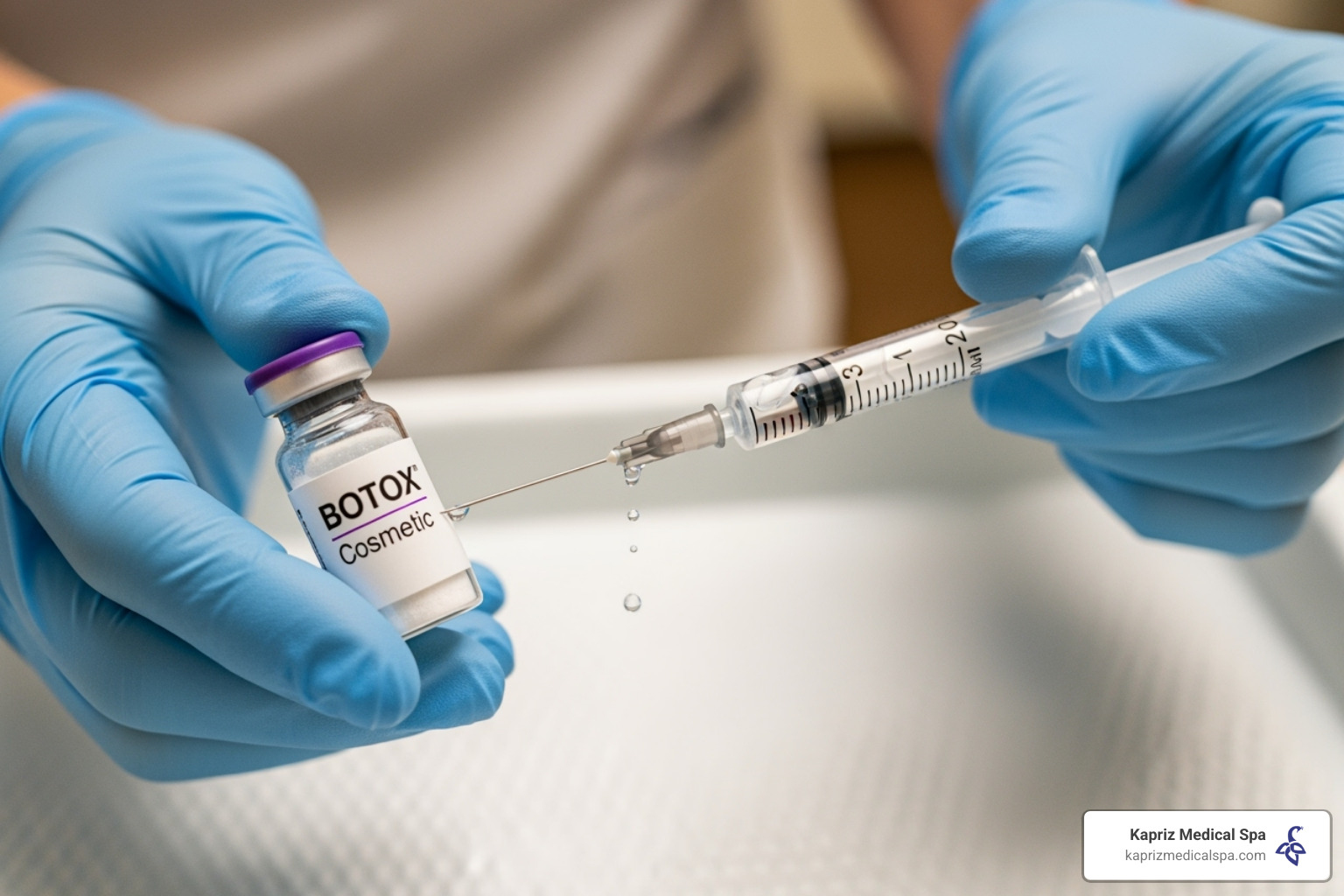
Think of it like making lemonade. You start with the same packet of lemon powder (your 100-unit Botox vial), but you can add different amounts of water. Add a little water, and you get concentrated lemonade. Add more water, and it’s diluted. The lemon flavor is still there, but the strength per sip changes dramatically.
Every standard vial contains 100 units of botulinum toxin type A. Your practitioner adds sterile saline to transform this powder into an injectable solution. The amount of saline they choose directly determines the concentration – and therefore how many units in a cc of botox you’ll receive.
According to Allergan, the manufacturer provides guidelines for reconstitution, but practitioners often adapt these based on their technique and treatment goals. If you’re curious about the relationship between volume and units, check out our detailed explanation of How Many Ml is 100 Units of Botox?.
The Reconstitution Formula: How Dilution Changes Everything
Let’s break this down with real numbers using a standard 100-unit vial. The magic happens when we add different amounts of saline – and the results might surprise you.
| Saline Added to a 100-Unit Vial | Units per 0.1 mL of Solution | Units per 1 mL (1 cc) of Solution |
|---|---|---|
| 1.0 mL | 10 units | 100 units |
| 2.5 mL | 4 units | 40 units |
| 4.0 mL | 2.5 units | 25 units |
See the dramatic difference? With concentrated dilution (1.0 mL saline), each cc contains 100 units. With a more diluted approach (4.0 mL saline), that same cc contains only 25 units.
This means if you need 20 units for your forehead, your practitioner might inject 0.2 cc of concentrated solution or 0.8 cc of diluted solution. Same therapeutic effect, different volumes.
Why Do Providers Use Different Dilutions?
You might wonder why practitioners don’t all use the same dilution recipe. The answer lies in the artistry of injection techniques and what works best for different situations.
Concentrated dilutions (less saline) pack more units into smaller volumes. This approach works beautifully for precision injections in delicate areas like around the eyes. You get more therapeutic punch with less liquid volume, which can mean fewer injection points and potentially less discomfort.
More diluted solutions (more saline) spread the units across larger volumes. Many practitioners love this approach because it allows for smoother, more even distribution within the muscle tissue. It’s like painting with a broader brush – you get more natural-looking results across larger treatment areas.
The treatment area also influences the choice. Broad areas like the forehead might benefit from diluted solutions that spread evenly, while precise work around crow’s feet might call for concentrated formulations.
Practitioner preference plays a huge role too. Different training programs teach different techniques, and experienced injectors develop their own preferred methods based on what consistently delivers beautiful results for their patients.
Some practitioners also find that patient comfort improves with certain dilutions. A slightly larger volume of diluted Botox might feel more comfortable during injection than a small, highly concentrated dose.
How does dilution affect the number of units in a cc?
Here’s the key relationship to understand: dilution and unit concentration work in opposite directions. It’s like a see-saw – when one goes up, the other goes down.
More saline means fewer units per cc. When we add 4 cc of saline to our 100-unit vial, those units spread out over the larger volume. Each cc now contains only 25 units because they’re distributed across more liquid.
Less saline means more units per cc. Add just 1 cc of saline to the same vial, and all 100 units are concentrated in that smaller volume. Now each cc packs the full 100 units.
This relationship is crucial for dosage accuracy. At Kapriz Medical Spa, our experienced injectors always focus on delivering the precise number of units you need, regardless of the dilution method. We calculate exactly how much of the reconstituted solution to inject to give you the therapeutic dose that will achieve your aesthetic goals.
Understanding this helps you ask the right questions during your consultation and ensures you’re getting exactly what you’re paying for – the units that create the results, not just the volume of liquid.
Your Personalized Botox Dosage: More Than Just Numbers
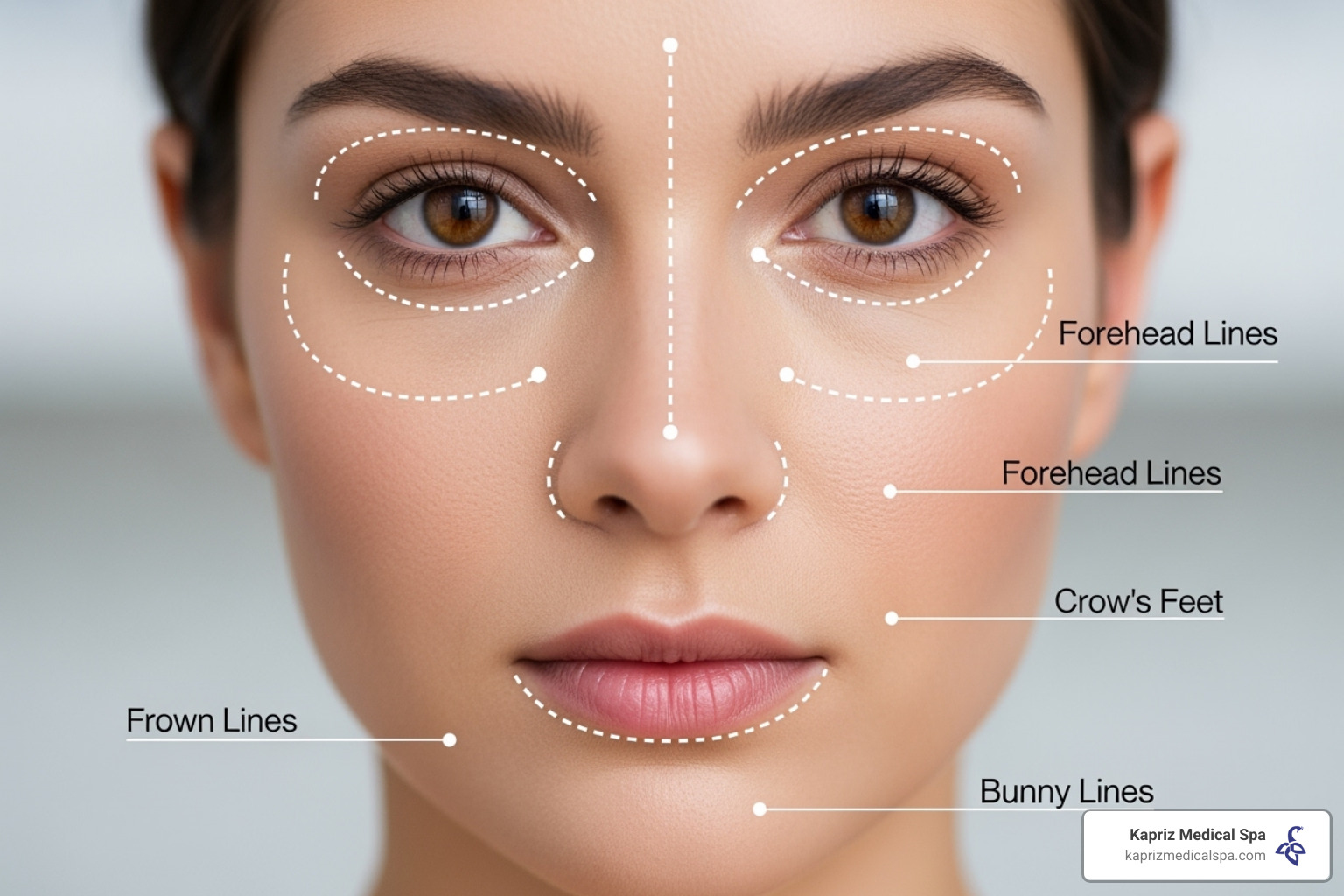
Here’s the beautiful truth about Botox: it’s not about following a cookie-cutter recipe. While understanding how many units in a cc of botox gives you the knowledge to ask smart questions, your actual treatment is far more personal and nuanced.
Think of it like getting a haircut. Your stylist doesn’t just grab the scissors and start cutting based on a generic photo. They look at your face shape, hair texture, lifestyle, and personal style. The same thoughtful approach applies to Botox.
Every face tells a unique story. Your muscle strength, the way you express joy or concern, even how you sleep at night – all of these factors influence what will work best for you. As our research shows, “every patient is different with different facial muscle strength, there are no universal Botox set recommendations for Botox units per area.”
This is exactly why we spend time really getting to know you during your consultation. We’re not just looking at your wrinkles – we’re watching how your face moves when you laugh, how your muscles work together, and listening to what bothers you most about your appearance. For a deeper dive into this personalized approach, check out our guide on How to Know How Many Units of Botox You Need.
Recommended Botox Units for Common Treatment Areas
While your specific needs will always be determined during our one-on-one consultation, it helps to understand the typical ranges for different areas. Think of these as starting points for our conversation, not rigid rules.
Forehead lines are usually the most noticeable, those horizontal lines that appear when you raise your eyebrows in surprise or concentration. Most people need 10-30 units here, though we often see the sweet spot around 12-20 units. The variation depends entirely on how strong your frontalis muscle is. Some people have muscles that could practically lift weights, while others have gentler muscle activity. For all the details on this area, visit How Many Units of Botox for Forehead Wrinkles?.
Those glabellar lines – you know, the “11s” that appear between your eyebrows when you concentrate or frown – typically need 15-25 units. Sometimes, if you have particularly strong muscles (hello, expressive personalities!), we might use up to 40 units. When we treat both your forehead and these frown lines together, we’re usually looking at around 40 units total.
Crow’s feet are those little lines that fan out from the corners of your eyes. They’re often the first sign of a life well-lived, full of laughter and smiles. Each side usually needs 5-15 units, depending on how pronounced they are and how active those muscles are when you smile. You can learn more about treating these at How Many Units of Botox for Crows Feet?.
For a lip flip – that subtle technique that helps your upper lip appear fuller by relaxing the muscle that pulls it inward – we use a delicate touch with just 2-8 units. It’s all about finesse here.
Other areas we commonly treat include bunny lines on the nose (5-10 units), marionette lines at the corners of the mouth (2-8 units), and addressing a gummy smile (2-10 units). For jawline slimming or TMJ relief, we work with the masseter muscles using 15-50 units per side, and neck bands might need 10-50 units depending on their severity.
Factors That Influence Your Ideal Dosage
Your perfect Botox dosage is influenced by several personal factors that make you uniquely you. Understanding these helps explain why your treatment plan might differ from your best friend’s, even if you’re targeting the same areas.
Muscle strength is the biggest game-changer. Some people have facial muscles that are naturally stronger and more active. If you’re someone who’s very expressive – the type who talks with their hands and their whole face – you’ll likely need more units to achieve the same level of relaxation as someone with gentler muscle activity.
Gender differences are real and significant. Men typically have larger, stronger facial muscles than women, which often means they need higher unit counts to achieve similar results. It’s not about being “tougher” – it’s simply anatomy.
Your metabolism plays a fascinating role too. Just like some people can eat pizza and stay slim while others just look at carbs and gain weight, some bodies process and break down Botox faster than others. If you’re a fast metabolizer, you might need slightly higher doses or more frequent touch-ups.
Age isn’t just a number when it comes to Botox. While it’s not the only factor, years of muscle contractions can create deeper, more established lines that require more units to smooth effectively. Think of it like ironing – a fresh wrinkle comes out easily, but one that’s been set for years needs more attention.
The severity of your wrinkles matters enormously. Fine lines that are barely visible at rest need far fewer units than deep grooves that have been etched by years of expression. We look at both static lines (visible even when your face is relaxed) and dynamic lines (only appear with movement).
Your treatment history can actually work in your favor. If you’ve had Botox before, your muscles might be somewhat “trained” to stay relaxed, potentially requiring fewer units over time. But if you’re new to Botox, we often start conservatively and can always add more at a follow-up appointment.
Most importantly, your aesthetic goals drive everything we do. Do you want to completely eliminate movement in certain areas, or do you prefer a subtle softening that maintains your natural expressions? There’s no right or wrong answer – only what feels right for you.
If you’re considering Botox for the first time, our comprehensive guide How Much Botox Do I Need for the First Time? walks you through everything you need to know to feel confident about your decision.
The beauty of working with experienced injectors is that we consider all these factors together, creating a treatment plan that improves your natural beauty while keeping you looking authentically like yourself.
Ensuring a Safe and Effective Botox Treatment

Getting safe, effective Botox isn’t just about understanding how many units in a cc of botox – it’s about choosing the right person to perform your treatment. When you’re trusting someone with your face, their expertise matters more than any measurement formula.
The truth is, even the most perfectly calculated dilution won’t help if your injector lacks the skill to use it properly. That’s why we always emphasize finding a qualified provider who understands both the science and artistry of Botox injections.
The Risks of Incorrect Dilution and Dosage
When dilution goes wrong, the consequences can range from disappointing to downright concerning. Let’s talk about what can happen when things don’t go as planned.
Over-dilution creates its own set of problems. When there’s too much saline mixed with your Botox, each injection delivers fewer active units than intended. You might find yourself wondering why your forehead lines are still dancing around after two weeks. Even worse, that extra liquid volume can cause the Botox to spread to muscles you didn’t want treated, creating unexpected effects.
Under-dosing is equally frustrating. When an area doesn’t receive enough units, you’re left with partial results – maybe one eyebrow moves more than the other, or your crow’s feet are softer on one side. Our research shows that even a difference of 1-2 units can dramatically affect adjacent muscles, so precision really matters.
On the flip side, over-dosing can leave you looking frozen or unnatural. Too many units in your forehead might give you that surprised expression that screams “I had work done.” In more serious cases, it can cause ptosis (droopy eyelids) or facial asymmetry that takes months to resolve.
Sometimes the dilution itself causes problems with comfort and bruising. If your practitioner uses a very concentrated solution but needs to inject large volumes, or if the dilution requires pushing too much liquid into a small area, you might experience more discomfort and bruising than necessary.
This is exactly why your injector’s expertise is non-negotiable. They need to understand facial anatomy, proper dilution techniques, and how your individual muscles will respond to treatment. You can see the difference expert technique makes in our Botox Before and After gallery.
Paying by the Unit vs. By the CC: What’s Best for You?
Here’s where we get passionate about protecting you as a patient: always, always pay by the unit. This isn’t just our opinion – it’s the industry best practice that ensures transparency and fair pricing.
Think about it this way: every 100-unit vial of Botox costs practitioners roughly the same amount (around $565). That means each unit costs about $5.65 wholesale. When you pay by the unit, you know exactly what you’re getting. Twenty units means twenty units, regardless of how much saline was added.
But when you pay by the cc? That’s where things get murky. Remember our earlier example – how many units in a cc of botox can range from 25 to 100 units depending on dilution. If you’re paying $300 for one cc, you might be getting 25 units (making each unit $12) or 100 units (making each unit $3). That’s a huge difference in value!
The math gets even more concerning when you realize some providers might use this pricing method to mask over-diluted products. You think you’re getting a great deal on that cc, but you’re actually receiving a watered-down treatment that won’t deliver the results you’re expecting.
Transparency in pricing builds trust, and trust is essential when you’re investing in your appearance. When we tell you a treatment will require 20 units at $12 per unit, you know exactly what you’re paying for and what to expect. No surprises, no confusion, just honest pricing.
At Kapriz Medical Spa, we believe in complete transparency. You’ll always know exactly how many units you’re receiving and what each unit costs. Check out our straightforward pricing on our Botox Cost Jacksonville FL page.
How to ensure you are receiving the correct number of units in a cc of botox
Even though we strongly recommend paying by the unit, we want you to be an informed patient who can advocate for yourself anywhere you go. Here’s how to protect yourself and ensure you’re getting quality treatment.
Start with questions – lots of them. A reputable provider will welcome your curiosity about their process. Ask about their standard dilution ratio, how many units are in each cc of their prepared solution, and why they choose that particular concentration. If they seem annoyed by your questions or can’t give clear answers, that’s a red flag.
Choose experience over price. The cheapest option is rarely the best when it comes to your face. Look for board-certified professionals with extensive training and a portfolio of natural-looking results. Check their credentials, read reviews, and don’t be afraid to ask about their experience with Botox specifically.
Demand a detailed treatment plan before any needles come near your face. Your provider should assess your facial muscles, discuss your goals, and propose specific unit counts for each area. This conversation should happen during your consultation, not while you’re already in the treatment chair.
Confirm your dosage right before treatment begins. A quick “So we’re doing 20 units total today – 10 in the forehead and 5 on each side for crow’s feet, correct?” ensures everyone is on the same page.
If you absolutely must work with a provider who charges by the cc, insist on knowing the concentration. They should be able to tell you exactly how many units are in each cc of their prepared solution. Then you can do the math yourself to understand what you’re really paying per unit.
You’re not just buying a product – you’re investing in expertise, safety, and results. The right provider will make you feel confident and informed every step of the way.
Your Path to a Refreshed Look
Now that you understand how many units in a cc of botox and why this knowledge matters, you’re equipped to make confident decisions about your aesthetic journey. This isn’t just technical jargon – it’s your roadmap to getting exactly what you pay for and achieving the results you want.
Think about it: you wouldn’t buy a car without knowing what’s under the hood, right? The same principle applies to Botox. When you understand the difference between units and volume, you can have meaningful conversations with your provider and ensure you’re getting genuine value.
Expert consultation forms the foundation of every successful Botox treatment. During your consultation, we take time to really understand your concerns, examine your facial anatomy, and discuss what you hope to achieve. Are you looking to soften those worry lines between your brows? Smooth out crow’s feet? Create a subtle brow lift? Your goals guide our entire approach.
Our personalized treatment plan goes far beyond just picking numbers from a chart. We consider your muscle strength, the way you express yourself, and even your lifestyle. A teacher who raises her eyebrows frequently might need a different approach than someone who works primarily at a computer. These details matter for treatment efficacy.
What sets us apart is our commitment to transparency and building genuine relationships. When we discuss your treatment, we’ll explain exactly how many units we recommend for each area and why. We’ll talk about the dilution we use and how it affects your treatment. No mystery, no confusion – just honest, clear communication.
You’ll always know you’re getting natural results because we focus on enhancing your existing beauty rather than creating an artificial look. Our goal is for people to notice you look refreshed and vibrant, not to guess what you’ve had done.
At Kapriz Medical Spa, our expert injectors create a custom plan based on your unique anatomy and goals, ensuring you receive the precise, effective dosage you need for beautiful, natural-looking results. We believe in building lasting relationships with our clients, which means we’re invested in your satisfaction not just today, but for years to come.
Ready to take the next step toward a more confident you? Our comprehensive Services: Botox Cosmetics: Renew Your Natural Beauty page has everything you need to know about our approach and what to expect. Schedule your consultation today – we can’t wait to help you achieve the refreshed, natural look you’ve been dreaming of.