
How many ml is 100 units of botox: 1 Ultimate Clarity
Explaining Botox: Units, Milliliters, and Your Treatment
The Foundation: What is a Botox Unit?
When we talk about Botox, you’ll hear the word “unit” a lot. But what exactly is a Botox unit? Well, it’s not a measure of how much liquid there is, like milliliters. Instead, a unit tells us about the potency or strength of the Botox. Think of it as the specific amount of the active ingredient that creates a desired effect. It’s truly a measure of the biologic strength of this amazing neurotoxin.
This “unit” system was standardized by Allergan, the original manufacturer of Botox. This standardization is super important because it means you can expect consistent, predictable results every time. When we administer Botox, our goal is to temporarily relax those specific muscles that cause wrinkles. The number of units tells us precisely how much active ingredient is present to achieve that smooth, relaxed look. This exact measurement is what allows us to tailor your treatment perfectly. If you’re curious to learn more about the basics, we have a helpful guide on Botox Basics: Your Guide to Youthful Skin.
Why Botox Comes in Units, Not Milliliters
You might be wondering why Botox is measured in units right from the start, instead of just milliliters. This is a common question, and the answer comes down to consistency, precise dosing, and most importantly, your safety. The actual liquid volume (milliliters) of the final injectable solution can vary because it’s mixed with saline right before your treatment. This is why the question of how many ml is 100 units of botox doesn’t have one single answer!
By using units, we have a universal standard for the active ingredient, no matter how it’s diluted. It’s a bit like baking: the recipe calls for a specific amount of sugar (units), and that’s what makes the cookie sweet, not the amount of water you use to dissolve it. Our skilled practitioners use this unit-based measurement to ensure you receive the exact therapeutic effect you need, perfectly custom to your individual muscle needs.
The Importance of Correct Unit Dosing
Getting the right number of units is absolutely crucial for achieving the beautiful, natural results you’re looking for. It’s a delicate balance we’ve mastered at Kapriz Medical Spa:
- Avoiding Over-Treatment: Our aim is always to improve your natural beauty, not to create a “frozen” or unnatural look. Too many units can sometimes lead to this, and we work diligently to prevent it.
- Preventing Under-Treatment: On the other hand, if too few units are administered, you might not see the full results you desire. The Botox could wear off sooner than expected, leaving those lines still visible and potentially meaning you’d need another appointment sooner than planned.
- Treatment Longevity: Proper unit dosing is directly connected to how long your fantastic Botox results will last. Typically, Botox effects last about 3 to 4 months, and correct dosing helps us achieve this optimal duration for you.
Understanding these nuances of dosing is a core part of our commitment to your satisfaction and safety. We believe in transparent conversations so you always feel confident in your treatment. If you’re curious about how we determine your personalized dose, we invite you to explore our article on How to Know How Many Units of Botox You Need?.
The Science of Preparation: From Powder to Injectable Solution
Botox arrives at our clinic in a vacuum-sealed vial, not as a liquid, but as a freeze-dried, aerosolized powder. You might even think the vial looks empty! But don’t be fooled—it contains precisely 50 or 100 powdered units of the neurotoxin. Before it can work its magic, this powder must undergo a crucial step: reconstitution.
Reconstitution is the process where we mix the powdered Botox with a sterile liquid, specifically sterile, preservative-free 0.9% Sodium Chloride Injection, USP (also known as saline). This transforms the powder into a liquid solution that can be accurately drawn into a syringe and injected.
Why Reconstitution is a Critical Step
Reconstitution is far more than just mixing powder with water; it’s a vital part of the Botox treatment process:
- Activating the Product: The saline activates the powdered Botox, making it biologically available for injection.
- Ensuring Sterility: We use only sterile saline and adhere to strict aseptic techniques to maintain the purity and safety of the solution.
- Achieving Correct Concentration: This is where the magic (and the math!) happens. The amount of saline we add directly determines the concentration of the Botox solution – how many units are contained within each milliliter of liquid. This precision is essential for effective treatment.
- Practitioner Skill: This step requires a skilled and experienced hand. Our medical professionals are experts in reconstitution, ensuring the solution is perfectly prepared for your treatment.
- Patient Safety: Incorrect reconstitution can lead to an ineffective treatment or, worse, an unsafe one. Our rigorous protocols ensure that every vial is prepared to the highest standards, prioritizing your safety above all else.

How Saline Affects Botox Concentration
This is where the answer to “how many ml is 100 units of botox” truly comes into play. The amount of saline used for reconstitution directly impacts the concentration of the final solution. It’s a simple dilution principle:
- More Saline = Less Concentrated: If we add a larger volume of saline to a 100-unit vial, the resulting solution will be more diluted. This means each milliliter of the solution will contain fewer Botox units.
- Less Saline = More Concentrated: Conversely, if we add a smaller volume of saline, the solution will be more concentrated, meaning each milliliter will contain more Botox units.
This concentration directly influences the “dose calculation” – how much liquid we need to draw into the syringe to deliver a specific number of units. For example, if a solution is very concentrated, we’ll inject a smaller volume of liquid to deliver your desired units. If it’s more diluted, we’ll inject a slightly larger volume. Rest assured, the number of units you receive is always the same, regardless of the volume of liquid.
How Many ML is 100 Units of Botox? A Guide to Dilution
So, we’ve talked about what a Botox unit is and how it gets prepared. Now, let’s tackle the big question that brings many people here: how many ml is 100 units of botox? Here’s the candid answer: there isn’t just one. It’s not a fixed amount. The total volume of liquid containing those 100 units depends entirely on how much sterile saline your practitioner adds during the reconstitution process.
Think of it like making a glass of lemonade. You have your lemon concentrate (the Botox units) and you add water (the saline). The more water you add, the more diluted your lemonade becomes, and the more liquid you’ll have in your glass. The same amount of lemon concentrate is still there, just spread out over more volume.
This choice of dilution is a careful decision made by your Kapriz Medical Spa practitioner. It’s based on your specific treatment goals and their expert injection technique. To help make this super clear, let’s look at that handy table again:
| Diluent Volume Added to 100-Unit Vial | Total Volume Containing 100 Units | Concentration (Units per 0.1 mL) |
|---|---|---|
| 1.0 mL | 1.0 mL | 10 Units |
| 2.5 mL | 2.5 mL | 4 Units |
| 4.0 mL | 4.0 mL | 2.5 Units |
| 8.0 mL | 8.0 mL | 1.25 Units |
| 10.0 mL | 10.0 mL | 1 Unit |
As you can see, 100 units of Botox could comfortably fit into as little as 1 mL of solution or be spread out over as much as 10 mL, all depending on the chosen dilution!
Common Dilution Ratios for a 100-Unit Vial
While the table shows many possibilities, some dilution ratios are far more common in cosmetic practices. These are the ones our experts at Kapriz Medical Spa typically work with to ensure the best results for you.
For instance, the manufacturer, Allergan, often recommends reconstituting a 100-unit vial of BOTOX® Cosmetic with 2.5 mL of sterile, preservative-free saline. This particular mix creates a solution where you get 4 Units per 0.1 mL of liquid. This is considered a standard for many aesthetic applications and is widely trusted. You can find this recommendation directly According to Allergan‘s official guidelines.
Other common ratios you might hear about include:
- A more concentrated 1 mL dilution: This means adding just 1.0 mL of saline to a 100-unit vial, leading to a potent solution of 10 Units per 0.1 mL.
- A more diluted 4 mL dilution: Here, 4.0 mL of saline is added, resulting in a concentration of 2.5 Units per 0.1 mL.
No matter which dilution is chosen, the critical factor is always the number of Botox units you receive, not the volume of liquid. That’s the real magic behind your treatment!
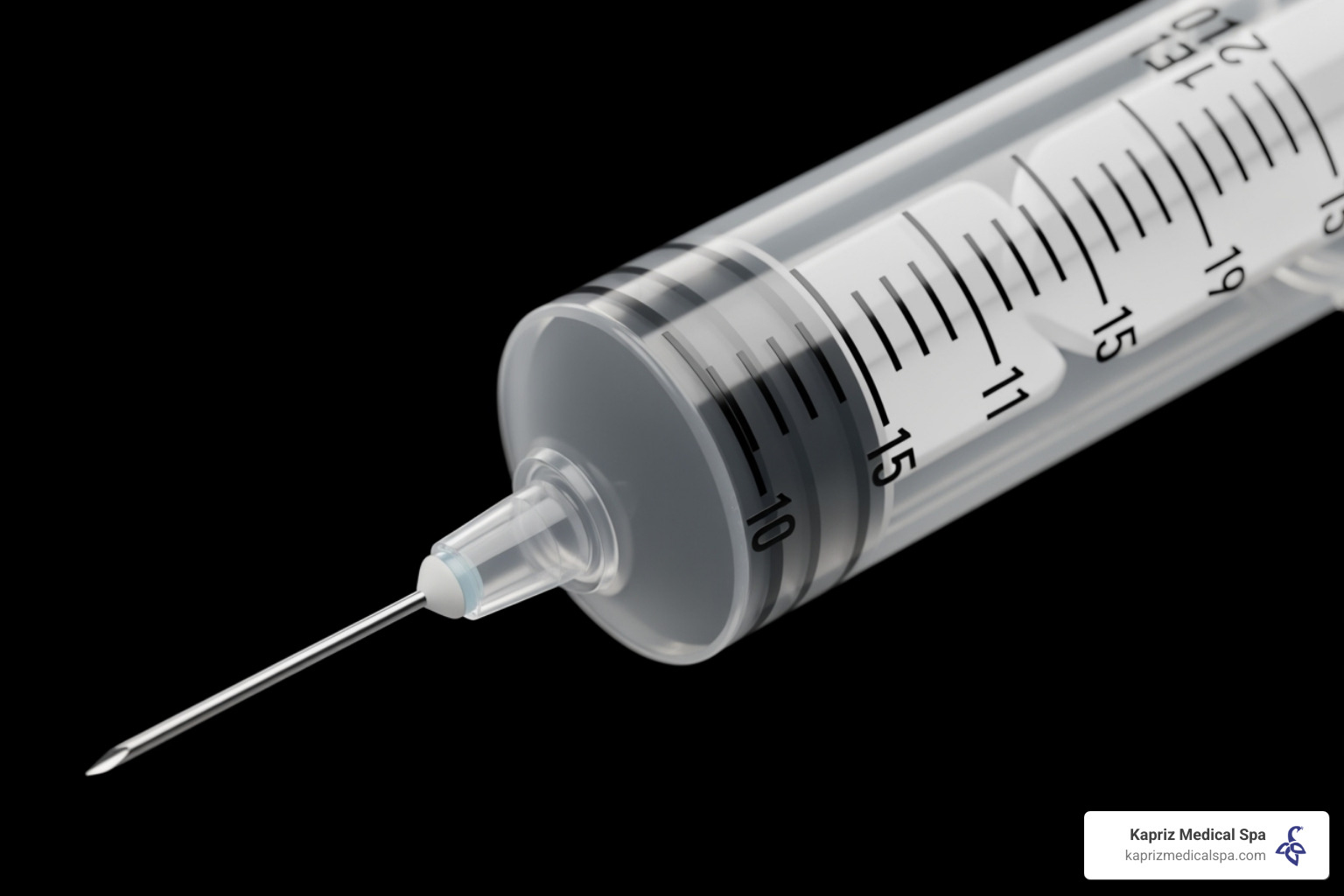
Calculating Injection Volume: How Many ML is 100 Units of Botox in a Syringe?
Let’s make this practical. Imagine your Kapriz Medical Spa expert determines you need a 20-unit dose of Botox for those pesky forehead lines. How much liquid will actually go into your skin? Well, it depends on the dilution used!
- If your practitioner uses the 2.5 mL dilution (4 Units per 0.1 mL), they’ll inject 0.5 mL of the solution. (That’s 20 units divided by 4 units per 0.1 mL, which equals five “0.1 mL segments,” or 0.5 mL total.)
- If they opted for the more concentrated 1.0 mL dilution (10 Units per 0.1 mL), they’d inject just 0.2 mL of the solution. (That’s 20 units divided by 10 units per 0.1 mL, which equals two “0.1 mL segments,” or 0.2 mL total.)
See? Both scenarios deliver the exact same 20 units of Botox, but the volume of liquid is different. This knowledge helps you understand your treatment better and why trusting your expert provider is so important. For more insights on specific unit recommendations for areas like the forehead, explore our guide on How Many Botox Units for Forehead Wrinkles?.
Why Practitioners Choose Different Dilutions
The choice of dilution isn’t just a random pick; it’s a strategic decision. Our experienced practitioners at Kapriz Medical Spa weigh several factors to ensure you get the best, most comfortable, and most effective treatment possible:
- Injector Preference and Technique: Some injectors simply feel they have better control and can be more precise when working with a slightly larger volume of liquid. This can make it easier to deliver tiny, exact doses into very specific muscles.
- Treatment Area and Muscle Size: For larger muscle groups (like the forehead) or broader treatment areas, a slightly more diluted solution might be preferred. This can help ensure a smoother, more even spread of the product, leading to a natural-looking result. For very small, precise areas, a more concentrated solution might be favored.
- Desired Spread: While Botox doesn’t travel far from the injection site, a slightly more diluted solution can offer a subtle increase in how it disperses within the muscle. This can be beneficial in certain situations, but don’t worry, our experts carefully manage this to avoid any unwanted spread.
- Precision in Measurement: Believe it or not, sometimes a slightly higher dilution can actually improve the accuracy of dosing. It’s often easier to measure, say, 0.1 mL on a tiny syringe than an even tinier 0.04 mL. Better measurement means better dosage control and a reduced risk of giving too much or too little at any single spot.
- Patient Comfort: While pain and bruising are mostly linked to the needle itself and the injector’s skill, some practitioners find that a slightly larger, more easily controlled volume can contribute to a smoother, more comfortable injection experience for you.
The “best” dilution is the one that allows your skilled injector to deliver the precise number of units safely and effectively, achieving optimal, natural-looking results just for you. It’s all part of the personalized care you receive at Kapriz Medical Spa.
The Impact of Dilution on Your Treatment’s Safety and Efficacy
It’s totally natural to wonder if the way your Botox is mixed might affect how safe or effective your treatment is. We get it! But here’s the most important thing to remember: the unit dosage is what truly counts, not the exact volume of liquid injected. Think of it this way: whether your 100 units of Botox are in 1 mL or 4 mL, it’s still the same powerful 100 units of active ingredient ready to work its magic.
At Kapriz Medical Spa, our experienced injectors are meticulous. They carefully calculate and deliver the precise number of units required to achieve your beautiful, specific aesthetic goals. This commitment to precision ensures we get you the results you want, safely and consistently, every single time. For more peace of mind, you can always explore our detailed Botox Safety Information page.
Does Dilution Affect Botox Safety?
The question of whether dilution affects Botox safety is a really smart one to ask! Some people worry that a highly diluted solution might spread a tiny bit further from the injection site, a process called migration. While this is a theoretical concern, in practice, this risk is very, very small when a qualified and experienced professional is doing your treatment.
Here’s why you can feel confident:
- Injector Technique is Paramount: The skill of your injector — their deep knowledge of anatomy, precise needle placement, and expert injection technique — matters far more in preventing any unwanted spread than the dilution ratio itself. Our practitioners are highly trained to ensure every injection is exactly where it needs to be.
- Established Safety Protocols: We stick to the strictest manufacturer guidelines and industry best practices for preparing and injecting Botox. This means we have rigorous protocols in place to minimize any potential risks.
- Benefits Often Outweigh Risks: Believe it or not, many skilled practitioners actually choose slightly higher dilutions because it can give them even better control and precision during the injection. This can make it safer to avoid delivering too much product in a very small, delicate area.
So, while the concept of migration is something we’re aware of, rest assured that in the hands of a qualified provider like those at Kapriz Medical Spa, your safety is always our absolute top priority, no matter the specific dilution chosen for your treatment.
How Concentration Affects Your Dose But Not the Outcome
Let’s quickly clear up a common misunderstanding: the concentration of the Botox solution (how many units are in each mL) affects the volume of liquid injected, but it doesn’t change the biological effect of the Botox units. This is a key part of understanding how many ml is 100 units of botox really works in practice.
Imagine you need a 4-unit dose of Botox for a small area.
- If we use a solution diluted to 4 Units per 0.1 mL, we would inject 0.1 mL of liquid to give you those 4 units.
- If we use a more concentrated solution of 10 Units per 0.1 mL, we would only need to inject 0.04 mL of liquid to deliver the exact same 4 units.
In both of these examples, you receive the identical 4 units of Botox. Because you received the same units, you will experience the same muscle relaxation and achieve the same beautiful, natural-looking results. The volume of liquid is just the vehicle! This means your focus should always be on the number of units you’re getting, as that’s the true measure of your treatment. Trusting your Kapriz Medical Spa provider means trusting their expertise in choosing the optimal dilution for your unique needs, ensuring consistent and effective results every time. For those considering their first treatment, our guide How Much Botox Do I Need for the First Time? offers even more helpful insights.
Frequently Asked Questions about Botox Measurements
We get it – the whole units versus milliliters thing can feel like learning a new language! Don’t worry, you’re not alone in feeling confused. These are the questions we hear most often at Kapriz Medical Spa, and we’re here to clear things up.
Is 100 units of Botox always 1 mL?
This is probably the biggest misconception we encounter, and honestly, it’s totally understandable why people think this way. The answer is no – 100 units of Botox is not always 1 mL.
Think of it this way: if you dissolve a packet of sugar in different amounts of water, you still have the same amount of sugar, just in different volumes of liquid. The same principle applies to Botox. Those 100 units represent the strength of the neurotoxin, not the final liquid volume.
How many ml is 100 units of botox depends entirely on your practitioner’s choice during reconstitution. As we showed in our earlier table, it could be 1 mL if they add 1 mL of saline, 2.5 mL if they add 2.5 mL of saline, or even 4 mL if they choose a more diluted approach. The “100 units” stays the same – it’s the potency that matters.
How many units of Botox will I need for my treatment?
Now this is where things get personal! There’s no one-size-fits-all answer because your face is uniquely yours. We consider so many factors when determining your perfect dose.
Your treatment area makes a huge difference. For example, those pesky forehead lines might need anywhere from 10 to 20 units, while crow’s feet typically require 10 to 24 units. But that’s just the starting point.
Your individual muscle strength plays a big role too. Some people naturally have stronger facial muscles that need more units to achieve the same relaxation effect. Your gender, metabolism, and even how deep your wrinkles are all factor into the equation.
This is exactly why we always start with a thorough consultation. Our experienced team takes the time to understand your aesthetic goals, examine your facial anatomy, and create a treatment plan that’s perfectly custom to you. It’s not just about the numbers – it’s about achieving results that improve your natural beauty.
Does more liquid (mL) mean a stronger Botox treatment?
This is another “ah-ha” moment for many of our clients! Absolutely not. More liquid doesn’t equal a stronger treatment – it’s all about those precious units we keep talking about.
Let’s say you need 20 units for your forehead. Whether that 20 units comes in 0.2 mL of concentrated solution or 0.5 mL of diluted solution, you’re getting the exact same strength of treatment. The saline is just the delivery vehicle – like the difference between taking your vitamins with a small glass of water versus a large glass. The vitamin dose is the same either way.
A skilled injector delivers the correct number of units for your desired effect, regardless of which dilution they choose. At Kapriz Medical Spa, we focus on precision and expertise, not volume. If you receive more milliliters during your treatment, it simply means your provider chose a more diluted solution – but you’re still getting the exact same number of active Botox units that your treatment plan calls for.
The beauty of working with experienced professionals is that they handle all these technical details behind the scenes, so you can focus on enjoying your results!
Achieve Your Aesthetic Goals with a Personalized Approach
Now that you understand how many ml is 100 units of botox depends entirely on dilution, you’ve learned something important: units measure strength, while milliliters measure volume. This isn’t just technical trivia—it’s the foundation of safe, effective Botox treatments.
When you walk into our clinic asking about volume, we’re thrilled to explain why units matter more. It shows you’re thinking critically about your treatment. Informed patient conversations are at the heart of what we do at Kapriz Medical Spa. We believe knowledge empowers you to make confident decisions about your aesthetic journey.
Our approach centers on the importance of a qualified injector who understands both the science and artistry of Botox. Whether your provider chooses a 1 mL dilution or a 4 mL dilution for your 100-unit vial, what matters is their expertise in calculating the exact units you need for your unique facial anatomy and aesthetic goals.
Kapriz Medical Spa stands apart because we don’t just deliver treatments—we build relationships. Our expert injectors take time to understand your concerns, explain your options, and create personalized treatment plans that evolve with you over time. We’re not interested in one-size-fits-all approaches or rushing you through appointments.
Every consultation begins with understanding your vision. Do you want subtle improvement that keeps people guessing? Or are you ready for more dramatic results? We listen, assess your facial structure, and recommend the precise number of units (not milliliters!) that will achieve your goals safely and naturally.
This personalized approach extends beyond your first visit. We’re here for touch-ups, questions, and adjustments as your needs change. Building lasting relationships means celebrating your confidence milestones and supporting you through every step of your aesthetic journey.
The science of Botox dilution might seem complex, but in the hands of skilled professionals, it becomes an art form. We handle the technical details—calculating units, choosing optimal dilutions, ensuring sterile preparation—so you can focus on enjoying your results.
Ready to experience the Kapriz difference? Your journey to refreshed, natural-looking results starts with understanding exactly what you’re receiving and why it works.