
how many botox units for forehead wrinkles: 10 Powerful Tips 2025
How Many Botox Units Will You Need for Forehead Wrinkles?
If you’re searching for a quick answer about how many botox units for forehead wrinkles, here’s what you need to know:
| Forehead Wrinkle Severity | Typical Botox Units |
|---|---|
| Mild | 10-15 units |
| Moderate | 15-20 units |
| Severe | 20-30 units |
| Manufacturer Guideline | 20 units (4 units in 5 sites) |
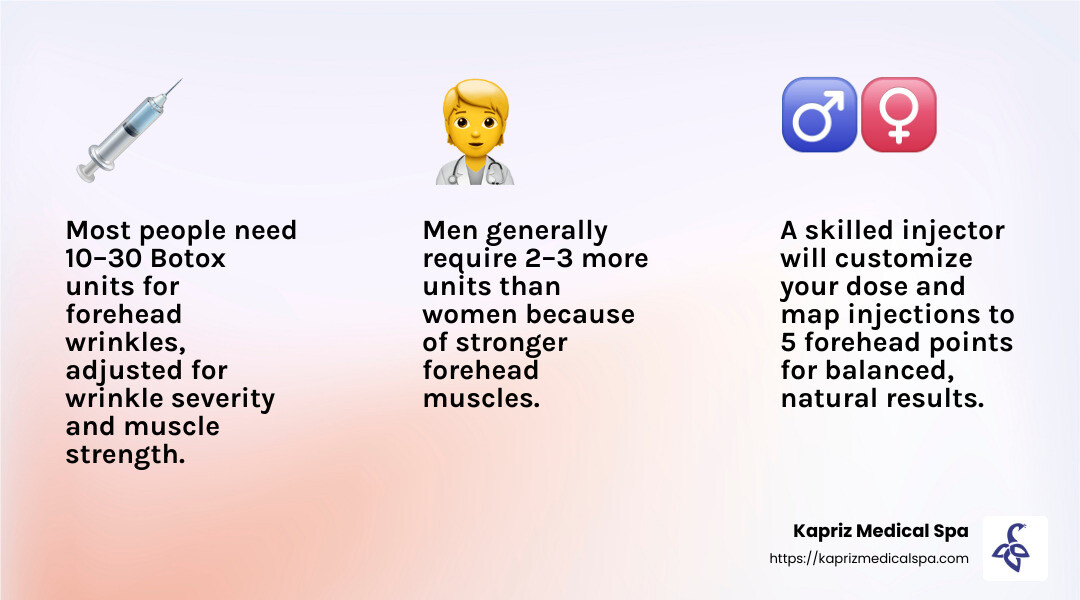
Most people require between 10 and 30 units of Botox for forehead wrinkles, with the exact amount depending on several key factors like muscle strength, gender, and the severity of your lines.
When those horizontal lines across your forehead start becoming more noticeable, you’re witnessing the natural aging process at work. These lines form when the frontalis muscle (the large muscle spanning your forehead) contracts repeatedly over years of facial expressions. Every time you raise your eyebrows in surprise or concentration, you’re creating the foundation for these wrinkles.
Botox works by temporarily relaxing this muscle, preventing it from creating those creases in your skin. The treatment is quick (usually under 15 minutes), relatively painless, and requires no downtime – making it one of the most popular cosmetic procedures worldwide.
A board-certified dermatologist or plastic surgeon will assess your unique facial anatomy and muscle strength during a consultation to determine your ideal dosage. As one expert injector notes, “A good doctor will inject a smaller amount than they suspect you will need, then have you return in a week for a touch-up.”
Men typically require about 2-3 more units than women due to stronger facial muscles, and first-time Botox users often start with a conservative dose that can be adjusted in follow-up treatments.
Must-know how many botox units for forehead wrinkles terms:
– how many units of dysport equal botox
– how many units of jeuveau do i need for lips
– how to know how many units of botox you need
Understanding Botox & Forehead Wrinkles
When you look in the mirror and notice those horizontal lines across your forehead becoming more pronounced, you’re witnessing the natural aging process at work. To understand how many botox units for forehead wrinkles you might need, let’s first explore what’s happening beneath your skin.
Your forehead is home to the frontalis muscle – a large, fan-shaped muscle that stretches from your eyebrows up toward your hairline. Every time you raise your eyebrows in surprise, concentration, or concern, this muscle contracts and creates temporary creases in your skin. After thousands of these expressions over the years, those temporary lines eventually become permanent fixtures.

Just below your frontalis muscle lies the glabellar complex – the muscles that create those vertical “11 lines” between your eyebrows. These include the procerus and corrugator muscles, which activate when you frown or concentrate. Many patients choose to treat both areas simultaneously for more balanced, natural-looking results.
According to scientific research on botulinum toxin, these dynamic wrinkles become more pronounced as we age due to a combination of repetitive muscle movements and the natural loss of collagen and elastin. While Botox can’t replace that lost collagen, it can prevent the muscle contractions that continue to deepen these lines.
What Exactly Is Botox?
Botox is actually a brand name for onabotulinumtoxin A – a purified protein derived from Clostridium botulinum bacteria. Don’t let that intimidate you! In the tiny, precisely measured doses used for cosmetic treatments, it’s completely safe.
When injected into specific muscles, Botox blocks the release of acetylcholine – the neurotransmitter that tells your muscles to contract. Without this signal, the muscle temporarily relaxes, and the skin above it smooths out.
“Many of my patients are surprised to learn that Botox doesn’t actually fill wrinkles – it prevents them from forming in the first place by relaxing the underlying muscle,” explains one of our specialists at Kapriz Medical Spa. “That’s why it’s become increasingly popular as a preventative treatment among younger clients.”
Botox is measured in units, which represent standardized amounts of the neurotoxin. These units ensure consistent potency and predictable results across treatments. When we discuss how many botox units for forehead wrinkles you might need, we’re referring to these standardized measurements.
The FDA first approved Botox for cosmetic use in 2002, specifically for treating glabellar lines. Approval for crow’s feet followed in 2013, and horizontal forehead lines in 2017. Each approval came with specific dosing guidelines based on extensive clinical trials.
Why the Forehead Ages First
Have you ever wondered why forehead wrinkles often appear before other signs of aging? There are several reasons why this area is particularly vulnerable:
Your forehead skin is surprisingly thin compared to other facial areas, making wrinkles more visible as they develop. Plus, we use our forehead muscles constantly throughout the day – expressing surprise, concentration, worry, and countless other emotions.
Sun exposure plays a major role too. Your forehead receives significant UV damage, which breaks down the collagen and elastin fibers that keep skin smooth and resilient. Add in the natural effects of gravity and the fact that we lose about 1% of our collagen each year starting in our mid-20s, and you can see why the forehead often shows age first.
“I like to tell my patients that forehead wrinkles aren’t just signs of aging – they’re evidence of a life fully lived, with all its surprises, moments of deep thought, and expressions of joy,” shares one of our practitioners. “That said, most people still prefer to keep those memories a little less visible, which is where Botox comes in.”
Understanding these underlying factors helps us determine the appropriate how many botox units for forehead wrinkles you personally might need – a topic we’ll explore more deeply in the next section.
How Many Botox Units for Forehead Wrinkles?
Let’s talk about what you really want to know – how many botox units for forehead wrinkles will give you those smooth, refreshed results you’re looking for?
Allergan, the company behind Botox, recommends a standard dose of 20 units for the forehead, typically spread across 5 injection points with 4 units at each site. This recommendation comes from extensive clinical trials that led to FDA approval. But here’s the thing – in the real world of aesthetics, one size definitely doesn’t fit all!
At Kapriz Medical Spa in Jacksonville, our experienced injectors typically use between 10 and 30 units for forehead lines. Why such a range? Because your face is uniquely yours, and your treatment should be too.
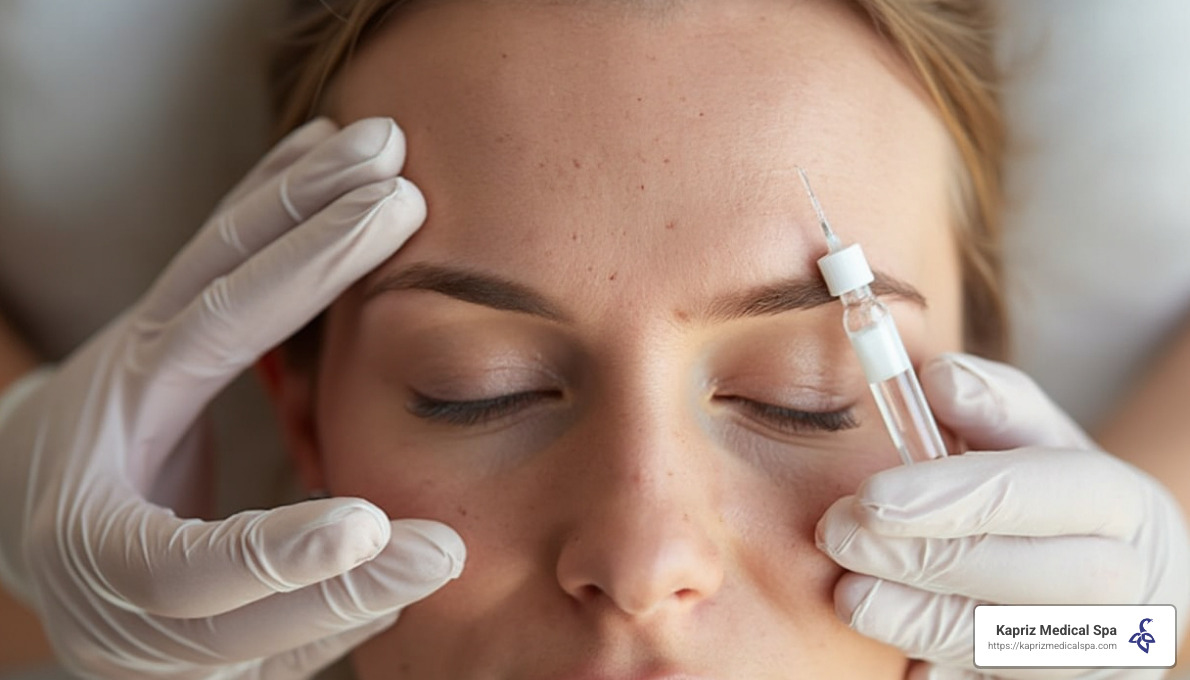
Think of your Botox treatment like a custom suit rather than something off-the-rack. The perfect amount depends on several factors that make you, well, you! These include the depth of your wrinkles, how strong your forehead muscles are, whether you’re a man or woman (men typically need 2-3 more units due to stronger facial muscles), your age, if you’ve had Botox before, and what kind of results you’re hoping for.
Curious about first-time treatments? We’ve put together a detailed guide on how many units of Botox for forehead first-time that answers all your beginner questions.
Typical Range: 10–30 Units – How Many Botox Units for Forehead Wrinkles?
Let me break down what those numbers actually mean based on the severity of your forehead lines:
If you have mild forehead lines (those faint lines that show up when you raise your eyebrows but mostly disappear at rest), you’ll likely need between 10-15 units. This is also the range we often recommend for younger clients looking for preventative treatment before deeper lines set in.
For moderate forehead lines that are visible even when your face is relaxed and become more pronounced with expression, the sweet spot is usually 15-20 units. Most of our clients in their 30s and 40s fall into this category.
If you’re dealing with severe forehead lines – those deeper, etched-in wrinkles that are quite noticeable even without any facial movement – you’ll typically need between 20-30 units for optimal results. This higher range is common for clients over 50 or those with significant sun damage.
As Dr. Thomas Jeneby, a board-certified plastic surgeon, often says, “A skilled injector will customize your treatment based on your unique facial anatomy and muscle structure. The goal is to soften lines while maintaining natural movement and expression.”
I love that philosophy because nobody wants to look “frozen” – just refreshed and more confident!
Consultation Process: Personalizing How Many Botox Units for Forehead Wrinkles
At Kapriz Medical Spa, determining your perfect Botox dose isn’t guesswork – it’s a science combined with artistry. During your consultation, we’ll take several important steps:
First, we’ll evaluate your wrinkles both at rest and when you make expressions. This helps us see exactly how your muscles move and where treatment will be most effective.
We’ll also test your muscle strength by having you make various expressions. Some people naturally have stronger frontalis muscles that require more units for the same effect.
We’ll talk about what you’re hoping to achieve. Do you want a completely smooth forehead, or would you prefer to maintain some natural movement? Your preferences matter tremendously in crafting your treatment plan.
Finally, we’ll review your medical history to ensure Botox is safe for you and to identify any factors that might influence your treatment.
One of our experienced practitioners often tells clients, “A good doctor will inject a smaller amount than they suspect you will need, then have you return in a week for a touch-up.” We accept this incremental approach because it helps avoid over-treatment and ensures you’ll look naturally refreshed, not obviously “done.”
Many of our clients appreciate this conservative start, especially for first-time treatments. It gives them time to adjust to their new appearance and decide if they want more complete relaxation in future sessions. After all, you can always add more, but you can’t take it away once it’s injected!
Your perfect Botox units for forehead wrinkles is a personal journey – and we’re here to guide you every step of the way.
Variables That Change the Unit Count
When it comes to figuring out how many botox units for forehead wrinkles will work best for you, it’s not a one-size-fits-all situation. Several factors play important roles in determining your ideal dosage, making your Botox treatment truly personalized.
Muscle Strength & Gender
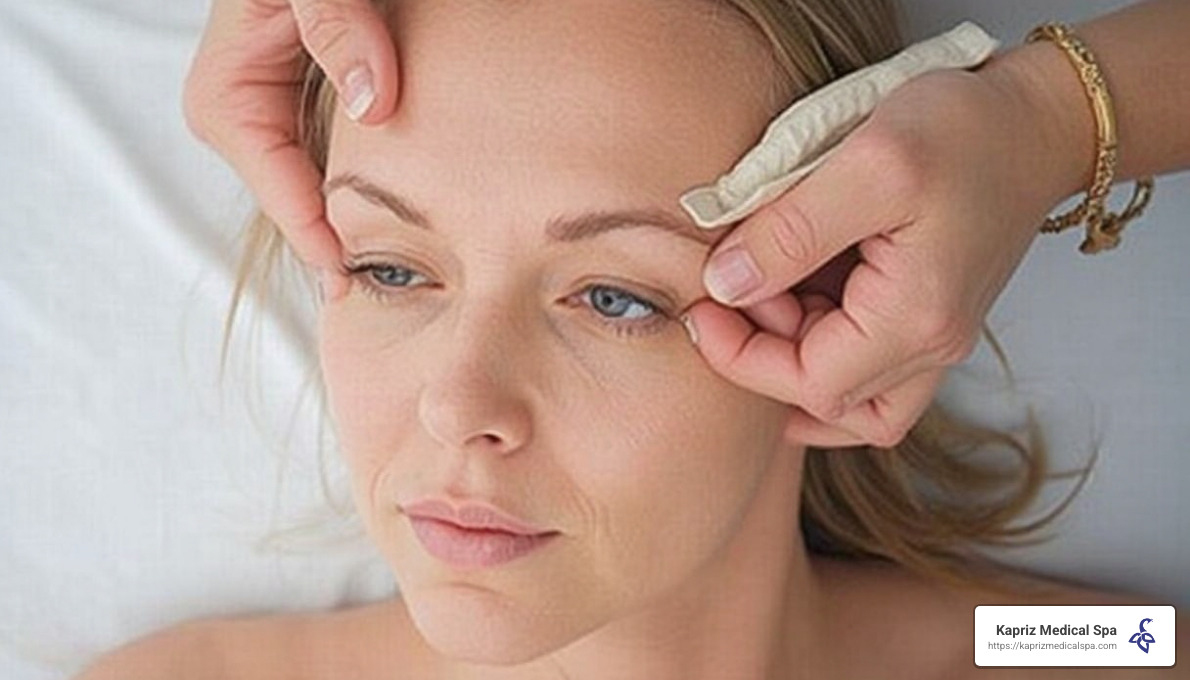
Have you ever wondered why your male partner might need more Botox than you do? It comes down to biology. Men typically have facial muscles that are about 50% larger and stronger than women’s, which means they need more Botox to achieve similar results.
The research backs this up. According to scientific research on male dosing, men generally require 2-3 additional units per injection site. So while a woman might need 15-20 units for moderate forehead lines, her male counterpart might need 20-25 units for the same level of wrinkle reduction.
Hormones also play a fascinating role in this equation. Testosterone contributes to thicker skin and more developed muscles in men, which affects how Botox works. At Kapriz Medical Spa, we take these differences into account, but we always look at the individual sitting in our chair rather than making assumptions based solely on gender.
Age brings its own considerations too. Interestingly, as we get older, our muscles can actually become more resistant to Botox, sometimes requiring slightly higher doses. On the flip side, if you’ve been getting Botox regularly for years, your muscles might have become somewhat atrophied, potentially needing fewer units over time.
Your metabolism matters as well. Those with faster metabolisms may process Botox more quickly, meaning their results might not last as long. If you’re the type who burns through coffee in no time, you might find yourself needing touch-ups a bit sooner than your friends.
Preventing the “Frozen” Look
“I don’t want to look frozen or expressionless” – this is probably the most common concern we hear from clients considering Botox at Kapriz Medical Spa. Rest assured, that overly stiff appearance comes from overtreatment, not from Botox itself.
For those worried about looking unnatural, “Baby Botox” might be your new best friend. This technique uses smaller doses – typically just 5-10 units across the forehead – to soften lines while preserving natural movement. It’s particularly popular with first-timers and younger clients looking for subtle prevention rather than dramatic correction.
The secret to natural-looking results often lies in balanced treatment. Your forehead muscle (frontalis) works in opposition to the muscles between your brows (glabellar complex). Treating only the forehead without addressing the “11 lines” between your brows can sometimes create an imbalance where your eyebrows might actually droop. That’s why experienced injectors often recommend treating both areas together for the most harmonious outcome.
“I tell my clients to think of Botox as a way to look like themselves, just more refreshed – like they’ve been on a great vacation,” says one of our practitioners. “The goal isn’t to eliminate all movement, but to soften the lines that bother you while maintaining your expressiveness.”
Your aesthetic goals matter tremendously in determining your unit count. Some clients prefer to maintain some movement and expression, while others want maximum wrinkle reduction. Neither approach is wrong – it’s all about what makes you feel confident.
For more detailed guidance on finding your personal Botox sweet spot, check out our helpful guide on how to know how many units of Botox you need.
From Consultation to Aftercare: The Treatment Journey
Thinking about getting Botox for your forehead wrinkles? Let’s walk through what your experience will actually be like, from the moment you book your appointment to the weeks following your treatment.
Before Your Appointment
The path to smoother skin starts before you even arrive at the spa. To prepare for the best possible experience, we recommend taking a few simple steps.
About a week before your appointment, it’s best to avoid blood-thinning medications and supplements. This includes common items like aspirin, ibuprofen (Advil), fish oil, and vitamin E. These can increase your chance of bruising, so taking a little break from them can make a big difference in your post-treatment appearance.
On the day of your appointment, arrive with a clean face free of makeup if possible. This saves time and ensures the treatment area is properly prepared. Don’t worry if you’re coming from work though – we can always cleanse your skin at the spa!
“I always tell my patients to come as they are, but with their questions ready,” says one of our Kapriz injectors. “The consultation is your time to address any concerns, and we want you to feel completely comfortable before proceeding.”
During Your Treatment
Many first-timers are surprised by how quick and straightforward Botox injections actually are. The entire process typically takes just 5-10 minutes – about the same time as a coffee break!
When you arrive, we’ll begin by cleansing your skin and discussing your goals one more time. Some clients prefer a light numbing cream or a quick ice application to minimize discomfort, though many find they don’t need it at all since the needle used for how many botox units for forehead wrinkles is extremely fine.
Your provider will then inject the predetermined number of Botox units into strategic points across your forehead. Most clients describe the sensation as a tiny pinch that lasts just a second. Some don’t even realize the needle has been inserted!
As Dr. Simon Ourian notes, “Many people don’t even realize that the needle has been inserted since it is such a smooth process.”
You’ll be in and out quickly, with minimal disruption to your day – no wonder Botox is often called a “lunchtime procedure”!
After Your Treatment
The beauty of Botox is that there’s virtually no downtime, but a few simple aftercare steps will help you get the best results:
For the first 4 hours after treatment, try to remain upright and avoid lying down. This helps prevent the Botox from migrating to unintended areas. You’ll also want to avoid touching or massaging the treated area for a full 24 hours – this includes facial massages, aggressive cleansing, or even resting your hand on your forehead while working.
It’s also wise to postpone strenuous exercise, facials, saunas, and hot tubs for 24 hours after your treatment. If you notice any small bruising (which happens occasionally), a gentle cold compress can help.
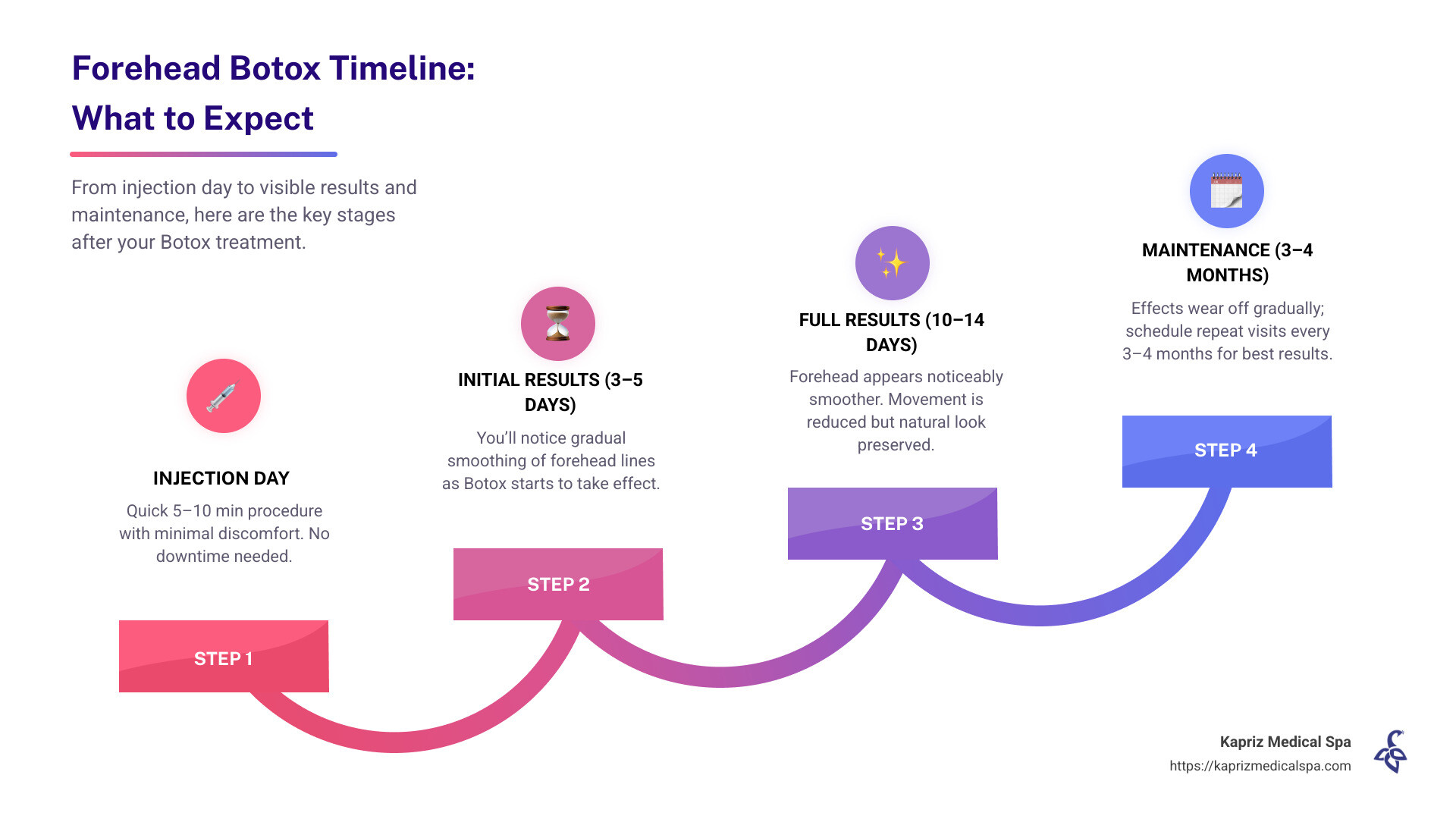
The magic of Botox doesn’t happen instantly. You’ll begin noticing changes within 3-5 days, but the full effect takes 10-14 days to develop. This gradual change is actually a benefit – no one will suddenly notice you’ve “had work done.” Instead, friends might comment that you look well-rested or refreshed without knowing exactly why.
Your results will typically last 3-4 months before gradually wearing off. Many of our clients at Kapriz Medical Spa schedule their maintenance appointments in advance to maintain their refreshed appearance without interruption.
Safety & Side Effects
Botox has an exceptional safety record when administered by qualified professionals, but it’s important to be informed about potential side effects.
The most common side effects are very mild and temporary: slight bruising at injection sites (which can be covered with makeup the next day), a mild headache for a few hours, or minor redness that typically resolves within an hour.
More significant side effects are rare but can include ptosis (drooping eyelid) in less than 1% of cases, asymmetry in results, or flu-like symptoms. The risk of these effects drops dramatically when you choose an experienced, board-certified injector who understands facial anatomy and proper technique.
“A good doctor starts low and fine-tunes at day 10,” is a principle we live by at Kapriz Medical Spa. This approach minimizes risk while ensuring beautiful results.
Not everyone is a candidate for Botox. If you’re pregnant, breastfeeding, have certain neuromuscular disorders, or take specific medications, Botox may not be right for you. That’s why we always conduct a thorough medical history during your consultation.
Longevity Tips
While Botox typically lasts 3-4 months, there are ways to help your treatment go the distance. Think of these as supporting actors that help your Botox (the star) shine even brighter.
Sun protection is absolutely crucial. Daily application of SPF 30+ sunscreen helps prevent the collagen breakdown that contributes to wrinkles. Your Botox results will look better and potentially last longer when you shield your skin from UV damage.
Quality skincare with ingredients like retinol, peptides, and antioxidants complements your Botox results by improving skin texture and elasticity. The combination of Botox for dynamic wrinkles and good skincare for skin quality creates a more comprehensive rejuvenation.
Regular maintenance treatments before your previous treatment fully wears off can help train your muscles to stay relaxed. Many clients find that with consistent treatments, their results may last longer over time.
Your lifestyle choices matter too. Staying hydrated, avoiding smoking, and minimizing alcohol consumption all support skin health and may extend your Botox results.
Some studies even suggest that zinc supplementation might prolong Botox effects, though you should always consult with your healthcare provider before starting any supplement regimen.
“The most beautiful results come from a combination of good treatments and good habits,” explains Dr. Thomas Jeneby. “Regular follow-up treatments are essential to maintain the smooth, youthful appearance Botox provides.”
An interesting pattern we’ve noticed at Kapriz Medical Spa: first-time treatments often wear off slightly faster, with subsequent treatments potentially lasting longer as muscles become conditioned to their more relaxed state. So if you’re new to Botox, don’t be surprised if your second treatment lasts a bit longer than your first!
Cost & Options: Budgeting and Alternatives
Let’s talk money—because understanding the cost of Botox helps you plan your beauty budget without any surprises down the road.
When I chat with clients at Kapriz Medical Spa about how many botox units for forehead wrinkles they’ll need, the conversation inevitably turns to cost. And I completely understand why! These treatments are an investment in your confidence and appearance.
Botox is typically priced per unit, and those units can vary quite a bit depending on where you live. Here in Jacksonville, Florida, you can expect to pay between $10-15 per unit. Since most forehead treatments require between 10-30 units, your total investment will likely fall somewhere between $100-450 for forehead treatment alone.
Geography plays a huge role in pricing—Botox in Manhattan will generally cost more than in smaller cities. Provider expertise also affects cost; a board-certified plastic surgeon might charge more than a nurse injector at a medical spa, though both can provide excellent results with proper training.
I always tell my clients that while it’s tempting to hunt for the lowest price, expertise should be your priority. After all, your face deserves the best care possible! That said, at Kapriz Medical Spa, we offer membership programs and package deals that make regular treatments more affordable without compromising quality.
For our local clients interested in detailed pricing information, our Botox cost Jacksonville FL guide breaks everything down.
Is Another Neurotoxin Better for You?
Botox might be the celebrity of the neurotoxin world (it even gets invited to Oscar parties—okay, I made that up), but it’s not the only star on the red carpet. Several FDA-approved alternatives might actually work better for your specific needs:
Dysport tends to diffuse more widely than Botox, which can be perfect if you’re treating larger areas like the forehead. Some clients notice results faster with Dysport—sometimes within 1-3 days compared to Botox’s 3-5 days. The catch? The units aren’t equivalent—you’ll need about 2.5-3 units of Dysport to achieve the same effect as 1 unit of Botox.
Xeomin calls itself the “naked” neurotoxin because it doesn’t contain the added proteins found in Botox. For some people who’ve developed resistance to Botox over time, Xeomin might provide better results. Its units are roughly equivalent to Botox (1:1).
Jeuveau, affectionately nicknamed “Newtox,” is the newest kid on the block. It works very similarly to Botox but sometimes comes with promotional pricing since the manufacturer is working to gain market share.
| Neurotoxin | Units Compared to Botox | Onset of Action | Duration | Diffusion |
|---|---|---|---|---|
| Botox | Standard (1:1) | 3-5 days | 3-4 months | Standard |
| Dysport | 2.5-3:1 | 1-3 days | 3-4 months | Wider |
| Xeomin | 1:1 | 3-5 days | 3-4 months | Similar |
| Jeuveau | 1:1 | 2-4 days | 3-4 months | Similar |
I’ve seen clients who swear by one product over another, even though they all contain forms of botulinum toxin. Your body might simply respond better to one formulation—it’s like how some people prefer Advil while others reach for Tylenol.
At Kapriz Medical Spa, we offer all four options because we believe in personalized treatment plans. During your consultation, we can discuss which might work best for your specific facial anatomy, budget, and goals.
If you’re particularly interested in comparing Botox to Dysport, our guide on how many units of Dysport equal Botox dives deeper into the differences.
How many botox units for forehead wrinkles you’ll need remains similar regardless of which neurotoxin you choose—the main difference is in how those units are counted and how the product behaves in your tissue. The right choice is the one that gives you the results you love at a price point that makes you smile (without creating more forehead lines!).
Frequently Asked Questions about Forehead Botox
If you’re considering Botox for your forehead wrinkles, you probably have some questions. I’ve gathered the most common ones I hear from clients at Kapriz Medical Spa, along with straightforward answers to help you feel confident about your treatment.
How soon will I see results?
The magic of Botox doesn’t happen overnight, but you won’t be waiting long! Most people notice the first subtle changes within 3-5 days after their treatment. Your forehead will gradually relax more over the following week, with the full, beautiful effect typically visible by day 10-14.
If you’re planning Botox for a special event like a wedding or reunion, I always recommend scheduling your appointment at least two weeks beforehand. This gives your results plenty of time to develop and allows for any touch-ups if needed.
One of our regular clients puts it perfectly: “I love watching my forehead transform over that first week—it’s like watching years melt away day by day!”
Can Botox treat both forehead and “11s” together?
Absolutely! In fact, treating both areas together often creates more harmonious, balanced results. Here’s why: your forehead (frontalis) muscle works to lift your eyebrows upward, while the glabellar muscles (which create those “11 lines” between your brows) pull downward.
Think of these muscles as opposing forces. If we only treat your forehead without addressing the glabellar area, those downward-pulling muscles remain at full strength with no opposition. This can sometimes create a heavy or lowered brow appearance.
A typical combined treatment at Kapriz Medical Spa might use 10-20 units for the forehead horizontal lines and another 15-25 units for the glabellar “11s,” totaling 25-45 units for complete upper face rejuvenation. The beauty of this approach is that it creates a refreshed, relaxed look while maintaining natural expressiveness.
How often will I need repeat treatments?
Botox isn’t permanent—which many clients actually appreciate! The effects typically last 3-4 months before gradually wearing off. This gives you flexibility to adjust your treatment over time if desired.
For consistent results, most of our clients at Kapriz Medical Spa schedule maintenance treatments every 3-4 months. Many people find that with regular treatments, the results may actually last slightly longer over time as the muscles become “trained” to be in a more relaxed state.
I’ve noticed that first-time Botox users sometimes metabolize the product a bit faster, with results lasting closer to 3 months. Meanwhile, long-term clients might stretch to 4 months or occasionally even longer between treatments.
We can help you establish a personalized treatment schedule that maintains your results year-round while fitting your lifestyle and budget.
Is Botox painful?
Good news—most clients describe Botox injections as causing minimal discomfort. The sensation is often compared to a small pinch or bug bite that lasts just a second. The needles we use at Kapriz Medical Spa are extremely fine (much smaller than those used for blood draws or vaccinations), and the procedure is very quick.
For clients who are more sensitive or nervous, we offer topical numbing cream or ice before treatment to further minimize any discomfort. Many first-timers are pleasantly surprised by how comfortable the experience is.
As one of our clients recently told me, “I was bracing myself for pain, but with the numbing cream and ice, I barely felt anything. I actually found my dental cleaning last week much more uncomfortable!”
Can I exercise after Botox?
While Botox requires almost no downtime, we do recommend avoiding strenuous exercise for 24 hours after your treatment. Here’s why: physical activity increases blood flow throughout your body, which could potentially cause the Botox to diffuse away from the intended treatment area before it has fully bound to the muscle receptors.
After that initial 24-hour period, you’re free to resume your normal exercise routine! Your Botox will be securely “locked in” to the targeted muscles, and your workout won’t affect your results.
Some clients schedule their treatments for Friday afternoons, giving them the perfect excuse for a relaxing weekend before returning to their high-intensity workouts on Monday.
What age should I start Botox?
There’s no single “right” age to start Botox—it truly depends on your individual anatomy, genetics, skin condition, and personal goals. Some people begin preventative treatments in their mid-to-late 20s, while others wait until lines are more visible in their 30s or 40s.
At Kapriz Medical Spa, we take a personalized approach, evaluating each client individually to determine if and when Botox might be beneficial. For some, starting earlier with small amounts of “preventative Botox” helps train facial muscles to create fewer dynamic wrinkles over time. For others, waiting until lines are more established makes more sense.
I often tell clients that the best time to start is when you begin noticing lines that bother you while your face is at rest—not just when you’re making expressions.
Will my forehead look unnatural after Botox?
When administered properly by an experienced injector, Botox should not make your forehead look “frozen” or unnatural. At Kapriz Medical Spa, we focus on creating natural-looking results that soften wrinkles while preserving appropriate facial expressions.
The “frozen look” typically results from over-treatment or improper technique. Our approach is to use precisely the right number of units for your unique facial anatomy—enough to smooth the wrinkles you’re concerned about, but not so much that you lose the ability to express yourself naturally.
Many clients tell us their friends and family notice they look more refreshed and well-rested, but can’t quite put their finger on what’s different. That subtle, natural improvement is exactly what we aim for with every treatment.
How many botox units for forehead wrinkles you’ll need is highly individual, and your perfect amount might be different from someone else’s. That’s why consultation with an experienced provider is so important for achieving those natural, beautiful results you’re looking for.
Conclusion
Finding the perfect number of Botox units for forehead wrinkles feels a bit like finding the right recipe for your favorite dish—it needs to be custom specifically to you. While that 10-30 unit range gives us a helpful starting point, your ideal treatment depends on so many personal factors: the strength of your muscles, how deep your wrinkles are, what kind of results you’re hoping for, and even your gender and age.
Here at Kapriz Medical Spa in Jacksonville, we take pride in creating completely personalized treatment experiences. When you visit us, you’re not just another forehead walking through the door—you’re a unique individual with specific concerns and hopes for your appearance. Our experienced injectors take the time to really see you, understanding what bothers you and what you want to achieve.
I remember one client who came in absolutely terrified of looking “frozen.” She’d seen too many celebrities with that deer-in-headlights look and wanted nothing to do with it. We started her with just 12 units across her forehead—on the conservative side—and she was thrilled with how natural her results looked. Just enough smoothing to make her feel confident, but still plenty of expression to look like herself.
What I always tell my clients is this: good Botox shouldn’t look like you’ve had Botox at all. People should just notice that you look refreshed, well-rested, maybe even a bit happier—but they shouldn’t be able to pinpoint exactly why.
If you’re considering Botox for your forehead wrinkles, keep these important points in mind:
Your treatment should always begin with a thorough, face-to-face assessment. No reputable provider should give you an exact unit count over the phone without seeing your facial movements in person.
For first-timers especially, starting conservatively makes sense. We can always add more at your follow-up if needed, but we can’t take it away once it’s injected. As one of our favorite sayings goes, “You can always add, but you can’t subtract.”
Consider treating complementary areas together. Your forehead works in tandem with those “11 lines” between your brows, and treating both often creates more balanced, natural-looking results.
Think of Botox as ongoing maintenance rather than a one-time fix. Most clients visit us every 3-4 months to keep their refreshed appearance consistent.
Perhaps most importantly, choose your injector wisely. The difference between natural-looking results and an obvious “done” appearance often comes down to the skill and aesthetic sensibility of the person holding the needle.
As one of our most experienced injectors often says, “In Botox, the magic isn’t in the bottle—it’s in the hands that administer it.”
We’d love to welcome you to the Kapriz family and help you find your perfect Botox units for forehead wrinkles. Our approach combines medical expertise with an artistic eye and a genuine desire to help you look and feel your best. Whether you’re bothered by deep horizontal lines or just noticing the first hints of wrinkles when you raise your eyebrows, we’ll create a treatment plan that’s as unique as you are.
To learn more about our approach to Botox or to schedule your personal consultation, visit our Botox services page or reach out to our Jacksonville office. We’re here to answer all your questions and help you decide if Botox is right for you.