
Advanced dermal filler techniques: 7 Powerful Proven Tips 2025
Mastering the Art of Advanced Facial Rejuvenation
Advanced dermal filler techniques go beyond basic injections to provide more natural-looking, longer-lasting results that address complex facial anatomy. If you’re looking to lift your aesthetic practice or understand what advanced techniques can do for you, here’s what you need to know:
Quick Answer: What Are Advanced Dermal Filler Techniques?
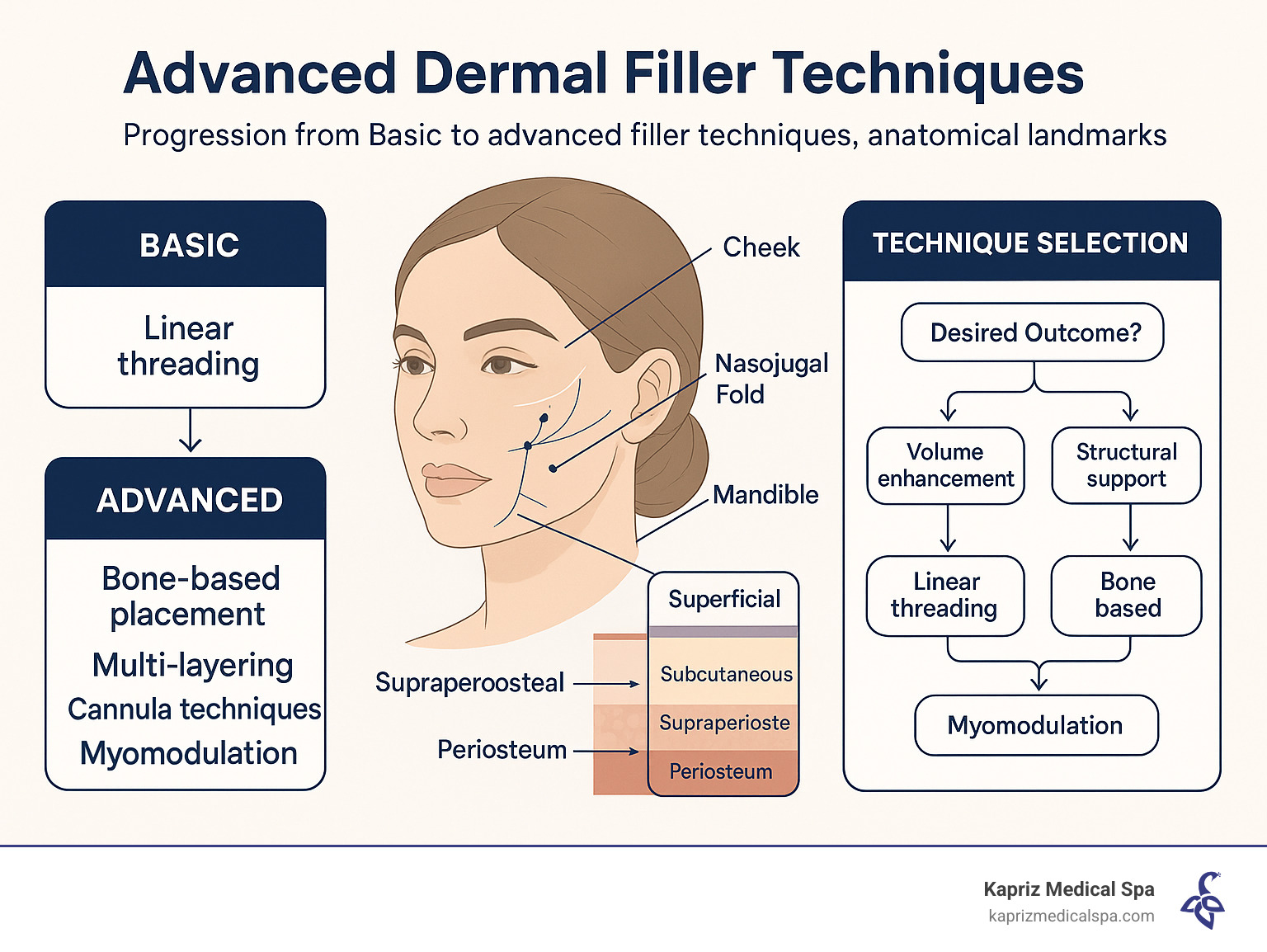
* Bone-based placement: Injecting directly on periosteum for structural support
* Multi-layering: Placing fillers at various tissue depths for 3D results
* Cannula techniques: Using blunt-tip instruments for safer vascular navigation
* Myomodulation: Strategic placement to improve or inhibit muscle function
* Combination approaches: Integrating fillers with other treatments for comprehensive results
Facial filler injection is the second most common nonsurgical cosmetic procedure in the United States, with approximately 3.4 million procedures performed annually. This popularity has driven innovation in both products and techniques.
What separates basic from advanced techniques isn’t just the tools or products used – it’s the sophisticated understanding of facial anatomy and aging processes. The most effective advanced techniques respect facial dynamics while addressing both volume loss and structural changes.
“The aesthetic benefit for the patient with temporary fillers can be attributed to 90% technique and 10% substance,” notes a comprehensive review in the dermatology literature. This highlights why mastering advanced techniques matters so much for achieving superior outcomes.
Safety remains paramount as we push boundaries in facial aesthetics. Research shows that practitioners with more than 5 years of experience have 70.7% lower odds of vascular occlusion than those with less experience. Similarly, using cannulas rather than needles reduces vascular occlusion risk by 77.1%.
At Kapriz Medical Spa, we believe that advanced techniques should be accessible but approached with proper training and understanding. Whether you’re looking to improve your skills as a practitioner or seeking treatment as a patient, knowing these sophisticated approaches can help you make informed decisions.
Advanced Dermal Filler Techniques: What Sets Them Apart
When it comes to facial rejuvenation, not all filler treatments are created equal. Advanced dermal filler techniques represent a beautiful evolution in aesthetic medicine—moving far beyond the simple “fill and plump” approach of yesteryear.
Think of basic filler techniques as painting in two dimensions, while advanced approaches create a three-dimensional masterpiece. The difference lies in understanding the face as a complex, dynamic structure rather than just a canvas for wrinkle-filling.
What makes these techniques truly special? At Kapriz Medical Spa, we focus on several sophisticated approaches that deliver naturally beautiful results:
Bone-based placement creates a foundation from the deepest layers up. By placing filler directly on the periosteum (the membrane covering your facial bones), we rebuild the structural framework that gives your face its youthful shape. This is like restoring the architecture before decorating the rooms!
Multilayering is our artist’s secret. We strategically place different types of fillers at various tissue depths, creating that natural, three-dimensional rejuvenation that never looks “done.” Each layer serves a specific purpose in recreating youthful contours.
Myomodulation might sound technical, but it’s actually quite fascinating. As Dr. Patrick Trévidic eloquently explains: “Placement of fillers in close proximity to the mimetic or sphincter muscles of the face appears to improve or suppress muscle function in a relatively predictable way.” In simpler terms, we can actually influence how your facial muscles work—enhancing some movements while softening others for more natural expressions.
Cannula techniques allow us to steer facial planes with remarkable precision while significantly reducing risks. These blunt-tip instruments glide through tissue planes rather than cutting through them, making the experience more comfortable with less bruising.
Combination treatments bring everything together. Just as a chef combines ingredients to create something greater than the sum of its parts, we integrate fillers with complementary treatments like neurotoxins or energy devices for truly comprehensive rejuvenation.
Key Differences From Foundational Methods
What truly separates basic from advanced techniques comes down to four essential elements:
First is depth precision. Advanced techniques require exact placement at specific tissue planes—from the superficial dermis to deep supraperiosteal levels. Each depth serves a distinct purpose in creating natural-looking results. It’s like knowing exactly where to plant different flowers in a garden for the most beautiful overall effect.
Second is understanding product rheology—the physical properties that determine how fillers behave in your tissues. The elasticity, cohesivity, and viscosity of different products matter tremendously. We carefully match these properties to specific facial regions and desired outcomes, much like a chef selecting the right ingredients for each dish.
Third is our unwavering safety focus. Advanced techniques incorporate detailed knowledge of facial vascular anatomy and danger zones. We’ve developed specific protocols designed to minimize risks while maximizing results. Your safety is always our priority at Kapriz.
Finally, we’re committed to creating natural outcomes. Rather than simply filling lines and wrinkles, we aim to restore youthful facial dynamics and proportions while maintaining your natural expressions. The goal isn’t to look different—it’s to look like yourself, just refreshed and refreshd.
At Kapriz Medical Spa in Jacksonville, our clients increasingly seek what we call the “untreated look”—where friends notice they look refreshed but can’t quite put their finger on what’s changed. This subtle improvement is the true hallmark of advanced techniques properly applied. It’s not about looking different; it’s about looking like your best self.
Anatomy Mastery: The Non-Negotiable First Step
Before diving into advanced filler techniques, practitioners must develop a deep, intimate understanding of facial anatomy that goes well beyond basic training. As Dr. Surek beautifully put it in a 2019 publication, we should “think of facial anatomy as a 2-tiered cake sitting on a platter (the facial skeleton).”
This cake analogy helps us visualize the complex landscape that skilled injectors must steer with confidence and precision. When we work with clients at Kapriz, we always explain that our advanced techniques are built on this foundation of anatomical respect.
Facial fat compartments change uniquely with age, deflating in some areas while descending in others. Understanding these patterns helps us restore volume precisely where it’s needed, rather than overfilling areas that don’t require intervention.
The face’s retaining ligaments act like nature’s scaffolding, anchoring skin to deeper tissues. These create transition zones that, when respected, lead to natural-looking results. Ignore them, and you might create that dreaded “worked on” appearance that nobody wants!
Perhaps most critically, vascular danger zones require our utmost attention. The nose and nasolabial fold areas have the highest complication rates for facial fillers, primarily due to their intricate vascular networks. This explains why we’re extra cautious when treating these regions.
The periorbital anatomy around your eyes is particularly complex – like delicate origami that must be preserved while we address hollowing. And the deepest supra-periosteal plane offers structural support that can transform results when accessed correctly.
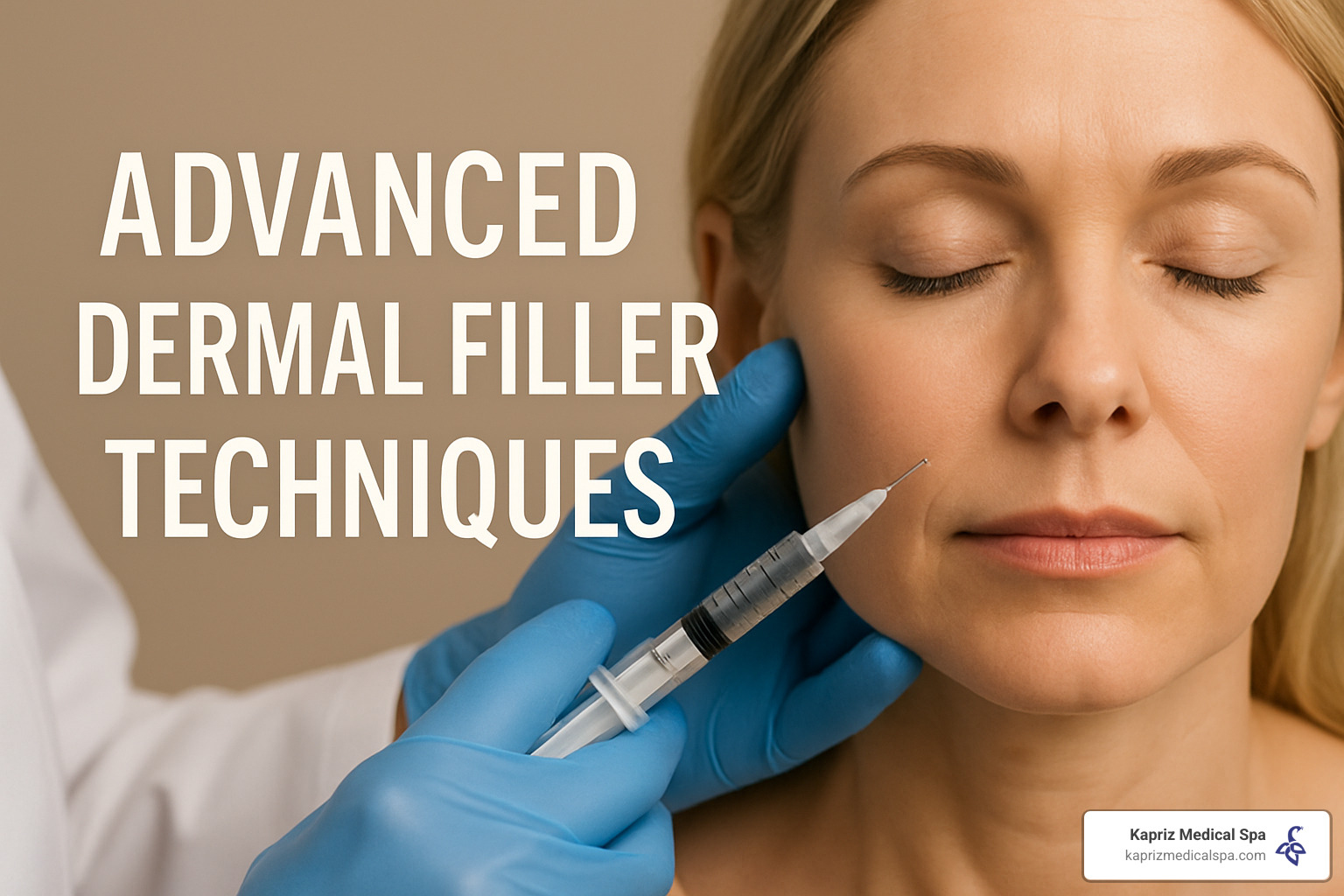
Research in the Clinical Plastic Surgery journal confirms what we see daily in our practice: aging faces show predictable patterns of volume loss and structural changes. This knowledge allows us to address specific anatomical deficits rather than simply adding volume everywhere – the difference between looking “refreshed” versus “filled.”
Tools to Improve Anatomical Accuracy
Modern aesthetic medicine has given us remarkable tools to improve our anatomical precision, and at Kapriz Medical Spa, we accept these advances wholeheartedly.
Ultrasound guidance allows us to see beneath the skin in real-time while injecting. A fascinating 2022 study showed that ultrasound-guided interfascial filler injection in the temple region significantly reduced complication risks by ensuring precise placement and avoiding blood vessels. Think of it as GPS for your face – why steer blindly when you can see exactly where you’re going?
3-D facial mapping has revolutionized our treatment planning. This digital imaging helps us document your unique facial proportions and plan treatments with mathematical precision, ensuring balanced, harmonious results.
For our team’s ongoing education, nothing beats cadaver labs for hands-on experience. These sessions provide our practitioners with unparalleled understanding of facial layers and structures that simply can’t be learned from textbooks alone.
At Kapriz Medical Spa, we’re committed to continuous learning about facial anatomy because we believe it’s the foundation of everything we do. This dedication translates directly to safer procedures and more natural-looking results for you – because beautiful outcomes begin with respecting what makes your face uniquely yours.
Product Selection & Rheology: Matching Filler to Technique
Have you ever wondered why some fillers create a soft, pillowy effect while others provide firm structural support? It all comes down to rheology—the science of how materials flow and deform. This fascinating aspect of advanced dermal filler techniques has completely transformed how we approach facial rejuvenation.
When I explain this to my clients at Kapriz Medical Spa, I often use the analogy of choosing the right tool for the job. You wouldn’t use a sledgehammer to hang a picture frame, right? Similarly, selecting the perfect filler for each facial area requires understanding both the product’s properties and your unique facial anatomy.
Let’s explore the main types of fillers we work with:
Hyaluronic Acid (HA) fillers are our most versatile option. Your body naturally produces HA, which makes these fillers incredibly biocompatible. What makes HA fillers special is how they can be manufactured with different cross-linking patterns and stiffness values (called G’) to target specific concerns and areas.
Calcium Hydroxylapatite (CaHA) does double-duty by providing immediate volume while stimulating your own collagen production. It’s particularly effective for areas needing structural support, like the jawline or cheekbones.
Poly-L-Lactic Acid (PLLA) works differently—it’s a biostimulator that gradually improves volume by triggering your body’s collagen production. Think of it as planting seeds that grow into natural-looking volume over time.
Polymethylmethacrylate (PMMA) is our permanent option, reserved for specific situations where long-term results are desired. We approach these with extra caution due to their permanence.
The magic happens when we match these products to your unique needs based on their physical properties:
The G’ value (elasticity) tells us how much the filler resists deformation. Higher G’ fillers provide more lift and structure—perfect for cheekbones or jawlines. Lower G’ fillers feel softer and are ideal for delicate areas like lips or under-eyes.
Cohesivity determines how well a filler maintains its shape and resists migration. Highly cohesive fillers stay exactly where we place them, while less cohesive ones integrate more naturally with surrounding tissues.
Cross-linking affects how long your results will last and how the filler behaves in your tissues. More cross-linking generally means longer-lasting results but potentially less natural movement.
Biphasic vs. monophasic structures refer to how HA molecules are arranged. Monophasic fillers tend to integrate more smoothly, while biphasic ones can provide more defined structure in certain applications.
A 2023 review article beautifully summarizes what we’re all looking for: “The ideal filler is biocompatible, immunologically inert, retains volume as injected, lasts many years but is easily reversible, looks and feels natural, and is economical in use as well as storage.” While no single product checks all these boxes, understanding each filler’s unique properties allows us to create custom combinations for optimal results.
Indications by Product Type
When addressing volume loss, we carefully select fillers based on the specific area:
For deep fat compartments that provide structural support, we typically choose high G’ HA fillers or CaHA. These create the foundation that supports other facial features.
For superficial fat compartments that require a more natural integration, medium G’ HA fillers work beautifully, creating soft, natural volume.
Temple hollowing requires special consideration—highly cohesive HA or diluted CaHA placed precisely in the interfascial plane can restore that youthful contour without looking overdone.
For contouring, different areas benefit from specific approaches:
Jawline definition typically calls for CaHA or high G’ HA placed directly on the bone (supraperiosteally) to create that sculpted look.
Chin projection often benefits from a layered approach—firm fillers deep for structure, with softer fillers superficially for a natural transition.
Nasal reshaping requires high G’ HA with incredibly precise placement to create structural changes without compromising blood flow in this high-risk area.
When it comes to improving skin quality, we have several options:
Fine lines respond well to low G’ HA placed very superficially, gently plumping the skin without creating unnatural fullness.
For overall skin hydration, we love using skin boosters with low-concentration, non-cross-linked HA that draws moisture to the skin.
Regenerative approaches using PLLA or diluted CaHA can stimulate your body’s natural collagen production for long-term improvement in skin quality.
At Kapriz Medical Spa, we maintain a comprehensive range of fillers because we believe in truly personalized treatment. We select not just the right product, but the right rheological properties for each specific indication and anatomical area. Your face is unique—shouldn’t your treatment be too?
Injection Method Playbook: Needle vs Cannula & Beyond
When it comes to achieving beautiful results with advanced dermal filler techniques, the tools and methods you choose matter just as much as the product itself. It’s like choosing between a paintbrush or palette knife for different effects in art – each has its perfect application.
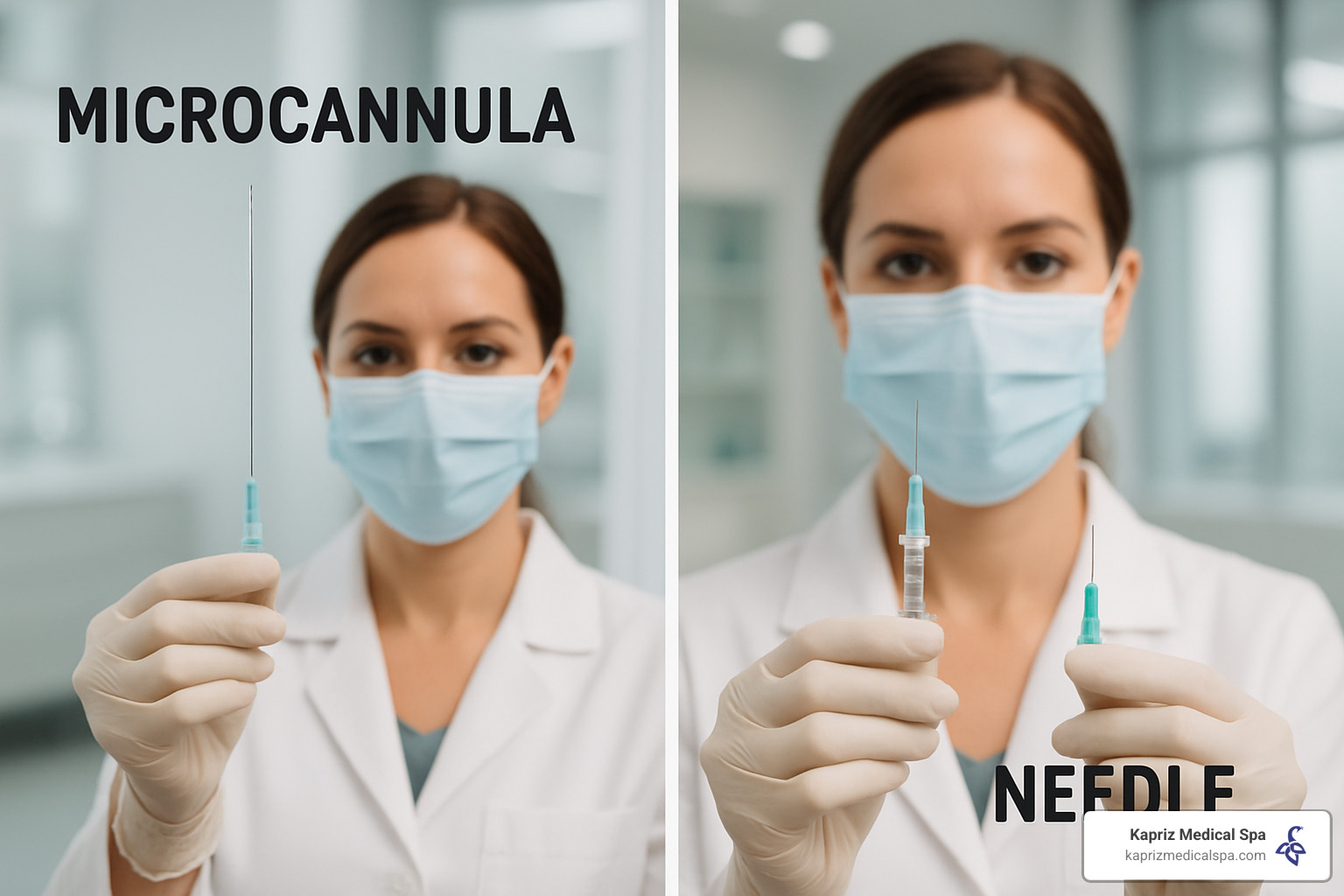
The needle versus cannula debate is one we discuss daily with our clients at Kapriz Medical Spa. Both tools have transformed how we approach facial rejuvenation, with safety being our north star in making these choices.
Needle vs. Cannula: A Safety Comparison
Let’s look at how these tools compare side by side:
| Feature | Needle | Cannula |
|---|---|---|
| Vascular Occlusion Risk | Higher | 77.1% lower odds |
| Precision for Deep Placement | Excellent | Good |
| Bruising/Swelling | More common | Less common |
| Entry Points Required | Multiple | Fewer |
| Learning Curve | Shorter | Longer |
| Best Applications | Precise bolus, supraperiosteal | Mobile areas, superficial planes |
The science backs up what we’ve seen in our practice – research published in JAMA Dermatology confirms that cannulas significantly reduce vascular complications. But this doesn’t mean we’ve tossed our needles aside! Each has its sweet spot in creating natural-looking results.
Think of it this way: a needle is like a precision scalpel, perfect for creating exact, deep support structures. A cannula is more like a gentle paintbrush, allowing us to glide through tissue planes with less trauma.
Beyond simply choosing between needle and cannula, our injection playbook includes several sophisticated techniques:
Aspiration has been the gold standard safety check for years – that little pull-back on the syringe to check for blood return before injecting. While some debate its reliability, we still include it as part of our safety protocol.
Bolus technique is like creating a foundation pillar – we place a concentrated amount of filler in one spot, typically deep on the bone, to create structural support. This works beautifully for areas like the chin or cheekbones.
When we want to create soft, natural-looking results along wrinkles, we often use linear threading, carefully placing lines of filler beneath the skin. For broader areas that need gentle volumizing, fanning allows us to treat more tissue from a single entry point – less pokes means happier clients!
For areas needing even distribution of volume, cross-hatching creates a supportive grid of filler that maintains its shape beautifully. And when treating the delicate glabella area between the brows, the three-point technique gives us predetermined safe injection points.
I’m particularly excited about some newer approaches we’ve incorporated at Kapriz. The “perpendicular strut” technique has been a game-changer for deep wrinkles. A study of 50 patients showed this method, which places vertical supports beneath wrinkles, provided significantly better correction of nasolabial folds compared to conventional approaches at the one-month mark.
Another favorite is the “arcing” method, creating continuous threads of filler at variable depths to form structural columns beneath the skin. This three-dimensional approach prevents creases from forming during facial expressions – so you can smile, laugh, and live expressively while maintaining your refreshed look.
Choosing the Right Approach
When we design your treatment plan at Kapriz Medical Spa, we consider three key factors in selecting the perfect technique:
First, we assess the vascular risk level of each area. High-risk zones like the glabella, nose, and temples require techniques that minimize any chance of intravascular injection.
Next, we consider which tissue plane needs treatment. Superficial concerns like fine lines need different approaches than deep volume loss.
Finally, we prioritize your comfort. Some techniques cause less discomfort and bruising, which means a better experience for you both during and after treatment.
As Dr. Surek beautifully puts it, “Think of facial anatomy as a 2-tiered cake sitting on a platter (the facial skeleton).” This visualization helps us select just the right injection plane and technique for natural-looking results.
At Kapriz, we rarely use just one technique during your treatment. Instead, we create a personalized injection symphony, combining different approaches to address your unique facial structure. The art of advanced dermal filler techniques is knowing not just which tool to use, but exactly how to use it for your specific needs.
Region-Specific Strategies With Advanced Dermal Filler Techniques
When it comes to facial rejuvenation, one size definitely doesn’t fit all. Each area of your face tells its own unique story through its anatomy, how it ages, and what risks are involved when treating it. Let’s take a friendly tour through some of the most challenging facial regions and how we approach them with advanced dermal filler techniques.
Tear Trough & Periorbital
Those pesky under-eye hollows can be one of the most frustrating signs of aging – and honestly, one of the trickiest areas for us to treat safely. The skin here is paper-thin, the anatomy complex, and everyone notices this area immediately.
For the tear trough region, we’ve refined several approaches that deliver beautiful results with minimal risk:
When working in this delicate area, we often place tiny amounts (just 0.1-0.2mL) of soft, low G’ hyaluronic acid filler in the deep medial fat pad. This creates a gentle support structure that lifts the entire area. For many clients, we prefer using a blunt cannula with a fanning technique – it’s gentler, causes less bruising, and helps us steer safely around the important blood vessels.
Dr. Kaufman-Janette and her research team recommend using only the softest, most malleable fillers in this region. This helps avoid that dreaded bluish tint (called the Tyndall effect) that can occur when the wrong product is placed too superficially under thin skin. Research shows this complication is rare (0.03-0.11% of cases), but we take every precaution to avoid it.
Sometimes we’ll use a multilayering approach, combining deeper structural support with more superficial refinement for a truly natural result that moves with your expressions.
Temple Volume Deficit
Have you ever noticed how hollow temples can make even a youthful face look gaunt and aged? This often-overlooked area responds beautifully to advanced dermal filler techniques.
The temple region requires a sophisticated understanding of the fascial planes – those sheet-like layers of tissue that create compartments in your face. We typically place filler between the superficial and deep temporal fascia for the most natural integration with surrounding tissues.
For clients needing more significant correction, we might use a supraperiosteal bolus technique, placing firmer fillers deep on the bone for structural support that can last 12-18 months.
Safety is paramount in this vascular region. A fascinating case study from 2022 demonstrated how ultrasound guidance can revolutionize temple treatments by allowing us to visualize and avoid the superficial temporal artery. The study showed successful temple improvement using 1mL of hyaluronic acid per side, with imaging confirming perfect placement and no vascular issues.
Jawline & Chin Definition
A defined jawline frames your entire face, creating that coveted youthful appearance. Creating this definition requires understanding both the bony foundation and how the soft tissues interact with it.
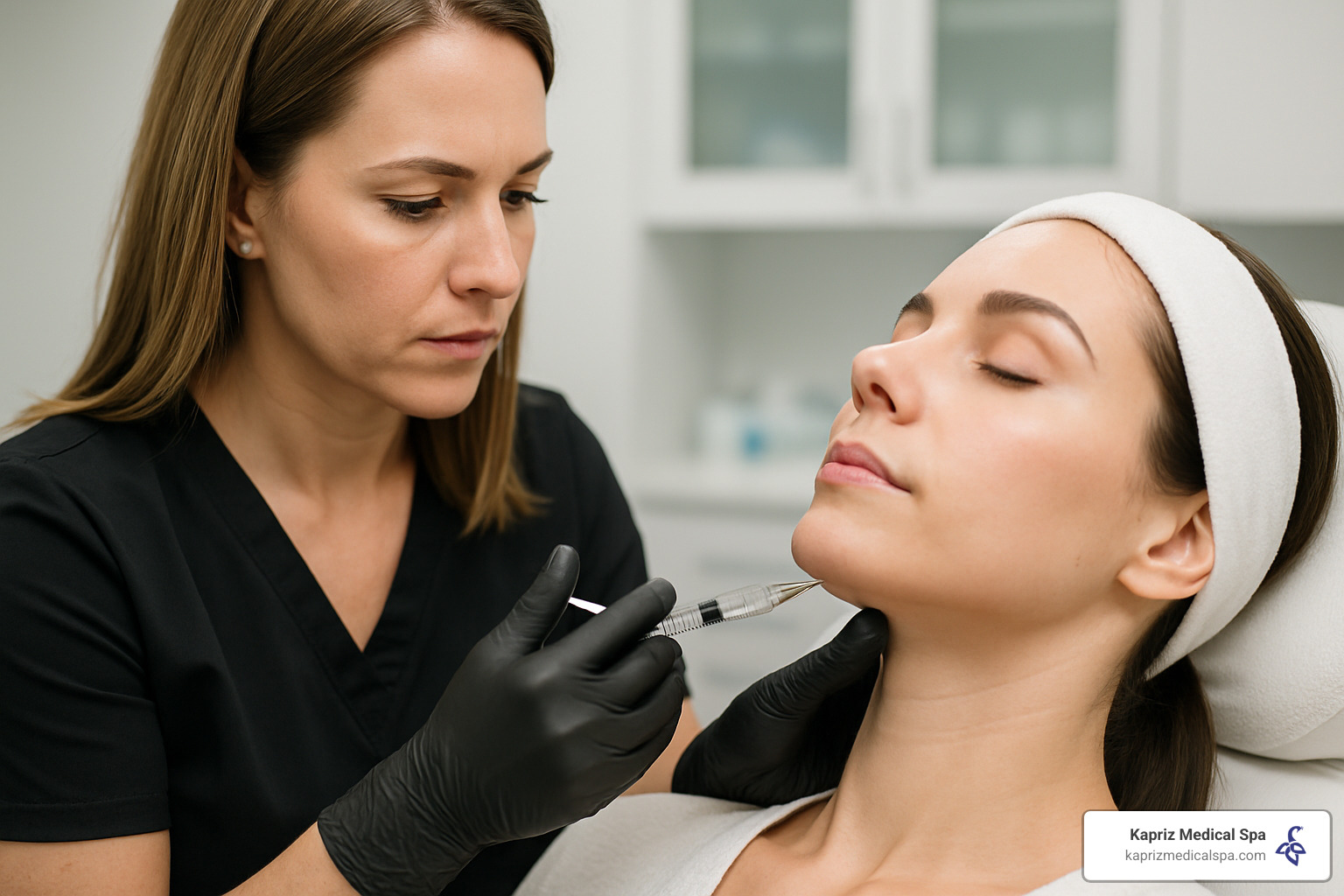
For jawline improvement, we often use calcium hydroxylapatite (CaHA) placed right on the periosteum of the mandible. This creates a beautiful, defined edge that mimics youthful bone structure. The dual-plane layering technique is another favorite – we combine deep structural support with more superficial contouring to create a natural-looking result.
One of the most exciting advances in jawline treatments involves myomodulation – strategically placing filler to influence how muscles function. As research notes, “Placement of fillers in close proximity to the mimetic muscles appears to improve or suppress muscle action in a relatively predictable way.” This is particularly valuable in the lower face, where muscle activity significantly influences aging.
For clients with early jowl formation, we pay special attention to the prejowl sulcus – that little depression that forms just ahead of a developing jowl. Filling this area creates a smooth, continuous jawline that looks naturally youthful.
At Kapriz Medical Spa in Jacksonville, we’ve finded that these region-specific techniques work best when we consider the whole face. Rather than treating isolated areas, we assess how each region interacts with others, both at rest and during animation. This comprehensive approach ensures results that look naturally beautiful from every angle – because that’s what true facial harmony is all about.
Risk Management & Complication Protocols
Let’s talk honestly about the elephant in the room – risks. While advanced dermal filler techniques can create stunning results, they also come with responsibilities. As we say at Kapriz Medical Spa, “with great injecting power comes great safety responsibility!”
The most significant complications we need to watch for include:
- Vascular occlusion: When filler blocks blood vessels, potentially leading to tissue damage
- Tyndall effect: That bluish discoloration nobody wants (especially under thin skin)
- Persistent edema: Swelling that overstays its welcome, particularly around the eyes
- Visual compromise: Rare but serious – we never want filler affecting eyesight
- Delayed inflammatory reactions: Those surprise nodules or granulomas that appear weeks later
Research shows that the nose and nasolabial folds are particularly tricky areas. It’s no coincidence they also have the highest complication rates – their complex vascular networks demand respect and precision.
Minimizing Risk
The good news? Most complications are preventable. Think of these strategies as your safety net:
Slow and steady wins the race. Rapid, high-pressure injections dramatically increase vascular risks. At Kapriz, we take our time, because your safety is worth those extra minutes.
Small amounts matter. We limit each injection point to tiny 0.1-0.2mL aliquots. This “micro-bolus” approach gives us precise control and minimizes potential damage if something goes wrong.
Keep that needle moving. A stationary needle is asking for trouble, especially in danger zones. Constant movement distributes product safely and reduces pressure at any single point.
Aspiration checks before injection may help identify if you’re in a blood vessel. While not foolproof (false negatives happen), it’s another layer of protection worth having.
Consider cannulas for safer navigation. Research confirms they reduce vascular occlusion odds by an impressive 77.1% compared to needles. That’s why we’ve acceptd cannulas for many of our advanced treatments at Kapriz.
As one safety-focused study evaluating three-point glabellar techniques noted, “Practitioners should be aware of safe injection techniques, potential complications, and management of these complications for good clinical practice.” We couldn’t agree more!
Managing Complications
Despite our best prevention efforts, complications can still occur. Having clear protocols isn’t just good practice – it’s essential:
For vascular occlusion, we immediately stop injecting, administer high-dose hyaluronidase (sometimes up to 1500 units), apply warm compresses, and may use nitroglycerin paste, aspirin, or refer for hyperbaric oxygen therapy depending on severity.
When Tyndall effect appears, we dissolve the superficial HA filler with precisely placed hyaluronidase. The blue tinge typically resolves within days.
Persistent edema responds well to lymphatic drainage, oral antihistamines, and occasionally low-dose steroids when conservative approaches aren’t enough.
Visual compromise requires emergency action – immediate ophthalmology referral, retrobulbar hyaluronidase, and ocular massage. Every minute counts in these rare but serious cases.
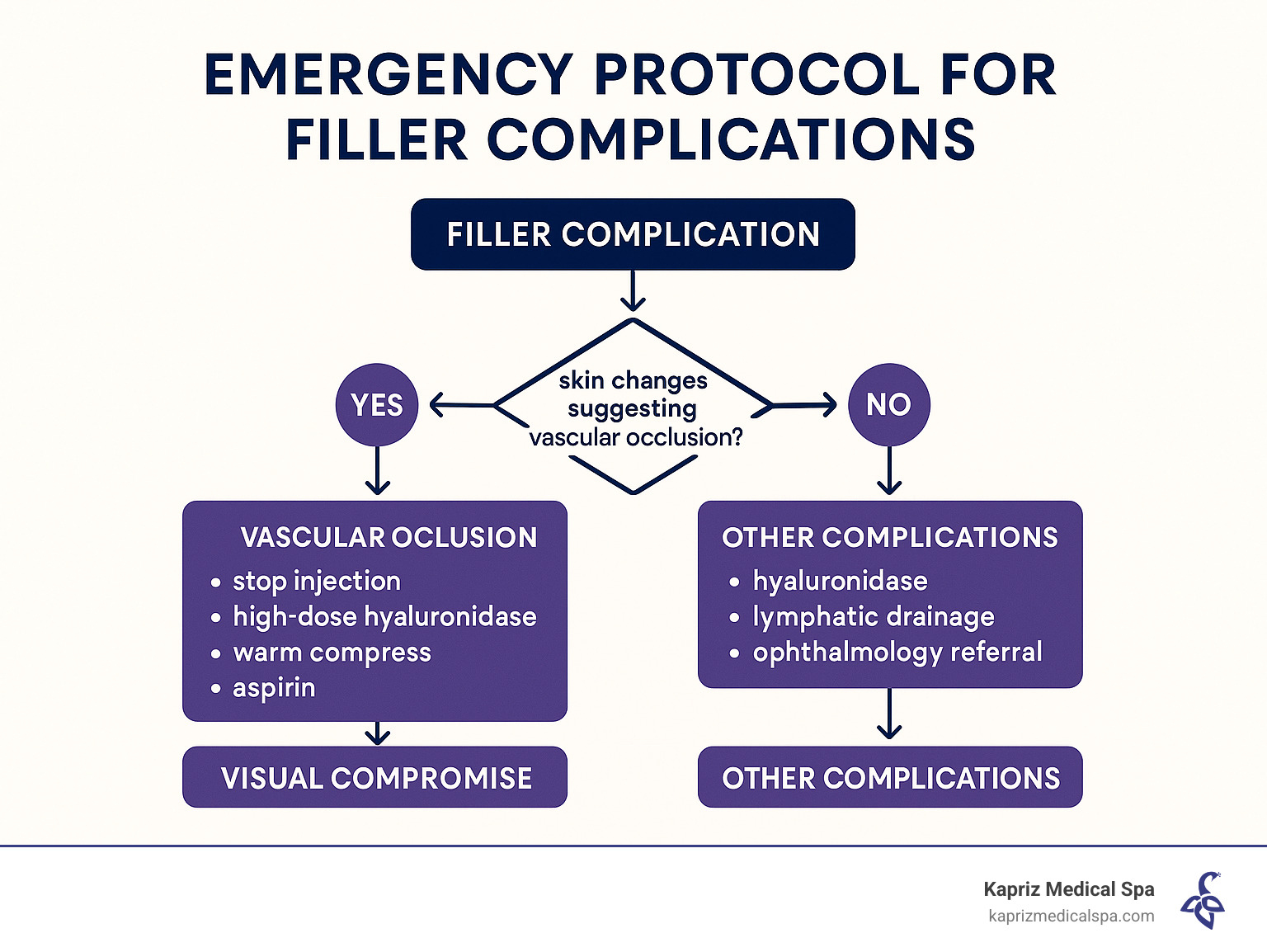
At Kapriz Medical Spa, safety isn’t just a buzzword – it’s woven into everything we do. We maintain fully-stocked emergency kits (including plenty of high-dose hyaluronidase), and our team regularly practices complication protocols. We stay current with the latest research and guidelines because your wellbeing matters more than any aesthetic outcome.
The best practitioners aren’t just skilled at creating beauty – they’re prepared for anything that might happen along the way. When you choose advanced dermal filler techniques, make sure your provider takes safety as seriously as results.
Patient Journey: Assessment to Aftercare
When it comes to advanced dermal filler techniques, the magic doesn’t just happen during the injection itself. The entire journey—from the moment you walk through our doors until weeks after your treatment—plays a crucial role in your results.
Think of your aesthetic treatment as a carefully choreographed dance between you and your provider. It starts with understanding your unique features and ends with ensuring your results look their absolute best.
At Kapriz Medical Spa, we’ve refined this journey to include several essential touchpoints:
First, we see the whole you. Our comprehensive facial analysis looks beyond just wrinkles or hollows. We assess your unique facial proportions, symmetry, and how aging has specifically affected your features. This holistic view helps us create treatments that improve your natural beauty rather than changing who you are.
We document your starting point. Those before photos might make you cringe, but they’re invaluable! Standardized photography helps us plan precisely and allows you to see genuine improvements after treatment. Many clients are amazed when comparing their before and after images, often noticing positive changes they hadn’t even realized.
“I was shocked looking at my before pictures—I didn’t realize how much my temples had hollowed until I saw them filled in again,” shares one of our regular clients.
We talk—really talk—about expectations. During your consultation, we’ll have an honest conversation about what’s realistically achievable. If you bring in a photo of a 20-year-old celebrity when you’re 45, we’ll gently guide you toward more natural-looking results that still make you look refreshed and confident.
The paperwork matters. Our informed consent process isn’t just a formality. We take time to discuss potential risks, benefits, and alternatives so you can make a truly informed decision about your treatment.
Customizing Plans for Individual Anatomy
No two faces are alike—which is why cookie-cutter approaches simply don’t work with advanced dermal filler techniques. We consider several key factors when customizing your treatment:
Gender makes a difference. Male and female faces have distinct characteristics, from forehead shape to jaw definition. What looks natural on a woman might look feminine on a man, and vice versa. Our techniques respect these differences.
Your ethnic background influences your treatment. Different ethnic groups have variations in facial structure, skin thickness, and aging patterns. For example, Asian skin typically shows less photoaging but may develop malar bags earlier, while Mediterranean skin might show more dynamic wrinkles. We adjust our approach accordingly.
Your age guides our strategy. Are we preventing early signs of aging in your 30s, or addressing established changes in your 50s? Each requires a different approach—prevention focuses on subtle improvements and skin quality, while correction might require more structural support and multi-layer techniques.
Before your treatment, we’ll discuss preparation steps like avoiding blood thinners (including certain supplements and medications) and possibly starting arnica or bromelain to minimize bruising.
After your treatment, we don’t just send you on your way. You’ll receive clear instructions on managing swelling, avoiding pressure on treated areas, and whether massage is recommended for your specific filler. And yes, we’ll schedule a follow-up to assess your results and make any necessary refinements.
“Aesthetic benefit with temporary fillers is 90% technique and 10% substance,” notes a comprehensive review in the field. This highlights why the skill of your provider—throughout the entire process—matters so much more than the brand of filler used.
At Kapriz Medical Spa, we believe that understanding your unique facial anatomy isn’t just helpful—it’s essential for creating results that look naturally beautiful. Our goal isn’t just to fill lines but to restore harmony to your features in a way that honors who you are.
Frequently Asked Questions about Advanced Dermal Filler Techniques
How much experience should a practitioner have before attempting advanced techniques?
When it comes to advanced filler techniques, experience truly matters. The numbers tell a compelling story – practitioners with over 5 years of injection experience have 70.7% lower odds of vascular occlusion compared to those still building their skills.
While there’s no magic number of months or procedures that suddenly qualifies someone as “advanced,” most experts in the field agree on a sensible progression:
Most practitioners should spend at least 1-2 years regularly performing basic injections before venturing into advanced territory. During this time, they should be completing specialized anatomy courses (cadaver dissection experience is incredibly valuable) and working closely with experienced mentors who can provide guidance.
The safest approach is always a gradual one – starting with lower-risk advanced techniques before attempting more complex procedures in high-risk areas like the glabella or nose.
At Kapriz Medical Spa, our injectors never stop learning. We believe in continuous education and skill refinement, ensuring mastery of fundamentals before progressing to advanced dermal filler techniques that require deeper anatomical understanding.
Does using a cannula always mean fewer complications?
While the research is impressive – cannulas are associated with 77.1% lower odds of vascular occlusion compared to needles – they aren’t a magic solution for every situation.
Think of cannulas and needles as different tools in your aesthetic toolkit, each with specific purposes. Cannulas excel in reducing vascular risks and creating less bruising, but they don’t eliminate complications entirely. Some precise applications, particularly supraperiosteal bolus placements where you need to contact bone, are often better accomplished with needles.
It’s also worth noting that cannula technique requires its own specific training and learning curve. The product selection matters too – not all fillers flow easily through cannulas, especially the higher G’ (stiffer) options.
In our experience at Kapriz, the best approach often combines both tools strategically – using needles where precision is paramount and cannulas in higher-risk areas or when treating larger zones. This balanced approach gives you the benefits of both while minimizing their individual limitations.
What filler lasts the longest in bone-based injections?
When it comes to longevity in bone-based (supraperiosteal) injections, not all fillers are created equal. The good news is that deep placements generally last longer than superficial ones, regardless of the product used.
Calcium hydroxylapatite (CaHA) typically delivers impressive 12-18 month results when placed on bone. Its unique composition provides excellent structural support while stimulating collagen production.
High G’ hyaluronic acid fillers with robust crosslinking can last 12-24 months in bone-based placements. Their stability and resistance to degradation make them excellent choices for structural support.
Poly-L-lactic acid, while technically a biostimulator rather than a traditional filler, can trigger collagen production that lasts 2+ years. The results develop gradually but can be remarkably long-lasting.
Permanent fillers like PMMA last indefinitely but come with a significantly higher risk profile that most practitioners avoid due to long-term complication concerns.
Individual factors always play a role in longevity – your metabolism, the specific area treated, and the injection technique all influence how long results will last. At Kapriz Medical Spa, we find that deep, bone-based placements generally offer the most durability since these areas experience less movement and have lower metabolic activity that would break down the product.
Conclusion
Advanced dermal filler techniques have transformed facial aesthetics from simple line-filling to a sophisticated art form. It’s like comparing a sketch artist to a master painter – both create beauty, but the master brings depth, dimension, and life to their work.
The journey from basic to advanced techniques isn’t just about learning new injection patterns. It’s about developing an intimate understanding of facial anatomy, mastering product selection, and cultivating the artistic vision to create natural-looking results that honor each person’s unique features.
What makes these techniques truly “advanced” is the thoughtful integration of science and artistry. When done well, the results speak for themselves – friends and family notice something different, but can’t quite put their finger on what’s changed. That subtle improvement is the hallmark of excellence in aesthetic medicine.
At Kapriz Medical Spa in Jacksonville, we believe that facial rejuvenation should improve your natural beauty without announcing itself to the world. Our team continuously studies the latest techniques and research, bringing that knowledge to every treatment we perform. We see each face as a unique canvas deserving of a customized approach.
The most beautiful results come from respecting facial dynamics and understanding how different areas of the face interact during expressions. This holistic perspective guides our hand whether we’re restoring temple volume, defining a jawline, or softening tear troughs.
Safety remains our north star throughout this process. Advanced techniques require advanced safety protocols, and we never compromise on the measures we take to ensure your wellbeing. From comprehensive anatomical assessments to emergency preparedness, we’ve built multiple layers of protection into every treatment.
If you’re considering dermal fillers, understanding the difference between basic and advanced techniques can help you make informed choices about your care. The right approach isn’t always the most complex one – it’s the one that addresses your specific concerns while respecting your facial anatomy and aesthetic goals.
We invite you to experience the difference that advanced techniques, delivered with warmth and precision, can make in your aesthetic journey. For more information about our approach to dermal fillers and the advanced techniques we offer, visit our dermal fillers page.
Your face tells your story. At Kapriz Medical Spa, we’re here to help you write its most beautiful chapters.