
How many units of botox is normal: Your #1 Smart Guide
Understanding Normal Botox Dosage for Your Treatment Goals
How many units of Botox is normal depends on the treatment area and your individual needs, but here are the typical ranges most people can expect:
Common Botox Unit Ranges:
- Forehead lines: 10-30 units
- Frown lines (between eyebrows): 10-25 units
- Crow’s feet: 5-15 units per side
- Full face treatment: 20-40 units total
- First-time users: Often start with 20-30 units
If you’re like many people considering Botox, you’re probably wondering whether the dosage you’ve heard about is actually normal. The truth is, there’s no single “normal” amount because every face is unique.
Botox works by temporarily relaxing the muscles that cause dynamic wrinkles – those lines that appear when you smile, frown, or squint. The number of units you need depends on factors like your muscle strength, the size of the treatment area, and your aesthetic goals.
What makes this even more important is that getting the right dose means the difference between natural-looking results and an overdone appearance. Too little, and you might not see the improvements you want. Too much, and you could end up with that “frozen” look nobody wants.
The key is working with an experienced practitioner who can assess your individual anatomy and create a personalized treatment plan. As one dermatologist noted in recent research: “There should be no such thing as ‘cookie-cutter Botox.’ Everyone’s anatomy is different and placement of injections will reflect that.”
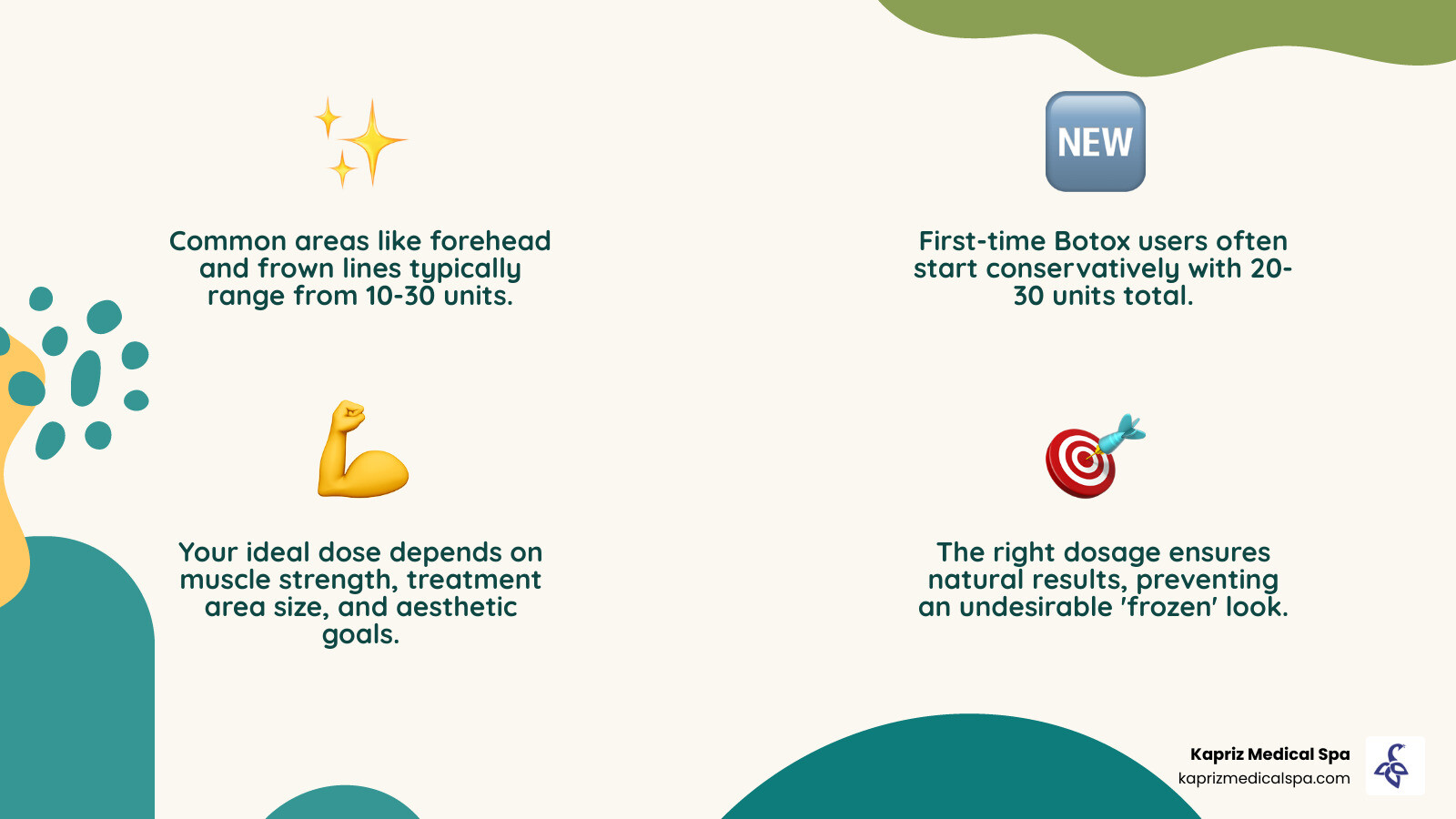
How many units of botox is normal terms at a glance:
- how many units of botox are used for forehead
- how many units of botox are used for crow’s feet
- how many units for full face botox
Understanding Botox and the “Unit” of Measurement
Let’s start with the basics – what exactly is Botox, and why do we measure it in these mysterious “units”?
Botox Cosmetic is made from Botulinum Toxin Type A, a purified protein that works as a neurotoxin. Don’t let that word scare you – it simply means it affects nerve function in a very controlled, temporary way. When your practitioner injects Botox into specific facial muscles, it blocks the nerve signals that tell those muscles to contract.
Think of your facial expressions as a daily workout for your muscles. Every time you smile, frown, or squint, you’re essentially doing reps that create creases in your skin. Botox acts like a gentle pause button, giving those hardworking muscles a break so your skin can smooth out and relax.
This muscle relaxation is what leads to wrinkle reduction. It’s not magic – it’s science working beautifully with your body’s natural processes.
Now, about those “units” everyone talks about when discussing how many units of Botox is normal. A Botox unit isn’t like measuring a cup of flour or a tablespoon of medicine. Instead, it’s a standardized measurement of the biologic strength of the product – basically, how much muscle-relaxing power is packed into each unit.
Each vial of Botox contains 100 units, which your practitioner mixes with saline to create the perfect concentration for your treatment. It’s important to know that these units are specific to Botox and aren’t the same as units from other botulinum toxin products.
Botox has impressive FDA approval for both medical and cosmetic uses. For cosmetic treatments, it’s specifically approved for horizontal forehead lines, those stubborn “11” lines between your eyebrows (called glabellar lines), and crow’s feet. Beyond beauty, it helps with medical conditions like chronic migraines and excessive sweating.
At Kapriz Medical Spa, we understand these nuances inside and out. We’re not just injecting – we’re creating personalized treatment plans that work with your unique anatomy and goals.
Want to dive deeper into the fundamentals? Check out our comprehensive guide on Botox Basics: Your Guide to Youthful Skin, or explore the broader FDA-approved uses for Botox to see just how versatile this treatment really is.
How Many Units of Botox is Normal for Common Treatment Areas?
When discussing how many units of Botox is normal, it’s important to remember these are general guidelines. The exact number you need is determined during a personalized consultation where we assess your unique facial anatomy, muscle strength, and aesthetic goals.

While the FDA provides recommendations, experienced practitioners often adjust these based on individual needs. It’s a blend of science and art to ensure your results look natural and refreshed, not “done.”
Here’s a helpful table showing the average Botox units typically used for various common treatment areas:
| Area Treated | Average Units of Botox |
|---|---|
| Forehead Lines | 10-30 units |
| Glabellar Lines (Frown Lines / “11s”) | 10-25 units |
| Crow’s Feet | 5-15 units per side |
| Bunny Lines (Nose) | 5-10 units |
| Chin (Dimpling) | 2-6 units |
| Jawline (Masseter) | 15-50 units per side |
| Neck Bands (Platysmal) | 25-50 units |
| Eyebrow Lift | 2-5 units |
| Corners of Mouth | 3-6 units |
How many units of Botox is normal for the forehead and frown lines?
The forehead and the area between the eyebrows (the glabellar complex) are among the most popular spots for Botox. The frontalis muscle controls horizontal forehead lines, while other muscles create frown lines. These muscles can be quite strong, especially if you’re very expressive.
For horizontal forehead lines, the number of Botox units typically ranges from 10 to 30 units, though some individuals with very strong muscles might require up to 50. The manufacturer of Botox Cosmetic suggests a dosage of 20 units for the forehead. Our practitioners often start conservatively, especially for first-time users, to see how your muscles respond and to smooth lines without creating a “frozen” look.
When treating the forehead, it’s often essential to also address the frown lines (“11” lines). This area generally requires 10 to 25 units, though some practitioners may use up to 40 units for more pronounced lines. Treating both areas together helps prevent an imbalance that can lead to a “heavy” or “droopy” brow. We prioritize a balanced, natural result that maintains your brow’s natural lift. For a deeper dive, check out our guide: How Many Botox Units for Forehead Wrinkles?.
What is the typical dosage for crow’s feet and other facial areas?
Crow’s feet, the lines that fan out from the corners of your eyes, are caused by the orbicularis oculi muscle. The typical Botox dosage is 5 to 15 units per side. The FDA recommends 12 units per side, but individual needs vary. We aim to soften these lines while allowing your eyes to sparkle. Find out more in our dedicated article: Botox for Crows Feet.
Beyond the most common areas, Botox can work wonders on other facial concerns:
- Bunny Lines: Lines on the sides of your nose when you scrunch it. A typical dosage is 5-10 units.
- Chin Dimpling: An “orange peel” texture on the chin can be smoothed with 2-6 units to relax the mentalis muscle.
- Jaw Slimming (Masseter Muscles): To slim a wider jawline or alleviate TMJ discomfort, injections into the masseter muscles can be transformative, often requiring 15-50 units per side.
- Eyebrow Lift: A subtle lift to the brows can open up the eyes, typically requiring 2-5 units.
- Corners of the Mouth: To lift downturned corners of the mouth, 3-6 units can be effective.
- Neck Bands (Platysmal Bands): These vertical cords in the neck can be smoothed for a more youthful profile, often requiring 25-50 units. This is sometimes called the “Nefertiti Neck Lift.”
These targeted areas require fewer units, but injection precision is paramount. Our master-certified injectors in Jacksonville, FL, are highly trained in facial anatomy, ensuring precise placement for optimal, natural-looking results.
Key Factors That Influence Your Ideal Botox Dosage
At Kapriz Medical Spa, we emphasize that how many units of Botox is normal for you is unique and can differ greatly from what works for others. There is no one-size-fits-all approach, which is why a personalized assessment is so important.
Your face has its own unique “fit” when it comes to Botox dosage, influenced by several key factors:
Muscle strength and size play the biggest role. If you’re naturally expressive, your facial muscles are likely stronger and require more Botox units for a smooth, relaxed look. During your consultation, we’ll ask you to make various expressions to assess your muscle movement and strength.
Gender makes a difference. Men typically have larger, stronger facial muscles and may need 20-30% more units than women for the same area. Research has shown that men may require higher doses for similar results.
Age and skin condition also influence dosage. Preventative Botox in your 20s or 30s for fine lines will likely require fewer units than treating deeper, established wrinkles in your 50s. Younger skin often responds to smaller amounts, while mature skin may need more.
Your body’s metabolism affects how quickly you process Botox. Some people break it down faster, meaning results may fade sooner. We can adjust your dosage based on your history.
Your aesthetic goals are key. Whether you want subtle softening with natural movement or a smoother look, your goals shape our recommendation. We aim to improve your natural beauty, not create a “frozen” appearance.
Previous treatments provide valuable information. Your response, the duration of results, and your satisfaction help us fine-tune your dosage for even better outcomes.
All these factors combine to create your personalized treatment plan. By considering your unique muscle strength, goals, and individual characteristics, we can determine the exact number of units that will give you the natural, refreshed look you’re dreaming of.
Your Botox Journey: From Consultation to Lasting Results
Starting your Botox journey can be exciting. At Kapriz Medical Spa, we guide you through every step with care and expertise. We aim to be your trusted partner in achieving your aesthetic goals, building a lasting relationship to help you look and feel your best.

Choosing the right practitioner is the most important decision you’ll make. Your results and safety depend on the skill of your injector. Our team consists of master-certified injectors with extensive training who understand facial anatomy and know how many units of Botox is normal for each unique face.
Your consultation is a thorough conversation about your goals, concerns, and medical history. We’ll have you make different facial expressions to see how your muscles move, which helps us create your personalized treatment plan.
The injection process is quick, taking only 15-30 minutes. We use incredibly fine needles, and most clients feel only a tiny pinch.
Aftercare is straightforward. We’ll give you clear instructions, but the main points are to stay upright for four hours and avoid intense workouts for 24 hours. This allows the Botox to settle properly.
Your results will gradually appear over a few days, with the full effect visible around two weeks. Most people enjoy their refreshed look for about 3-4 months.
Side effects are typically mild in experienced hands, such as slight bruising, swelling, or redness at the injection sites, which usually fades quickly. Serious side effects are rare with a proper provider. For complete details, see our Botox Safety Information page.
How many units of Botox is normal for a first-time user?
If you’re new to Botox, we always start conservatively with a lower dose to see how your muscles respond. Everyone’s anatomy is different.
For most first-timers, we recommend starting with 20-40 units total for common areas. This might mean 15-20 units for frown lines and 10-15 for crow’s feet. The goal is a noticeable improvement while keeping your expressions natural.
We schedule a follow-up appointment about two weeks after your first treatment. This allows us to check your results and add a few more units if needed to perfect your look. These small adjustments help us dial in your perfect dose for future treatments.
This careful, personalized approach ensures you won’t get an “overdone” look. We want you to look like the best version of yourself. Want to learn more? Our guide How Much Botox Do I Need for the First Time? has all the details.
Frequently Asked Questions about Botox Dosage
We often get asked similar questions about Botox dosage, cost, and how often to get treatments. Let’s address some of these common inquiries to further explain the process for you and help you feel even more comfortable.
How much does Botox cost based on units?
The cost of your Botox treatment is mainly decided by two things: how many units of Botox is normal for your specific needs, and the skill of the person giving you the injections. Where you live also plays a part. Here in Jacksonville, FL, the average cost for one unit of Botox usually falls between $10 and $20.
To figure out your total cost, you just multiply the number of units you receive by the cost per unit. For example, if you need 20 units for your forehead and each unit costs $12, your total would be $240. For a bigger treatment, perhaps covering a few areas and needing 30 units, the cost could be anywhere from $360 to $600. You’re not just paying for the product; you’re investing in the precise skill and experience of your injector. A highly trained professional will make sure your results look natural, and they’ll help avoid any unwanted side effects. For more specific pricing details in our area, please visit our Botox Cost Jacksonville, FL page.
Can you get too much Botox?
Yes, it is definitely possible to get too much Botox. This is exactly why choosing an expert injector is so incredibly important! While Botox is very safe when used correctly, putting in too many units can lead to that “frozen” or expressionless look, where your face just can’t move naturally or show emotion. Nobody wants to look “overdone,” and we certainly don’t want you to!
Beyond just looking unnatural, too much Botox can also cause temporary problems like a droopy eyelid or eyebrow, or even uneven results. This happens if the tiny amount of neurotoxin spreads to muscles it wasn’t intended for. Our philosophy at Kapriz Medical Spa is always “less is more.” We aim for a subtle, natural rejuvenation that gently softens your lines while letting your unique expressions shine through. We believe your friends should notice you look refreshed and radiant, not that you’ve had “work done.” A skilled injector truly understands this delicate balance needed to get you the best results without losing your natural beauty.
How often should I get Botox injections?
The effects of Botox are temporary, which means they don’t last forever. Typically, you can expect your smooth results to last about three to four months. How long it lasts can vary a little depending on the treated area, the number of units used, how quickly your body processes things, and how consistently you receive treatments.
When the Botox starts to wear off, you’ll notice your muscles slowly becoming active again, and your lines will gradually reappear. This is your sign that it’s time for a maintenance treatment. Most of our clients find it works best for them to schedule their appointments every 3-4 months to keep that smooth, refreshed look going strong.
It’s interesting to note that some patients who receive Botox regularly over time might find that their muscles become “trained” to be less active. This can sometimes lead to results that last a bit longer (even up to 4-6 months!) or sometimes you might even need slightly fewer units in your next treatments. It’s a bit like muscle memory, but working in reverse! Sticking to a regular schedule not only helps you maintain your beautiful results but can also help prevent those deep-set wrinkles from forming in the first place. We make it easy for you to maintain your beautiful results. You can find out more about scheduling your next appointment and our convenient locations on our Botox Treatments Near Me page.
Achieve Your Natural Beauty with a Personalized Plan
So, what have we learned about how many units of Botox is normal? The truth is, there’s no magic number that works for everyone. Your perfect dose is as individual as your smile, your laugh lines, and the way you express yourself.
While those general guidelines we discussed – like 10-30 units for forehead lines or 5-15 units per side for crow’s feet – give us a starting point, your actual needs depend on so much more. Your muscle strength, your age, even how fast your body processes the treatment all play a role in creating your personalized plan.
Think of it this way: asking “how many units is normal” is a bit like asking “what size shoe is normal?” The answer always comes back to what fits you best.
The beauty of working with experienced professionals is that we don’t believe in cookie-cutter treatments. At Kapriz Medical Spa in Jacksonville, FL, we take the time to really understand your face, your goals, and your lifestyle. Maybe you want to soften those “11” lines but keep your expressive eyebrows. Perhaps you’re looking for subtle prevention rather than dramatic change. Or you might want to address multiple areas for a complete refresh.
Our master-certified injectors have seen thousands of faces, and we know that the most beautiful results happen when we listen first, then create a plan that’s uniquely yours. We’re not just about the injection itself – we’re about building a relationship with you, understanding how your needs might change over time, and being there for your entire aesthetic journey.
What makes us different is our commitment to enhancing both your inner and outer beauty. We believe confidence comes from feeling like the best version of yourself, not like someone else entirely. That’s why we always start conservatively, especially for first-time clients, and why we schedule follow-up appointments to make sure you’re thrilled with your results.
Your journey to natural-looking, refreshed skin starts with a conversation. During your consultation, we’ll map out exactly what’s normal for you, create a treatment plan that fits your budget and timeline, and answer every single question you have.
Ready to find your perfect dose and open up your most confident self? We’d love to meet you and show you the Kapriz Medical Spa difference.