
How Many Units of Botox Are Used for Crow’s Feet: 7 Powerful Facts 2025
Understanding Crow’s Feet and Why Botox Units Matter
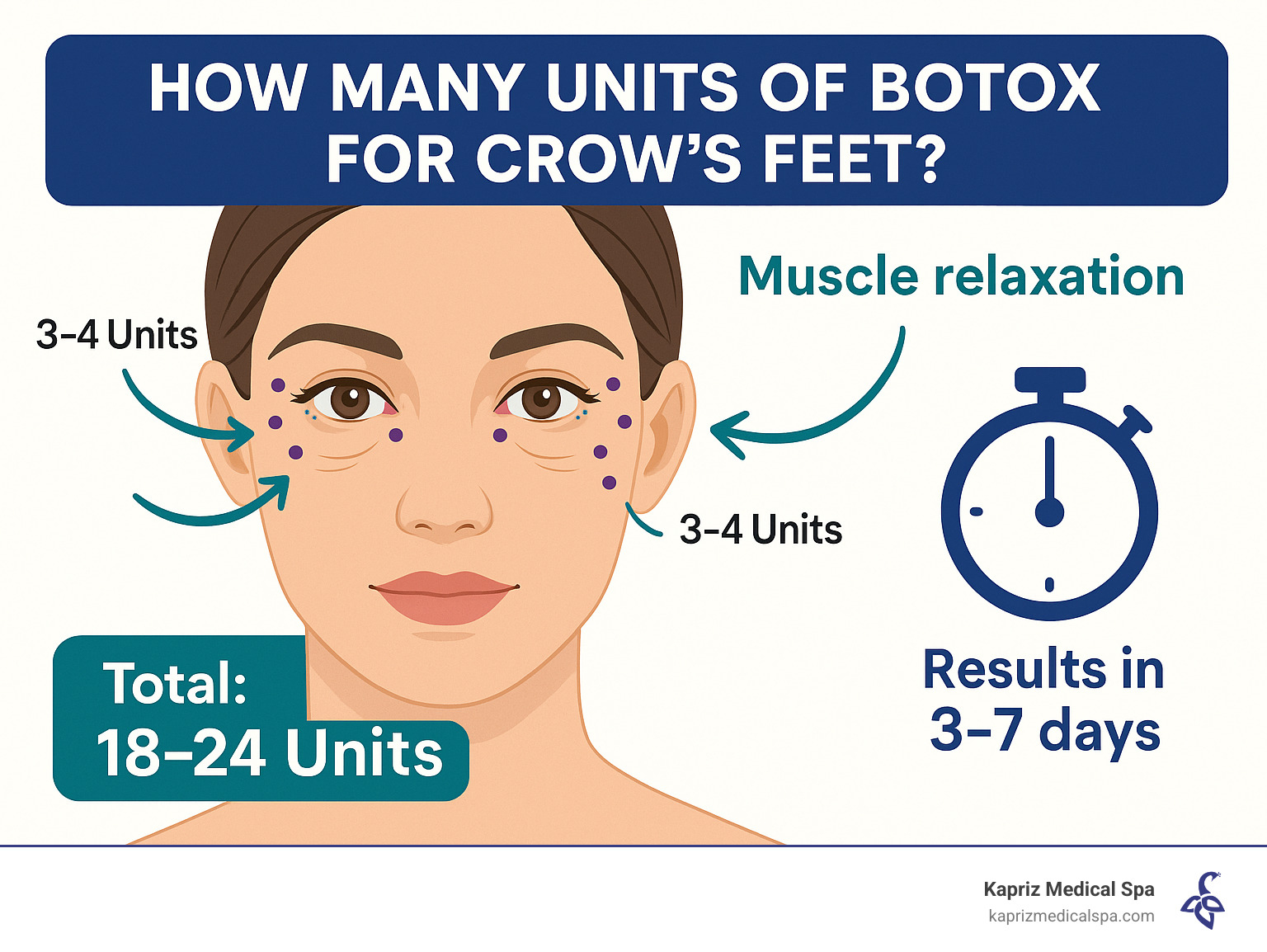
How many units of botox are used for crow’s feet ranges from 18-24 units total, with most patients needing 9-12 units per eye. Here’s the quick breakdown:
Standard Dosing Guidelines:
– Total units needed: 18-24 units for both eyes
– Per eye: 9-12 units (typically 10-12 units)
– FDA recommendation: 24 units total (12 units per side)
– Conservative approach: 5-10 units per eye for new patients
– Injection sites: 3 points around each eye (3-4 units per site)
Those fan-shaped lines at the outer corners of your eyes are called crow’s feet. They form from repeated muscle contractions and natural collagen loss as we age.
Botox works by temporarily blocking nerve signals to the muscles around your eyes, relaxing the muscles that create those dynamic wrinkles for 3-4 months.
The exact number of units depends on your muscle strength, metabolism, age, and line depth. Some people see great results with just 5 units per eye, while others may need up to 15 units per side.
Simple guide to how many units of botox are used for crow’s feet:
– how many units of botox for face slimming
– how many units of dysport equal botox
– how much botox do i need for the first time
How Many Units of Botox Are Used for Crow’s Feet?
When you’re wondering how many units of botox are used for crow’s feet, the FDA recommends 24 units total for treating crow’s feet, based on extensive clinical studies by Allergan.
In practice, most patients get excellent results with 18-24 units total – about 9-12 units per eye. For first-time patients, we often start conservatively with 5-10 units per eye. It’s easier to add more units at a follow-up than wait months for over-treatment to fade.
Some people need more – up to 15-20 units per eye for deeper lines or stronger muscles. A scientific research study following 1,362 patients found that proper dosing led to results lasting at least four months.
Typical Dosage: How Many Units of Botox Are Used for Crow’s Feet per Eye?
We use three injection points around each eye, creating a fan pattern that follows your natural crow’s feet lines. Each injection site gets 3-4 units, strategically placed about 1 cm apart along your orbital rim. This adds up to 9-12 units per eye total.
This three-point strategy ensures even muscle relaxation while keeping your expressions natural. Symmetry is everything – we carefully measure each injection site because even a 1-2 unit difference between eyes can create noticeable unevenness.
How Many Units of Botox Are Used for Crow’s Feet in Men vs. Women?
Men typically need more Botox than women for crow’s feet. Men usually require 12-15 units per eye compared to women’s average of 8-12 units per eye.
Men generally have stronger facial muscles and thicker skin, requiring more product for the same smoothing effect. Women typically do well with 16-24 units total, while men often need 20-30 units total.
However, muscle strength matters more than gender when planning your personalized dose. We always assess individual muscle activity during consultation.
Factors That Change Your Personal Unit Count
Determining how many units of botox are used for crow’s feet requires a personalized approach. At Kapriz Medical Spa, we consider several key factors.
Age plays a huge role in your unit count. Patients in their twenties or thirties typically need fewer units, while those in their forties or beyond often require more product due to deeper, more established lines.
Skin thickness varies between individuals. Thicker skin requires more Botox to reach the underlying muscles effectively.
Wrinkle depth tells us about your needs. Fine lines that only appear when smiling respond to lower doses, while lines visible at rest typically need higher doses.
Muscle strength varies dramatically. Some patients have naturally strong facial muscles requiring higher doses to achieve the same relaxation level.
Your metabolism affects how your body processes Botox. Fast metabolizers might need slightly more units or find results don’t last as long.
Facial expressiveness impacts dosing. Naturally animated speakers or those with expressive jobs might need more product to counteract muscle activity.
We also consider previous treatments, sun damage, and lifestyle factors. For complete information, review our detailed Botox Safety guide.
Metabolism, Lifestyle, and Longevity of Results
High metabolism can require 10-20% more units than standard doses. Regular exercisers and those who process medications quickly often need higher doses.
Sun exposure significantly affects results. Patients with extensive UV exposure see results fade 25-30% faster than those using proper sun protection.
Smoking reduces blood flow and breaks down collagen faster, potentially requiring higher doses and shorter result duration.
Stress levels matter because tense facial muscles work against Botox effectiveness.
Collagen loss accelerates after age 20 at about 1% yearly, meaning older patients may need higher doses and more frequent treatments.
Can Starting Early Reduce Future Unit Needs?
Preventative Botox is highly effective. Starting treatments before deep lines form can save units and money long-term.
For patients in their twenties, we typically start with 6-8 units per eye. You’re preventing lines rather than treating established ones.
In early thirties, we might use 8-10 units per eye, still less than treating deeply etched lines.
After age 35, standard dosing is usually needed as some lines have likely set in.
Patients who started preventative treatment often maintain lower doses well into their forties, compared to those who wait until lines are well-established.
The Procedure, Results, and Aftercare Timeline
Getting Botox for crow’s feet is surprisingly quick – most patients complete treatment during lunch breaks.
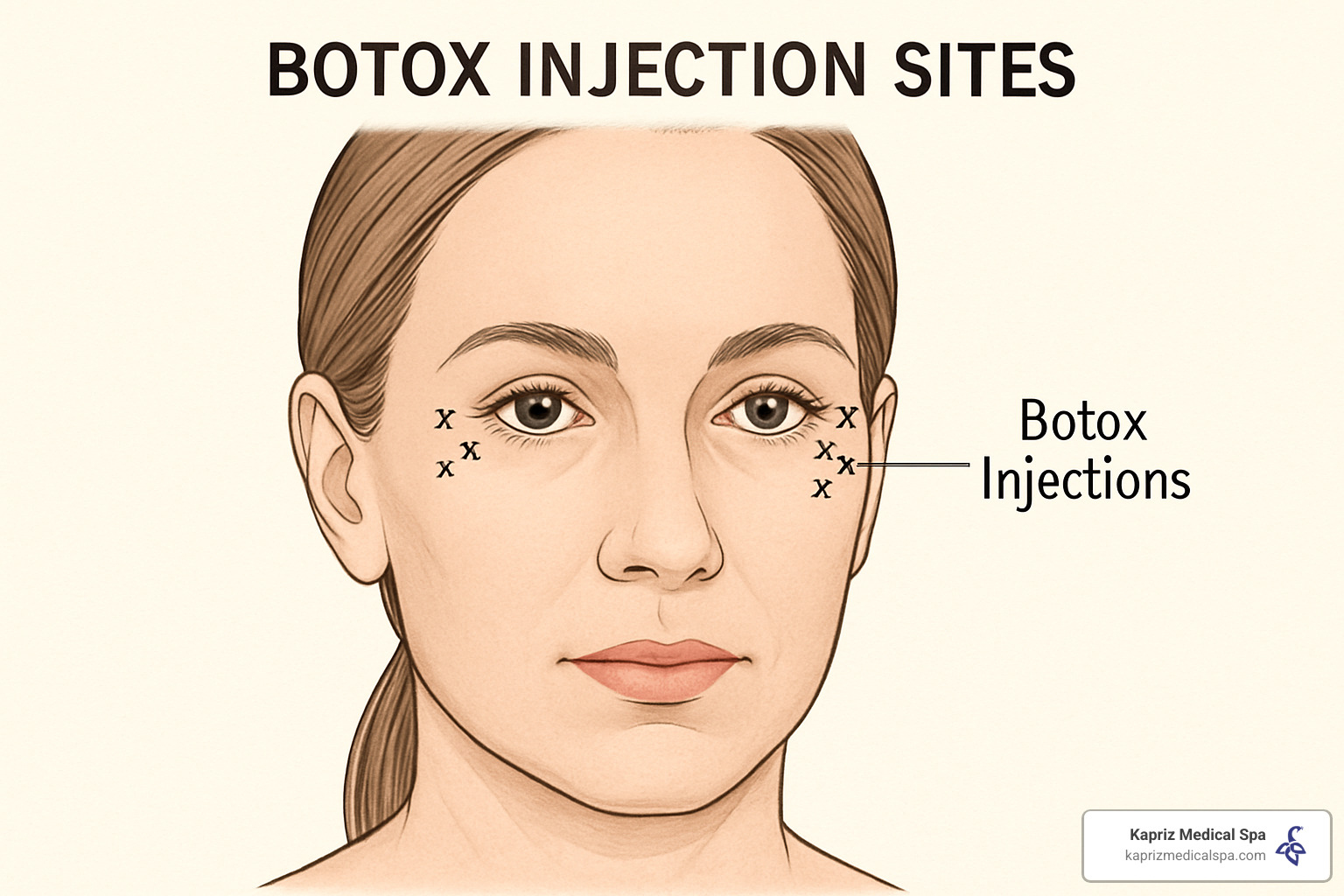
Your consultation includes facial anatomy analysis and muscle movement assessment. We discuss medical history, medications, and desired results to determine exactly how many units of botox are used for crow’s feet for your case.
Treatment day involves cleaning the area, marking injection sites, and optional numbing cream or ice. The injection process takes 5-10 minutes for both eyes. The entire visit typically takes 30 minutes. See examples in our Botox Before and After gallery.
Step-by-Step Botox Session for Crow’s Feet
We use ultra-fine 30-32 gauge needles – much smaller than typical medical injections. Most patients describe the sensation as tiny pinpricks, similar to eyebrow plucking.
We make three precise injections around each eye following the natural fan pattern. The Botox spreads 30-45mm from each injection site, making precise placement crucial. We treat both eyes during the same session for perfect symmetry.
Our conservative approach makes it easier to add units at touch-ups than wait months for over-treatment to fade.
When Will You See Results and How Long Will They Last?
Unlike dermal fillers with immediate results, Botox works gradually. Initial muscle relaxation begins within 24-48 hours. By 3-7 days, you’ll see noticeable smoothing. Full effects develop over 10-14 days.
According to scientific research on onset, most patients achieve significant improvement within one week.
Results gradually fade over 3-4 months as Botox naturally metabolizes. Most patients notice first signs of muscle movement returning around 3 months, though some enjoy results up to 6 months.
We recommend scheduling maintenance appointments 3-4 months after treatment, ideally before lines fully return.
Pricing, Safety, and Alternatives
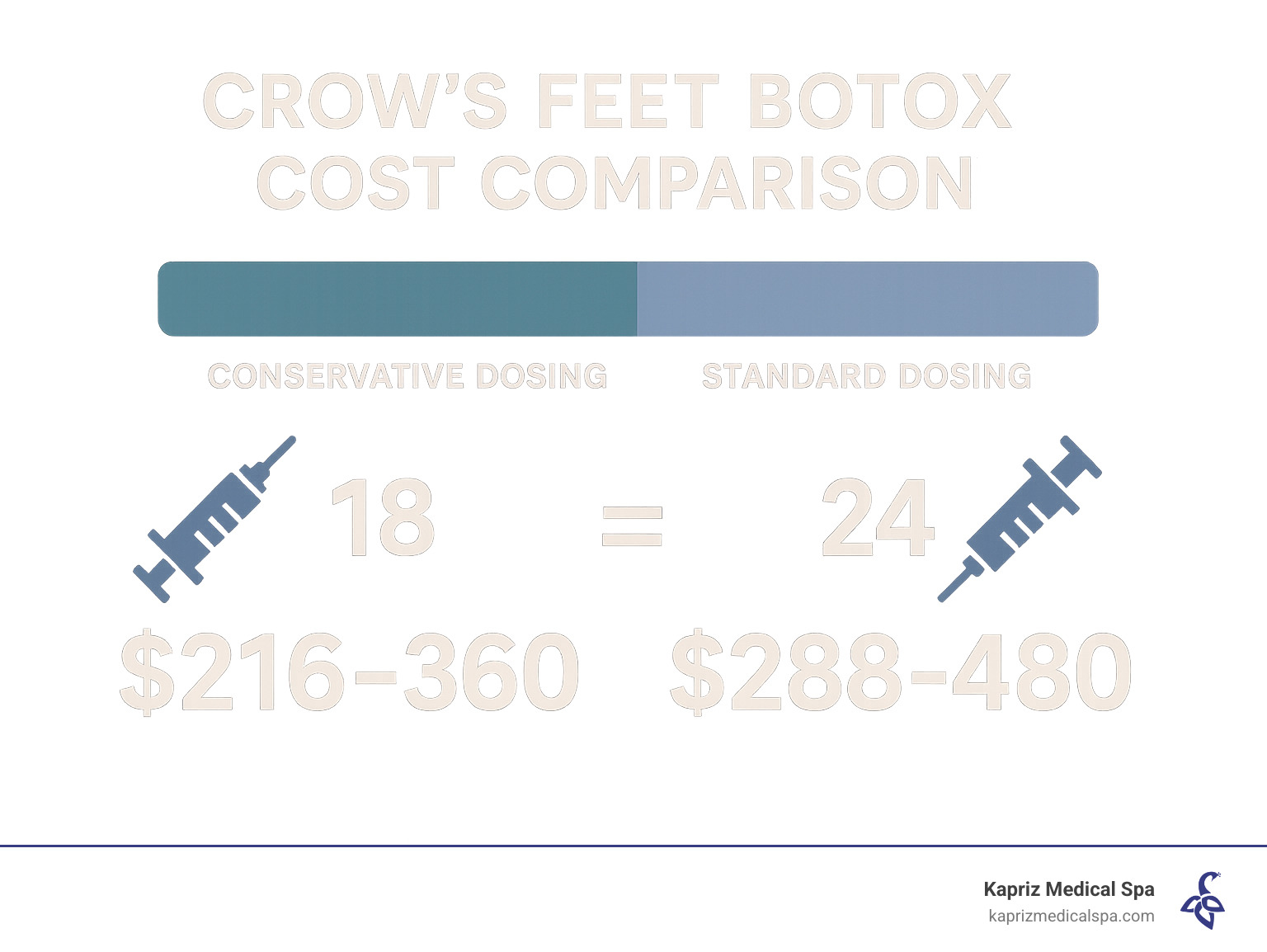
How many units of botox are used for crow’s feet directly impacts cost. Most practices charge $9-$20 per unit, meaning typical sessions run $180-$400 for both eyes. In Jacksonville, rates typically range $12-$15 per unit.
The math: 18 units costs about $216-$270, while 24 units runs $288-$360. Considering 3-4 months of smoother, more youthful eyes, many patients find excellent value.
Botox has an excellent safety record. FDA approval for crow’s feet came in 2013 after extensive trials. The scientific research on safety shows serious complications are incredibly rare with qualified professionals.
Most side effects are minor: mild bruising (10-15% of patients) or slight swelling (5-10%). The most concerning potential side effect is droopy eyelid, occurring in less than 1% of properly administered treatments.
Side Effects and Risk Management Around the Eyes
At Kapriz Medical Spa, we use conservative dosing for first-time patients, map injection sites precisely, and keep placement away from upper eyelid muscles.
Most patients experience minimal discomfort. Light bruising occasionally occurs – ice and arnica cream help. We recommend avoiding blood thinners like aspirin for one week before treatment if doctor-approved.
Dry eyes can rarely happen but are temporary. Keep artificial tears handy and skip contact lenses the first day.
Call us immediately for: severe headache, vision changes, difficulty closing eyes, or infection signs.
Aftercare is straightforward: no rubbing for 24 hours, avoid lying flat for 4 hours, skip the gym for one day.
Non-Botox Options for Smoothing Crow’s Feet
Topical treatments include prescription retinoids (stimulate collagen), peptide creams, and antioxidant serums.
Professional treatments include chemical peels (improve texture), microneedling (stimulate collagen), and laser resurfacing (address texture and sun damage).
Dermal fillers add volume to fill deeper lines visible at rest.
The best results often combine treatments – Botox for dynamic lines plus other treatments for overall skin quality. Don’t forget basics: daily sunscreen, quality sunglasses, and good eye cream.
Frequently Asked Questions about How Many Units of Botox Are Used for Crow’s Feet
What’s the minimum that works? Some patients see improvement with 5 units per eye (10 total), but most need 8-12 units per eye for optimal results.
Can you overdo crow’s feet Botox? Yes. Over-treatment can make closing eyes difficult or create a frozen expression. We always start conservatively.
How do I know if I need the full 24 units? We assess deep lines visible at rest, natural expressiveness, and previous treatments during consultation.
Why do different injectors use different amounts? While FDA recommends 24 units, experienced practitioners customize based on individual facial anatomy. How many units of botox are used for crow’s feet should reflect your unique needs.
Will crow’s feet get worse if I stop Botox? No – they return to where they would have been naturally. Regular patients often find lines don’t deepen as quickly over time.
How Soon Should I Plan a Touch-Up?
Most patients follow 3-4 month treatment cycles. After your first treatment, we schedule a two-week check-in to ensure perfect balance and add units if needed.
Next full treatment typically happens at 3-4 months. Regular patients often get longer-lasting results than those who wait until lines fully return.
High-metabolism individuals might need treatments every 3-4 months, while preventive patients often stretch appointments to 4-6 months.
Schedule your next appointment when you notice about 30% of lines returning – don’t wait for complete return.
Is It Safe to Combine Crow’s-Feet Botox with Other Treatments?
Absolutely! Combining treatments often creates the most stunning results.
Compatible treatments include dermal fillers (wait 2 weeks between), chemical peels (space 1-2 weeks apart), and laser treatments (2-4 weeks between). Most skincare treatments can be done the same day.
Our timing strategy: Botox first, then fillers. This allows precise filler placement after seeing muscle relaxation.
Combined results often surprise patients. Botox relaxes muscles while fillers restore volume, and laser work improves overall skin quality for a comprehensive, natural approach.
Can I Prevent Crow’s Feet with Preventative Botox Dosing?
Preventative Botox trains muscles to relax before creating permanent creases. The ideal starting age is 25-35, especially if you notice fine lines when smiling or have family history.
Preventive dosing differs from corrective treatment. Instead of 12-15 units per eye for established lines, preventive patients often need just 6-10 units per eye with longer intervals between treatments.
Long-term benefits are significant. Patients starting preventive treatment in their twenties often maintain the same low dose into their forties, while those waiting until lines are established often need progressively higher doses.
Prevention is easier than correction – you’re maintaining current appearance rather than reversing damage.
Conclusion
Finding the right answer to how many units of botox are used for crow’s feet means understanding your unique needs and working with caring professionals. While most people need 18-24 units total, your personal requirements might differ.
At Kapriz Medical Spa in Jacksonville, we create individualized treatment plans that fit your lifestyle, budget, and aesthetic goals. We’re helping you feel confident and beautiful in your own skin.
Key takeaways: Most patients need 9-12 units per eye, men typically require 20-25% more than women, and preventive treatments can reduce long-term needs. Results last 3-4 months with excellent safety profiles when properly administered.
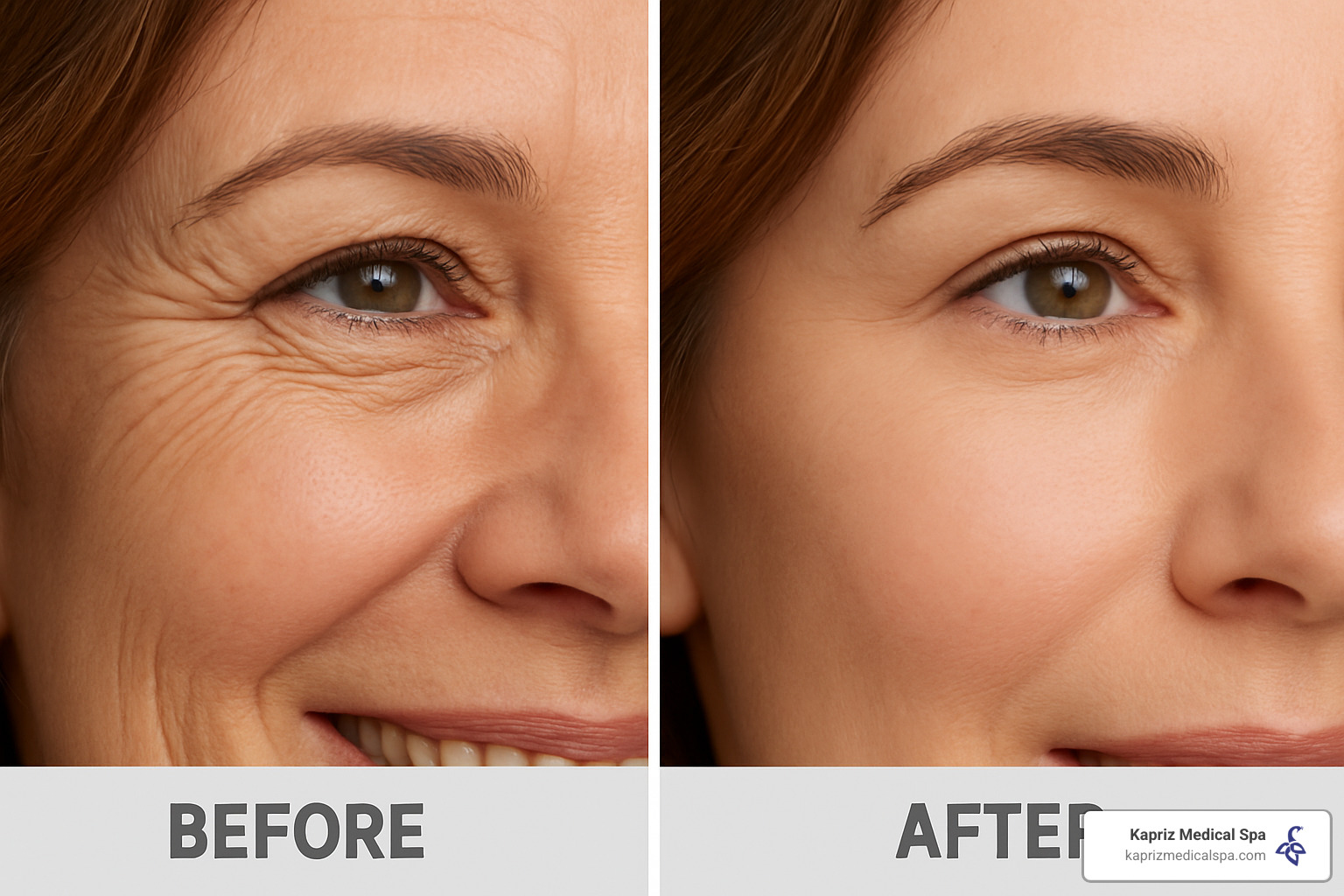
The investment typically ranges from $180-$400 per session, making crow’s feet treatment highly effective for anti-aging. Most clients tell us the confidence boost makes it worthwhile.
What’s most rewarding is watching clients light up seeing their results – looking like themselves, just refreshed and more youthful. That’s the magic of proper dosing.
Ready to find your perfect unit count? We’d love to meet you for a consultation where we’ll examine your facial anatomy, discuss your goals, and design a completely customized treatment plan.
For comprehensive information about our crow’s feet treatments, explore our detailed guide on Botox for Crow’s Feet or call our Jacksonville location to schedule your personalized consultation.
The best Botox treatment creates results that make you feel like the most vibrant, confident version of yourself. That journey starts with finding the right team who understands both the science and art of facial aesthetics.