
how many units for under eye botox: 7 Powerful Facts 2025
Understanding Under Eye Botox Dosage
When it comes to refreshing tired eyes, less is definitely more. How many units for under eye botox is one of the most common questions we hear at Kapriz Medical Spa – and the answer might surprise you.
Unlike other facial areas that might receive higher doses, the delicate under-eye region typically requires just 1-2 units per eye (making a total of 2-4 units for both eyes). This conservative approach isn’t about saving product – it’s about safety and natural-looking results.
Those tiny lines and that subtle puffiness making you look tired even after a full night’s sleep? They can often be addressed with this minimal dosage. The under-eye area is incredibly delicate, with thin skin and the fine orbicularis oculi muscle requiring a precise, gentle touch.
| Under Eye Botox Dosage | Units |
|---|---|
| Standard dose per eye | 1-2 units |
| Total typical treatment | 2-4 units |
| Higher range (less common) | Up to 8 units total |
| Compared to crow’s feet | 10-15 units per eye |
“We typically start with just 2 units per under-eye area for most patients,” explains our lead injector at Kapriz. “This micro-dosing approach gives us beautiful results while minimizing any risk of complications.”
Why such a conservative amount? The stakes are higher here than in other facial zones. Over-treatment could lead to unwanted effects like drooping or asymmetry, which is why experienced injectors approach this area with extra caution.
Your personal dosage may vary based on several factors. Men often require slightly higher doses due to stronger muscle structure. Age, metabolism, wrinkle severity, and previous treatments also influence how many units you’ll need for optimal results. During your consultation, we’ll assess these factors to create your personalized treatment plan.
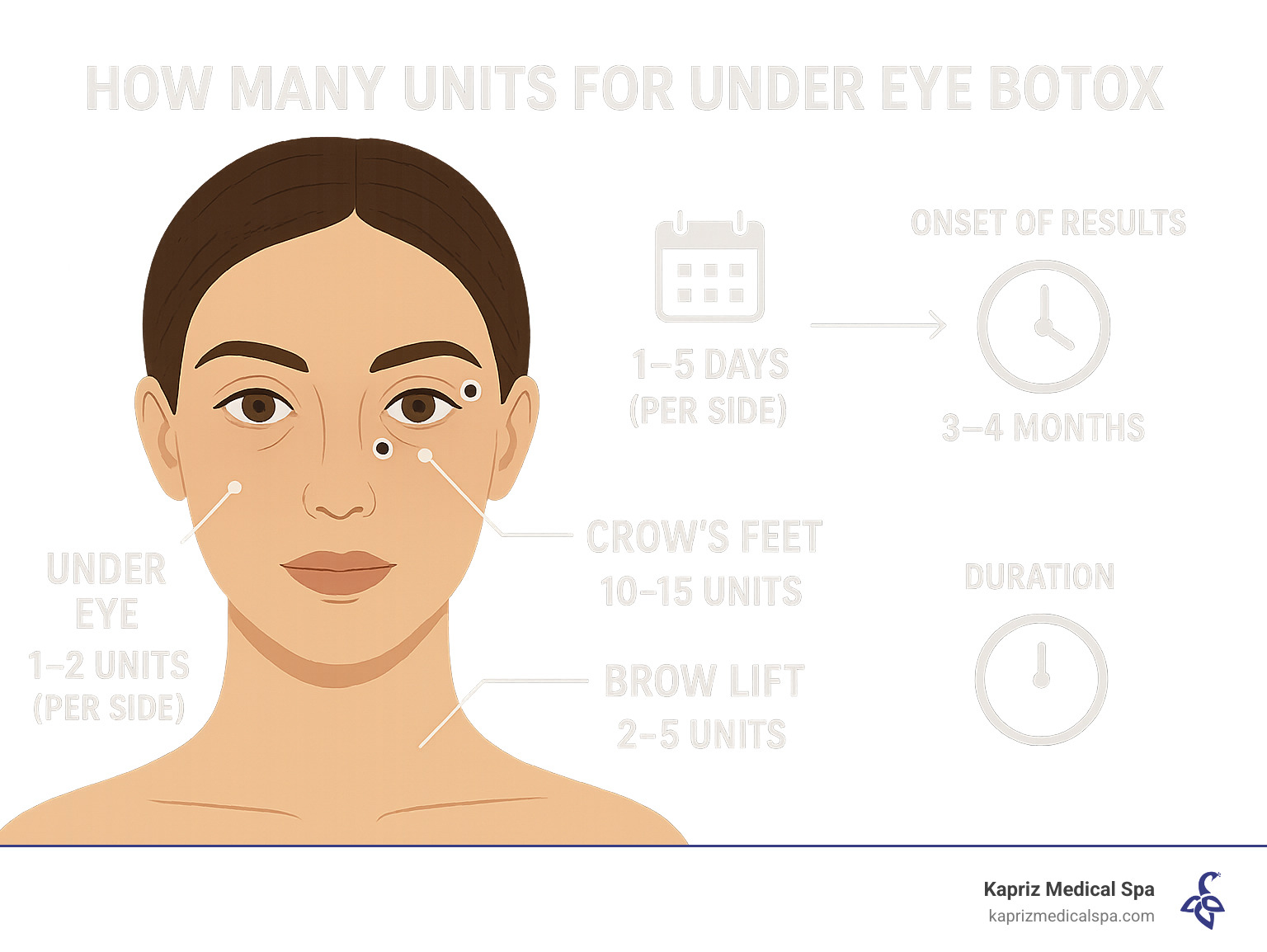
When considering how many units for under eye botox you might need, it helps to understand the full picture. You may want to explore related information about how much botox do i need for the first time, how to know how many units of botox you need, or even how many units for full face botox if you’re considering a more comprehensive treatment.
When it comes to under-eye Botox, precision matters more than quantity. Those tiny 1-2 units can make a remarkable difference in refreshing your appearance while maintaining your natural expressiveness.
Under-Eye Botox 101: What It Is & How It Works
Ever wonder how those tiny injections can make such a big difference in your appearance? Under-eye Botox works by targeting the orbicularis oculi muscle – that’s the circular muscle that wraps around your eye and is responsible for those crinkly lines and puffy areas that appear when you smile or squint.
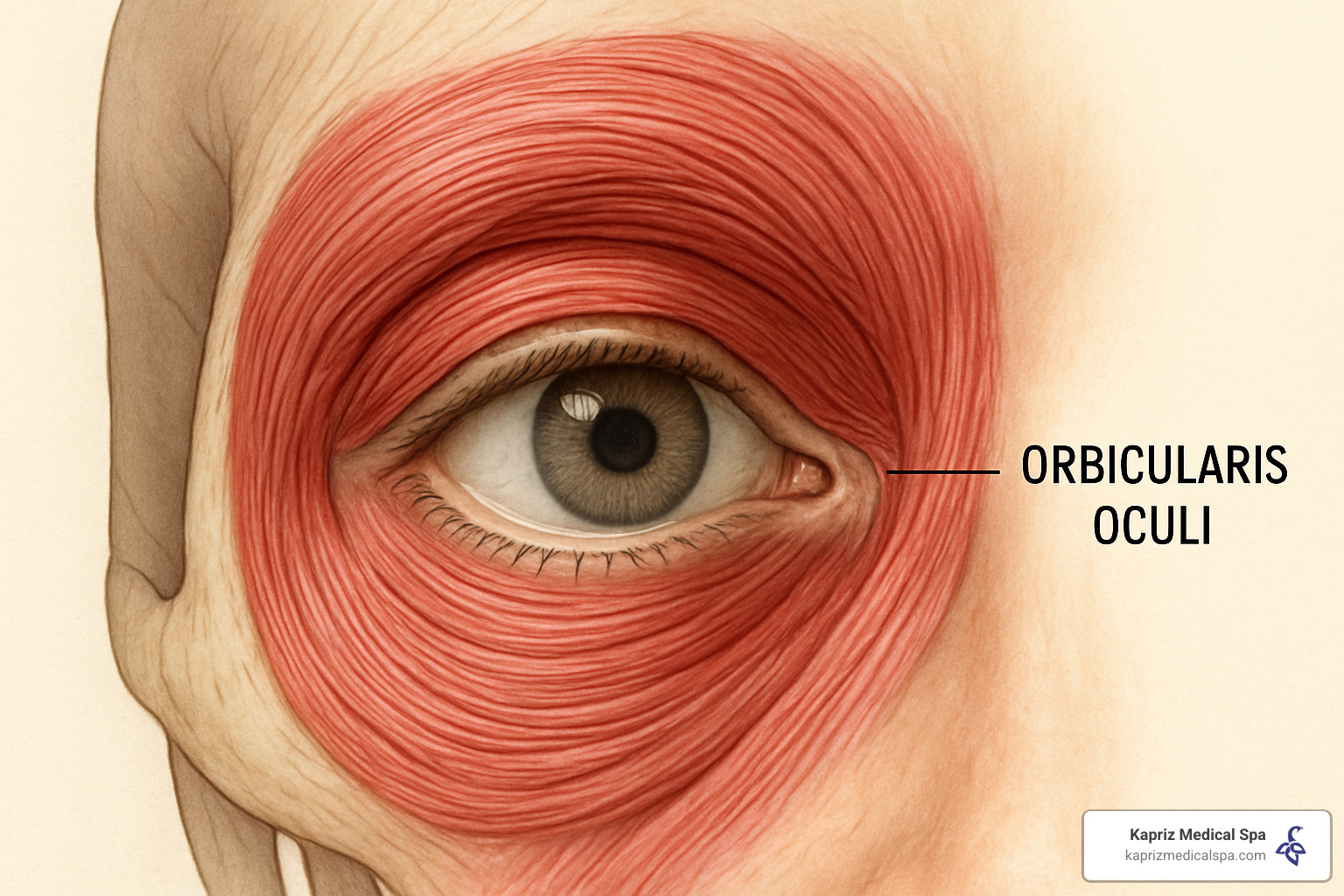
When your provider injects how many units for under eye botox (typically just 1-2 units per side), something fascinating happens at the cellular level. The botulinum toxin blocks the communication between your nerves and muscle fibers, essentially telling that muscle to take a little break from its full contracting power. This relaxation smooths out dynamic wrinkles – the ones that appear with facial expressions – and reduces the bulging that some people experience when smiling.
“Those little bulges many people notice when smiling – what we sometimes call ‘jelly rolls’ – often result from having a particularly strong orbicularis oculi muscle,” explains our aesthetic specialist at Kapriz Medical Spa. “By strategically and conservatively relaxing this muscle, we can soften the appearance of these bulges while ensuring you maintain your natural expressiveness.”
Unlike fillers that physically add volume beneath the skin, Botox works by addressing the muscle activity that contributes to certain under-eye concerns. The result? A more refreshed, less tired-looking you – without changing your fundamental facial structure or expressions.
Scientific research on infra-orbital Botox confirms that these micro-injections can effectively address lower eyelid wrinkles with minimal risk when performed by skilled practitioners using proper techniques and conservative dosing.
Is It FDA-Approved?
Here’s something important to know: while Botox has FDA approval for treating crow’s feet (those lines at the outer corners of your eyes), its use directly under the eyes is considered “off-label.” Don’t let that term worry you – off-label use is extremely common in medicine and simply means the treatment is being used for a purpose beyond its original FDA approval.
Many effective and safe treatments across all medical specialties are used off-label when clinical experience has shown positive results. For under-eye Botox specifically, board-certified providers have been safely performing this procedure for years using careful techniques and the appropriate minimal dosing.
At Kapriz Medical Spa, we believe in transparency. We always provide thorough informed consent discussions before any off-label treatment, ensuring you understand both the potential benefits and limitations of under-eye Botox so you can make a confident decision about your care.
Cosmetic Concerns It Treats
Under-eye Botox can be surprisingly effective for several specific concerns:
Fine lines and wrinkles that appear when you smile or squint can be softened significantly. Those dynamic wrinkles – the ones that show up with facial expressions – respond particularly well to Botox treatment. The under-eye bulges or “jelly rolls” that become more prominent when you’re animated can be reduced by relaxing the muscle that causes them. And if you’re noticing early signs of under-eye bags, Botox can help by relaxing the muscle that sometimes accentuates mild bagginess.
Jennifer, a 42-year-old client from Jacksonville, shared her experience: “I was always conscious of how my under-eyes would crease and puff when I smiled. After just a tiny amount of Botox – my provider said it was only 2 units under each eye – I was amazed at how much fresher I looked in photos, even when smiling big. My friends keep saying I look well-rested!”
It’s worth noting that under-eye Botox isn’t a one-size-fits-all solution. If you have static wrinkles (present even when your face is relaxed), significant fat pads, or hollow tear troughs, you might benefit more from other treatments like fillers or surgical options. During your consultation at Kapriz Medical Spa, we’ll help determine if under-eye Botox is right for your specific concerns or if another approach might serve you better.
Safety, Candidacy & Risk Profile
Let’s talk about safety first – because when it comes to your precious eyes, there’s nothing more important. At Kapriz Medical Spa, we take a cautious and personalized approach to under-eye Botox treatments.
You’re likely a good candidate for under-eye Botox if you’re over 18, in good health, and bothered by those little dynamic wrinkles or bulges that appear when you smile. The key word here is “dynamic” – meaning they show up with movement. If you’re looking for dramatic changes or have severe under-eye concerns, we might recommend a different approach.

Did you know there are gender differences when it comes to how many units for under eye botox you might need? Men typically have stronger facial muscles and may need slightly higher doses – perhaps 2 units per side instead of the 1 unit that works well for many women. But remember, this isn’t a one-size-fits-all situation. Your treatment will be customized to your unique facial structure.
“I always tell my patients that under-eye Botox is truly an art form,” shares our lead injector at Kapriz. “The delicate balance between too little (no results) and too much (risk of complications) is why experience matters so much in this area.”
Speaking of complications, they’re rare when you choose an experienced provider, but it’s important to know what they might include. You might experience some temporary bruising where the needle entered your skin. A bit of swelling or redness can happen too, but typically fades within hours. The more serious (but thankfully uncommon) risk is eyelid ptosis – a drooping of the eyelid that can occur if the Botox migrates to unintended muscles.
For a deeper dive into safety considerations, our Botox Safety Information page has everything you need to know.
Who Should Skip Under-Eye Botox?
Not everyone is an ideal candidate for this treatment. If you have significant skin laxity (looseness), prominent fat pads, or a history of allergic reactions to botulinum toxin products, this might not be your best option.
Those with certain neuromuscular disorders like myasthenia gravis should avoid Botox altogether. And if you’re pregnant or breastfeeding, we recommend waiting. While no adverse effects have been conclusively proven, we believe it’s better to err on the side of caution when it comes to your health and your baby’s.
One common misconception I hear in consultations is about under-eye bags. “My friend told me Botox would fix my bags – is that true?” Unfortunately, it’s not. True under-eye bags are caused by fat pads and skin laxity, not muscle activity. For those concerns, dermal fillers or other treatments might be more appropriate.
Minimizing Complications
At Kapriz, we’ve developed a careful approach to maximize safety:
First, we use a micro-dosing technique – starting with just 1-2 units per side. We’d rather have you come back for a touch-up than deal with an over-treated area.
Second, precision is everything. Our injectors are thoroughly trained in periorbital anatomy (the structure around your eyes) and place each tiny amount of Botox exactly where it needs to go.
Third, we always schedule a follow-up appointment about two weeks after your treatment. This gives us a chance to check your results and make any necessary adjustments.
“I was so nervous about getting anything done near my eyes,” shares Melissa, a 42-year-old client. “But the team at Kapriz explained everything so thoroughly that I felt completely at ease. They used just 1 unit under each eye at first, and the results were subtle but amazing – just enough to smooth out those smile lines without looking frozen.”
With under-eye Botox, less is definitely more. Our conservative approach means you’ll still look like yourself – just a more refreshed version!
How Many Units for Under Eye Botox?
Now to the central question: how many units for under eye botox are typically used? The consensus among experienced injectors is clear – less is more in this delicate area.
The standard dosage range for under-eye Botox is quite conservative compared to other facial areas. Most patients receive just 1-2 units per eye (2-4 units total). In some cases, up to 8 units total might be used, though this higher range is much less common. For perspective, this is significantly less than what’s typically used for the forehead (10-30 units) or crow’s feet (10-15 units per side).
This conservative approach isn’t just our preference – it’s supported by Guidelines set by Allergan, the manufacturer of Botox Cosmetic. Their guidance emphasizes using the minimum effective dose in sensitive areas like the under-eye region.
“We typically start with just 1 unit per side for first-time patients,” explains our aesthetic nurse at Kapriz Medical Spa. “This allows us to see how your muscles respond before considering any adjustments at your follow-up appointment.”
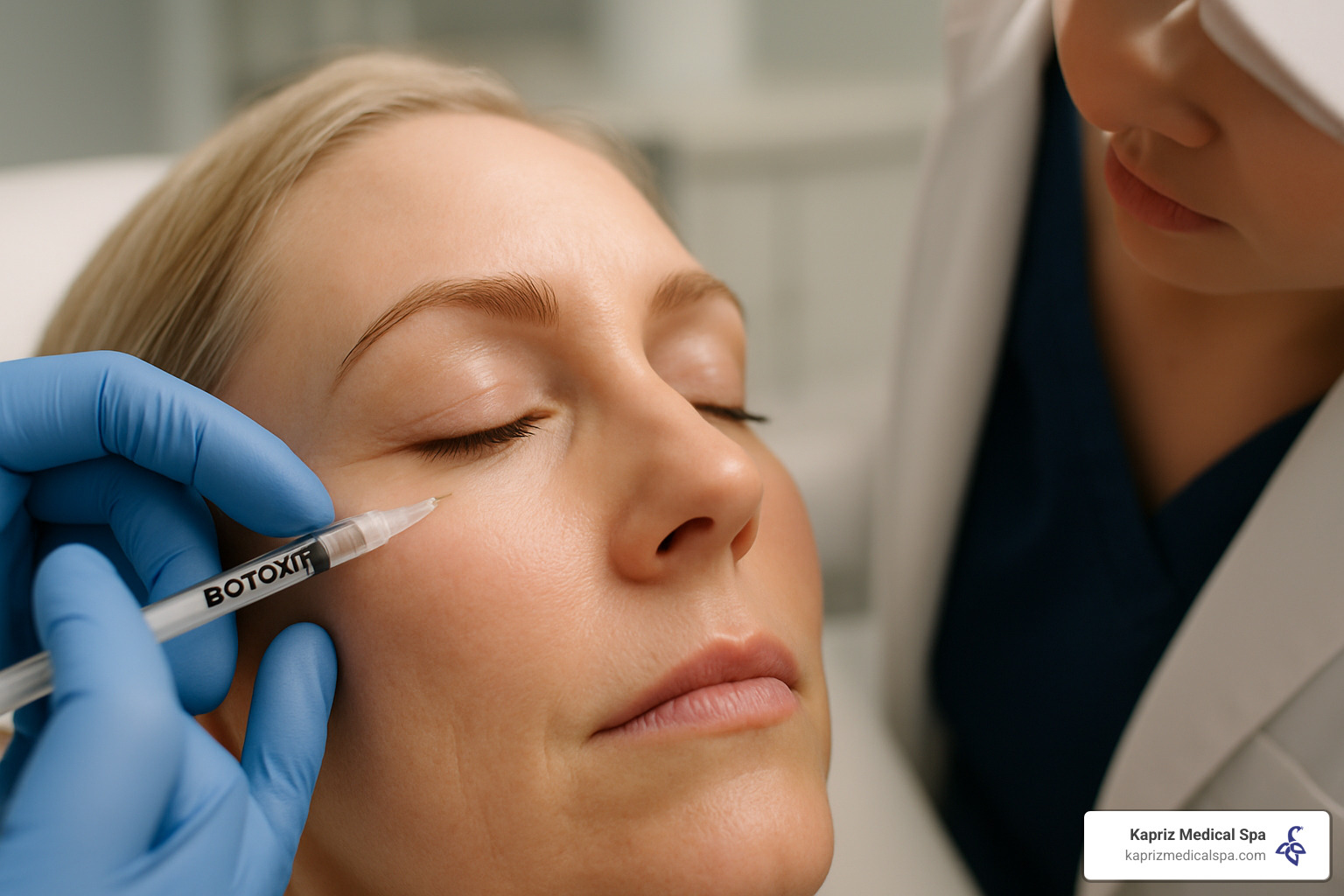
Typical Range: How Many Units for Under Eye Botox Per Eye
When we break down the typical range on a per-eye basis, the numbers remain quite modest. Most providers follow these guidelines:
For most patients, the standard dose is just 1-2 units per eye. If you’re new to Botox, we’ll likely start with just 1 unit per eye to see how your body responds. Men often require the higher end of the range (2 units per eye) due to stronger facial muscles. Our philosophy is always to start conservatively and add more if needed during a follow-up visit.
This micro-dosing approach gives you noticeable improvement while minimizing risk. As Maria, one of our clients, told us: “I was surprised that such a small amount of Botox could make such a difference. My under-eye area looks smoother, but I can still express myself naturally – no one can tell I’ve had anything done!”
For more specific information about under-eye Botox units, visit our detailed guide: How Many Units of Botox for Under Eyes?
Factors Influencing How Many Units for Under Eye Botox
The exact number of units you might need depends on several key factors that make your treatment uniquely yours.
Your muscle strength plays a major role – stronger orbicularis oculi muscles typically require more units to achieve the desired effect. The severity of your wrinkles also matters, with deeper lines sometimes needing the higher end of the dosage range. Your individual anatomy is another important consideration, as the placement and size of eye muscles varies from person to person.
Your body’s metabolism affects how quickly you process Botox, with faster metabolizers sometimes needing slightly higher doses or more frequent treatments. Gender differences are notable too – men often need slightly higher doses than women due to stronger facial muscles. Finally, your response to previous treatments helps guide future dosing if you’ve had Botox before.
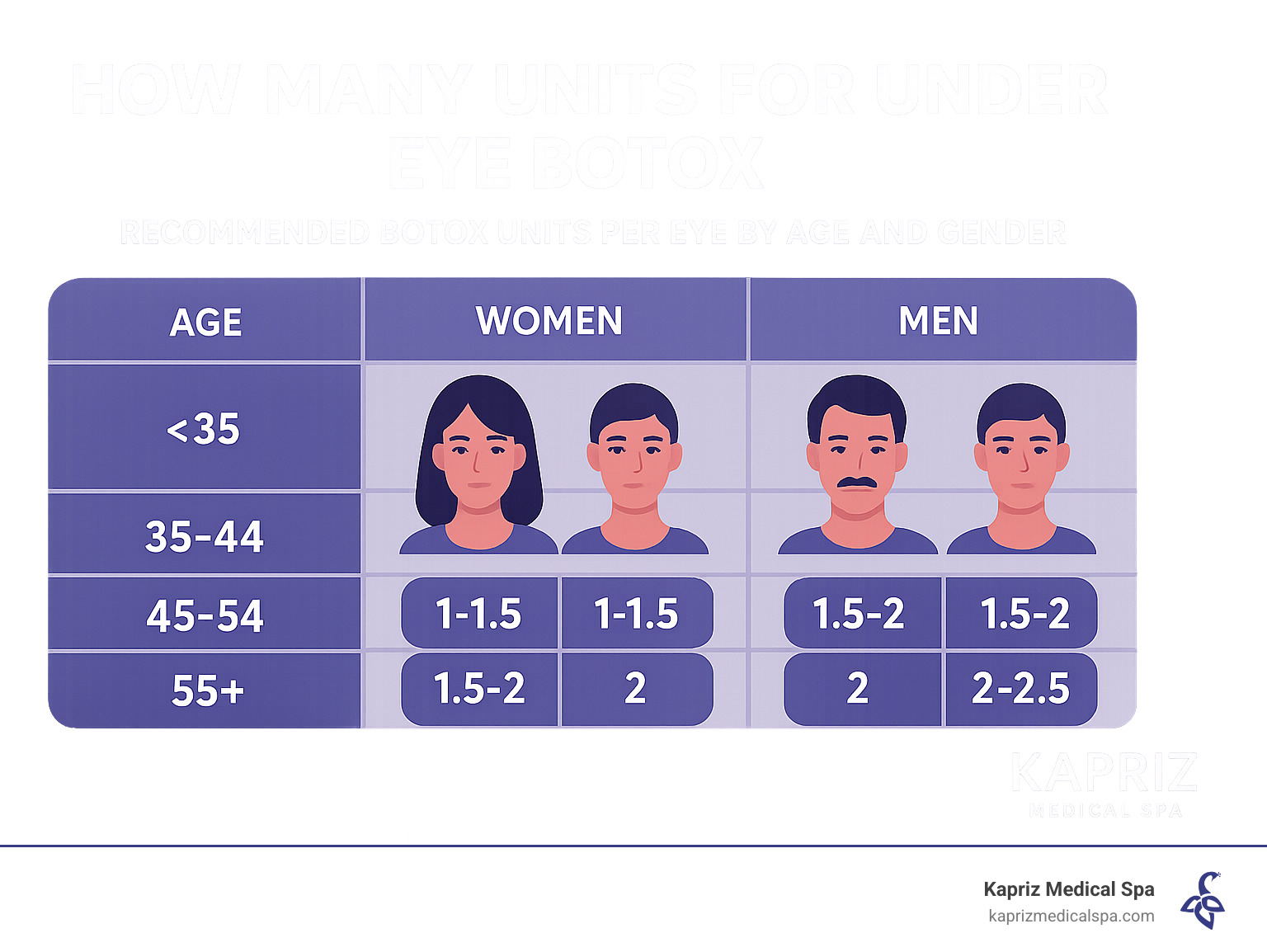
“Muscle strength and size—not just area—drive Botox dosage requirements,” notes a leading aesthetic medicine publication. This is why we never take a one-size-fits-all approach at Kapriz Medical Spa. Your treatment should be as unique as you are.
Comparing Nearby Eye Areas
To put under-eye Botox dosing in perspective, it helps to compare it with other treatments around the eyes. The difference is quite dramatic!
While the under-eye area typically receives just 1-2 units per side (2-4 units total), crow’s feet treatments usually involve 10-15 units per side (20-30 units total). A brow lift with Botox generally requires 2-5 units per side (4-10 units total), and treating glabellar (frown) lines typically takes about 20 units total.
This significant difference in dosing highlights why specialized training in under-eye Botox is so important. The same provider who might confidently inject 12 units into your crow’s feet area will use extreme precision and restraint when treating under your eyes.
Many of our clients at Kapriz opt for a holistic approach, treating multiple areas around the eyes for a harmonious result. After all, these areas work together to create your expressions. For more information about treating the outer eye area, visit our page on Botox for Crows Feet.
Procedure, Results, Cost & Aftercare
At Kapriz Medical Spa, your under-eye Botox treatment begins with a thorough consultation. We’ll discuss your concerns, examine your facial anatomy, and determine if you’re an ideal candidate for this procedure.
The actual treatment is surprisingly quick:
1. Cleansing of the treatment area
2. Application of topical numbing cream if desired (though most clients find the procedure comfortable without it)
3. Precise injections using an ultra-fine 30-gauge needle
4. The entire injection process takes just 5 minutes
Most clients describe the sensation as a quick pinch – “like a light insect bite” is a common comparison. The minimal discomfort is well worth the results, which begin to appear within 3-5 days and reach full effect after about 7 days.
Results typically last 3-4 months for most people, though this can vary based on your metabolism, muscle strength, and activity level.
As for cost, under-eye Botox typically ranges from $200-$500 per treatment session. At Kapriz Medical Spa, we price Botox by the unit, generally between $10-$15 per unit. Since under-eye treatments require fewer units than other areas, they tend to be more affordable than full forehead or crow’s feet treatments.
We also offer CareCredit financing options to help make your treatments more accessible. For complete information about our Botox offerings, visit More info about Botox treatments.
Step-by-Step Injection Day
Here’s what to expect on the day of your under-eye Botox treatment at Kapriz Medical Spa:
- Arrival and preparation: You’ll be welcomed and made comfortable in our treatment room
- Photography: We’ll take before photos for your medical record
- Marking injection sites: Your provider will carefully mark the precise injection points
- Final discussion: We’ll review the treatment plan and answer any last-minute questions
- Injection technique: Using a micro-bolus technique, tiny amounts of Botox are placed at the marked sites
- Post-injection care: Gentle pressure may be applied to minimize bruising
- Aftercare instructions: You’ll receive detailed guidance for optimal results
One client, Jennifer, described her experience: “I was nervous about getting injections so close to my eyes, but the procedure was so quick and precise that I barely felt anything. The injector explained each step, which made me feel completely at ease.”
Recovery & Aftercare Tips
Recovery from under-eye Botox is minimal, allowing most people to return to normal activities immediately. However, we do recommend these aftercare guidelines:
- Avoid touching or rubbing the treated area for 24 hours
- Keep your head liftd for several hours after treatment
- Apply a cold compress if you experience any swelling (uncommon)
- Avoid strenuous exercise for 24 hours
- Skip facial treatments (massages, facials) for 1-2 weeks
- Maintain gentle facial expressions for the first day
“Refrain from vigorous physical activity and bending over for four hours post-injection,” advises a leading aesthetic medicine journal. These simple precautions help ensure optimal placement of the Botox and reduce the already low risk of complications.
When to Schedule Maintenance
For most clients, we recommend scheduling maintenance treatments every 3-4 months to maintain your refreshed appearance. Some interesting observations about maintenance:
- Many people notice their results last longer after several treatments
- This “muscle training” effect can sometimes extend the time between sessions
- Your provider may adjust your dosage over time based on your response
“With regular treatments, muscles weaken and may require fewer units for maintenance,” notes an aesthetic medicine publication. This means your long-term investment in under-eye Botox may actually decrease over time.
Alternatives, Maintenance & Choosing Your Provider
Let’s be honest – while how many units for under eye botox is important to understand, Botox isn’t the only solution for refreshing tired eyes. Sometimes it’s just one piece of a larger puzzle. At Kapriz Medical Spa, we believe in giving you the full picture of what’s possible.
Many of our clients achieve their best results through a customized approach that might include:
Dermal fillers work wonders for those hollow tear troughs that Botox can’t address. Think of fillers as adding volume where you’ve lost it, while Botox relaxes muscles that are working overtime.
Laser resurfacing is your go-to for improving skin texture and evening out tone. I’ve seen remarkable changes in clients whose main concerns were crepey skin or discoloration rather than dynamic wrinkles.
Microneedling is like sending a wake-up call to your skin, triggering collagen production for that natural plumpness we all miss from our younger days.
Medical-grade skincare is the unsung hero of any eye rejuvenation plan. The right products can maintain and improve your professional treatments while addressing concerns at home.
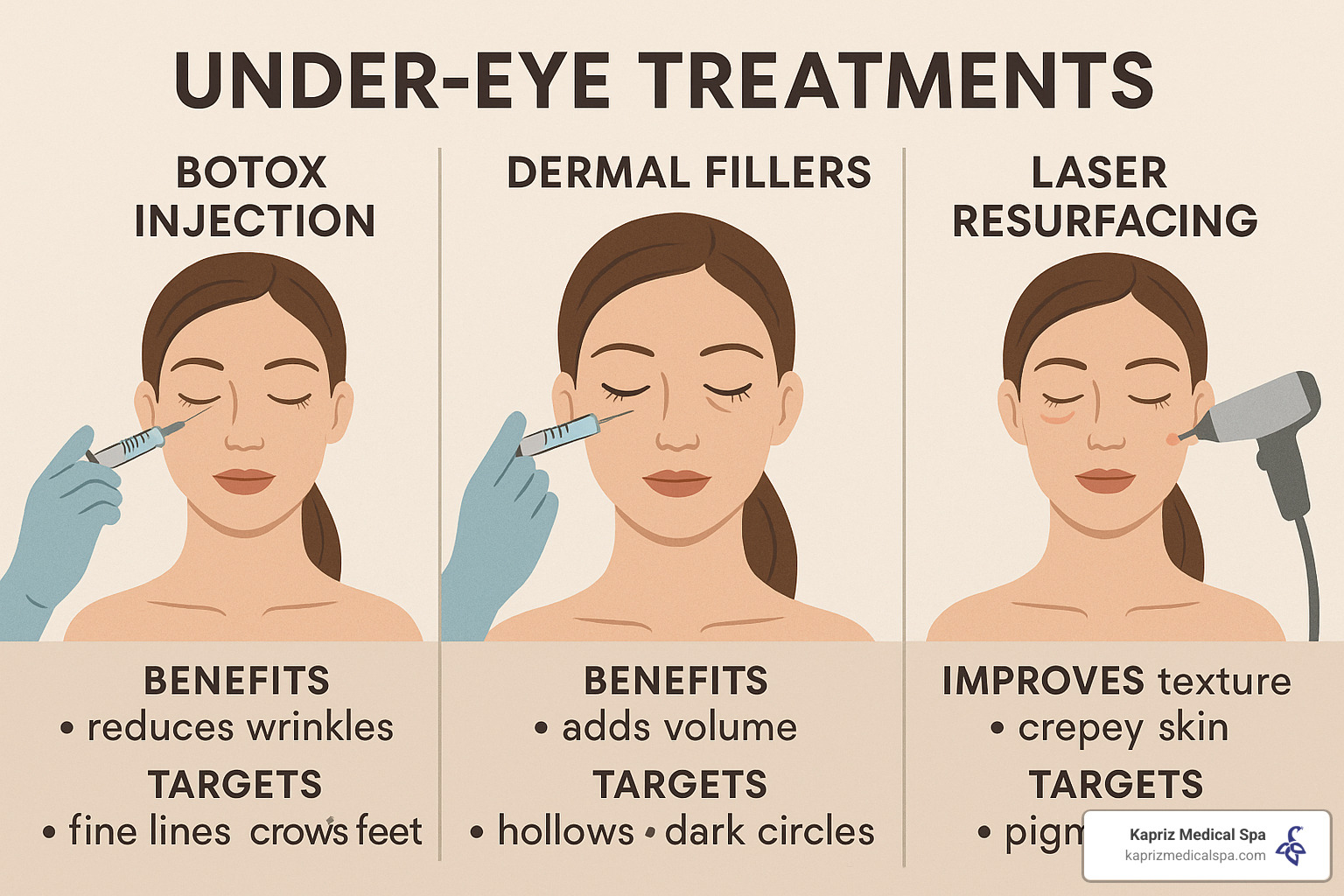
I remember Sarah, a client who initially came in asking only about Botox for her under-eyes. After a thorough consultation, we finded that her concerns would be better addressed with a combination of a tiny amount of Botox (just 1 unit per eye) plus a touch of filler for her tear troughs. “I never would have known the difference,” she told me at her follow-up. “I thought I just needed Botox, but this combination approach gave me results I didn’t think were possible.”
When it comes to choosing who will perform your under-eye Botox, this isn’t the time to hunt for the cheapest deal. The provider you select matters more than almost any other factor in your results and safety.
Look for a provider who has board-certified credentials – whether that’s a dermatologist, plastic surgeon, or a nurse with specialized training in facial aesthetics. At Kapriz, all our injectors have completed advanced training specifically for the delicate eye area.
Ask to see before and after photos of their actual patients, particularly those with similar concerns to yours. This visual evidence speaks volumes about their skill level and aesthetic sensibility.
Pay attention to their communication style. Do they offer transparent explanations of what Botox can and cannot do? Are they willing to tell you when an alternative might work better? The best providers will sometimes talk you out of a treatment if it’s not right for you.
Notice if they take a conservative approach, especially for first-time treatments. Starting with fewer units and building gradually is the hallmark of an experienced injector who prioritizes natural results.
At Kapriz Medical Spa in Jacksonville, we pride ourselves on our specialized knowledge of periorbital anatomy and injection techniques. We understand that you want to look refreshed, not frozen – like yourself on your best day, not someone else entirely.
For a deeper dive into our philosophy on facial rejuvenation, check out Botox Basics: Your Guide to Youthful Skin.
Frequently Asked Questions
Can Botox fix under-eye bags or dark circles?
I wish I could tell you that a few units of Botox would banish those persistent bags and dark circles, but I’d be doing you a disservice. The truth is, Botox typically isn’t effective for true under-eye bags or dark circles.
Here’s why: Under-eye bags are usually caused by fat pads that have shifted forward or skin that has lost elasticity – neither of which responds to muscle relaxation. Dark circles often result from genetics, pigmentation issues, or thin skin showing blood vessels underneath.
For bags, we typically recommend dermal fillers to restore volume loss around the tear trough, which creates a smoother transition between the lower eyelid and cheek. For significant bags, surgical options might be your best bet.
For dark circles, we often suggest laser treatments that target pigmentation or specialized skincare with brightening ingredients like vitamin C and kojic acid.
That said, some clients do notice an improvement in the appearance of mild bags when Botox softens the “crunch” of their smile. This is because relaxing the orbicularis oculi muscle can reduce the upward push against any existing fat pads when you smile.
Will under-eye Botox make my eyes look smaller?
This is a common concern I hear in consultations, and I’m happy to reassure you. When properly administered, under-eye Botox should actually create a more open, refreshed appearance – not make your eyes look smaller.
The key phrase here is “properly administered.” In inexperienced hands, too many units or incorrect placement could affect muscles that help maintain normal eyelid position, potentially leading to a heavy feeling or slight droop.
This is precisely why we’re so conservative with dosing at Kapriz Medical Spa. We’d rather have you return for a touch-up than risk over-treatment. Our injectors understand the delicate balance required to refresh without restricting natural movement.
Many clients tell us they receive compliments about looking well-rested or younger, but their friends can’t quite put their finger on what’s different. That subtle improvement is exactly what we aim for.
How often should I get under-eye Botox?
Most of our clients find that under-eye Botox treatments last about 3-4 months, though this timeline varies based on several factors unique to you.
If you have a particularly active metabolism or very strong facial muscles, you might notice the effects wearing off a bit sooner. Conversely, some clients – especially those who’ve had several treatments – find their results lasting longer over time as the muscles become “trained” to relax.
What’s fascinating is how this maintenance schedule can evolve. Many of our long-term clients report needing fewer units or less frequent treatments after their first year. This happens because the targeted muscles can actually become a bit weaker with consistent treatment, requiring less Botox to maintain the same effect.
At Kapriz, we’ll work with you to develop a personalized maintenance plan that keeps you looking your best while respecting your time and budget. We believe in building relationships with our clients, not just providing one-off treatments.
Conclusion
I think we’ve all been there—staring in the mirror, wondering if those little lines under our eyes are making us look more tired than we feel. The good news? How many units for under eye botox isn’t a mystery anymore. With typically just 1-2 units per eye (2-4 units total), you can achieve that refreshed look without overdoing it. This conservative approach isn’t just about saving money—it’s about ensuring your safety while still giving you those noticeable improvements you’re after.
Throughout our journey together, we’ve finded some important truths about under-eye Botox:
First, less really is more when it comes to this delicate area. While you might need 20+ units for your forehead, your under-eyes require a much gentler touch. Think of it as precision work rather than broad strokes.
Second, your treatment should be as unique as you are. Your muscle strength, facial structure, and even your gender play important roles in determining your perfect dosage. That’s why at Kapriz, we never take a one-size-fits-all approach.
Third, choosing the right provider makes all the difference. The under-eye area requires specialized knowledge and a steady hand. Our team at Kapriz Medical Spa has the training and experience to help you achieve natural-looking results that improve—rather than change—your appearance.
Botox works beautifully for dynamic wrinkles and those little bulges that appear when you smile, but it’s not a miracle solution for every under-eye concern. Some issues, like pronounced hollowing or true bags, respond better to fillers or other treatments.
The beauty of under-eye Botox is in its simplicity. A quick 5-minute treatment with minimal discomfort, little to no downtime, and results that last 3-4 months. Many of our clients tell us they love how they still look like themselves—just more rested and refreshed.
At Kapriz Medical Spa in Jacksonville, we’re passionate about helping you look your best while still looking like you. Our approach combines medical expertise with an artistic eye to ensure your results are both safe and beautiful.
Ready to see what under-eye Botox could do for you? We’d love to meet you for a personalized consultation where we can discuss your concerns and create a treatment plan that’s perfectly suited to your needs. For more information about our comprehensive Botox services, visit More info about our Botox services.
After all, the best compliment after getting Botox isn’t “Wow, you got Botox!”—it’s “Wow, you look amazing! Did you change your hair?” Let us help you achieve that natural, refreshed look you’ve been dreaming of.