
How Many Botox Units in 1 ml Syringe: Top 5 Essential Facts 2025
Why Understanding Botox Units per mL is Critical for Safe Treatment
Understanding how many botox units in 1 ml syringe depends entirely on how the Botox powder is reconstituted with saline. This isn’t just medical trivia – it’s the foundation of safe, effective treatment that determines whether you get the results you want or face complications.
Quick Answer: Units in 1 mL Syringe
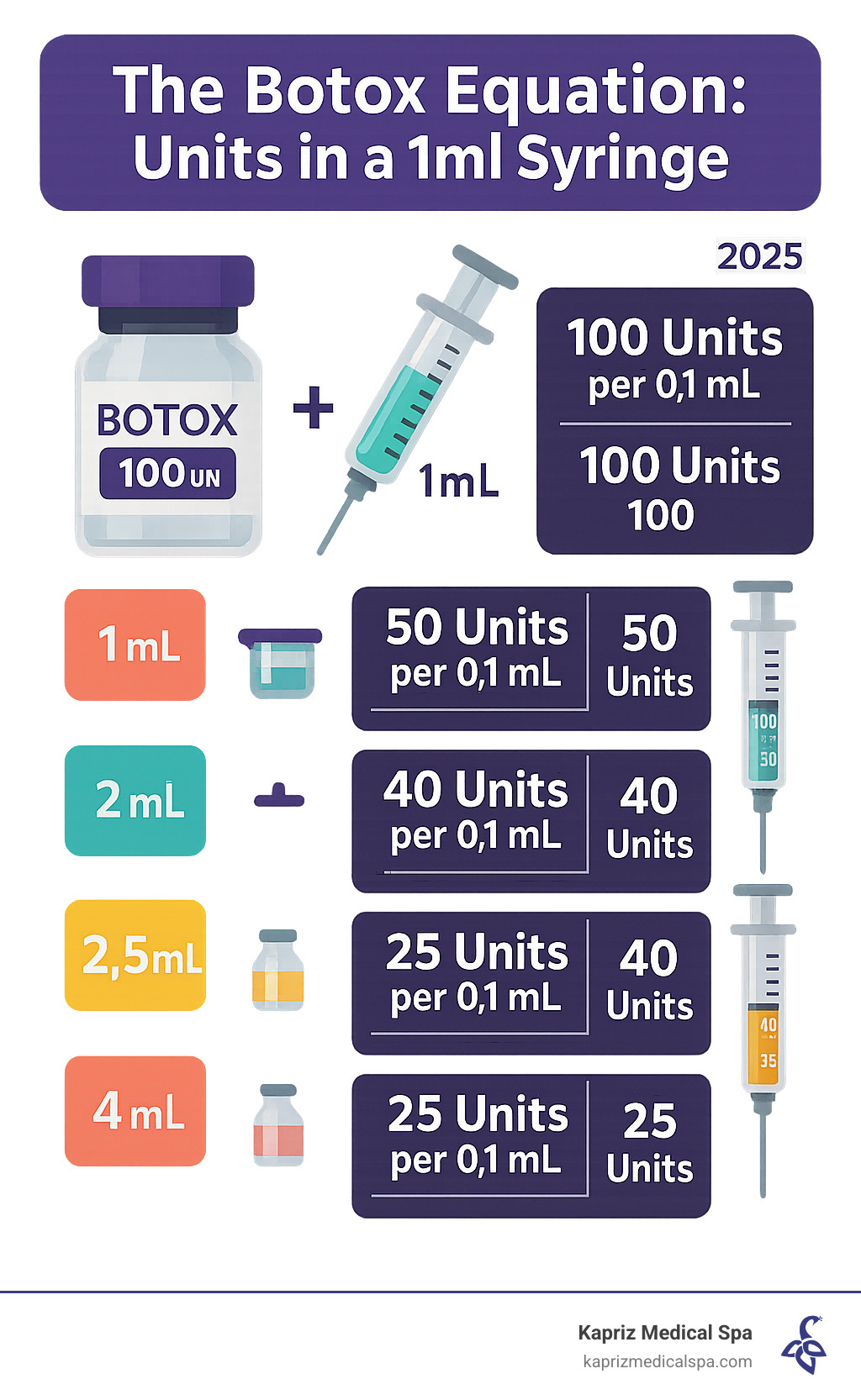
- 1 mL diluent: 100 units per 1 mL syringe
- 2 mL diluent: 50 units per 1 mL syringe
- 2.5 mL diluent: 40 units per 1 mL syringe
- 4 mL diluent: 25 units per 1 mL syringe
The math is simple once you know the dilution ratio. A standard 100-unit vial mixed with different amounts of sterile saline creates different concentrations. When practitioners use 2.5 mL of saline (the most common dilution), each 0.1 mL contains 4 units – meaning a full 1 mL syringe holds 40 units.
But here’s what most people don’t realize: the amount of saline used completely changes how many units you’re getting. Use too little saline and the concentration becomes dangerously high. Use too much and you might not get enough active ingredient to see results.
This precision matters because Botox units measure biological potency, not volume. As one prescribing guide notes, “BOTOX units are specific to the preparation and assay method used and are not interchangeable with other botulinum toxin products.”
Essential how many botox units in 1 ml syringe terms:
- how to know how many units of botox you need
- how much botox do i need for the first time
- how many units of dysport equal botox
Understanding Botox Units and Vial Concentration
Before we dive into how many botox units in 1 ml syringe, we need to understand what we’re actually measuring. Think of Botox units like horsepower in a car – they tell you about strength and performance, not just size.
What Is a “Unit” of Botox?
Here’s where it gets interesting (and slightly weird). A Botox unit measures biological strength using something called a mouse bioassay. I know, I know – it sounds medieval, but this testing method is actually genius because it ensures every single vial delivers the exact same muscle-relaxing power.
The Allergan standard unit creates perfect consistency across all batches. Whether you’re getting treatment in Jacksonville or Japan, one unit of Botox has identical potency. This mouse-based assay might sound outdated, but it’s the gold standard that keeps treatments predictable and safe.
But here’s the crucial part: Botox units are assay-specific and non-interchangeable with other brands. You can’t swap them like generic medications. Each manufacturer uses different testing methods, so their units measure differently.
How Manufacturers Supply Botox Powder
Botox arrives at medical practices as a white, freeze-dried powder in single-use vials containing either 100 units or 200 units. The powder looks completely harmless – almost like powdered sugar – but it’s completely inactive until mixed with sterile saline.
Each vial is vacuum-sealed, and you’ll actually hear a satisfying “pop” when the needle pierces the rubber stopper. That sound tells you the vial is authentic and hasn’t been tampered with.
Always look for the holographic security label on genuine Botox vials. This isn’t just fancy packaging – it’s your protection against counterfeit products that unfortunately exist in some markets.
The powder itself has no expiration concerns when stored properly, but once you add saline, the clock starts ticking. Understanding this timeline is crucial for determining how many botox units in 1 ml syringe you’ll actually be getting during your treatment.
According to scientific research on botulinum potency, proper storage and handling of these vials directly impacts the final concentration and effectiveness of your treatment.
Reconstitution Basics & Dilution Tables
The magic happens when you mix that white powder with sterile saline – and this is where how many botox units in 1 ml syringe gets determined. Think of it like making coffee: the amount of water you add changes the strength of your final cup.
Reconstitution might sound fancy, but it’s simply mixing Botox powder with preservative-free 0.9% sodium chloride (sterile saline). The amount of saline you add completely changes the final concentration – and this is where precision becomes absolutely critical.
According to scientific research on dilution protocols, there’s a specific technique that protects the delicate protein structure. You draw up saline with a 21-gauge needle, then inject it slowly down the side of the vial – never directly onto the powder. This gentle approach prevents the protein from breaking down.
Here’s the part that surprises many people: you gently swirl, never shake the mixture. Shaking can damage the botulinum toxin and reduce its effectiveness. Once mixed, you have 24 hours to use it when stored at the proper temperature of 2-8°C.
Standard 100-Unit Vial Dilution Chart
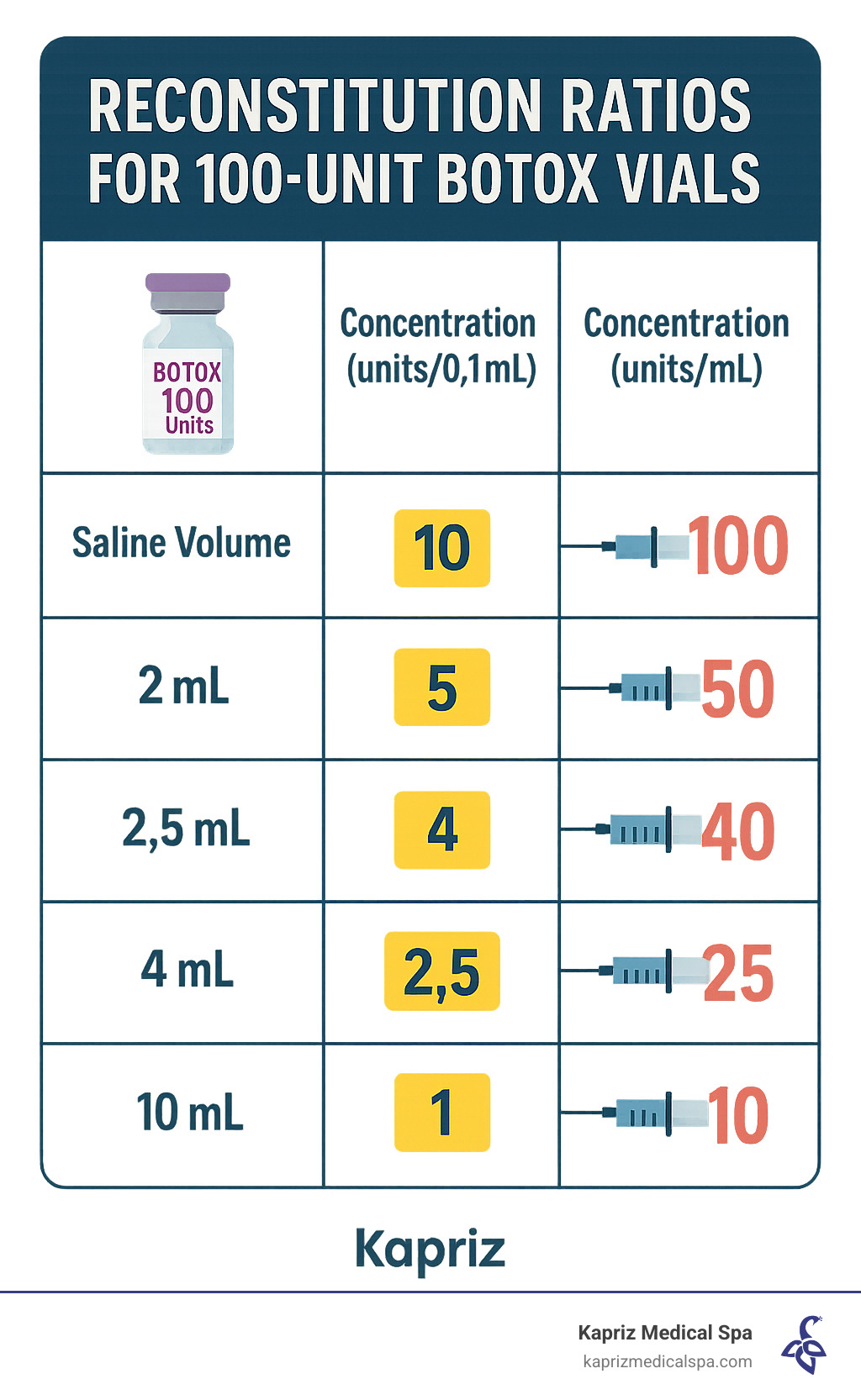
Now let’s get to the numbers that determine how many botox units in 1 ml syringe. With a standard 100-unit vial, your dilution choice creates these concentrations:
1 mL diluent creates the strongest concentration at 10 units per 0.1 mL, which means 100 units per 1 mL syringe. This high concentration is rarely used in practice because it’s difficult to control precise dosing.
2 mL diluent gives you 5 units per 0.1 mL, resulting in 50 units per 1 mL syringe. This concentration works well for larger treatment areas or when you need multiple injection sites.
2.5 mL diluent is the sweet spot for most practitioners, delivering 4 units per 0.1 mL and 40 units per 1 mL syringe. This dilution offers excellent control for precise facial treatments.
4 mL diluent creates a gentler concentration of 2.5 units per 0.1 mL, giving you 25 units per 1 mL syringe. This works beautifully for areas where you want subtle effects or broader diffusion.
Therapeutic vs. Cosmetic Dilutions
Different medical conditions call for different concentrations, and this dramatically affects how many botox units in 1 ml syringe you’ll end up with. For overactive bladder treatment, practitioners typically use 10 mL of saline with a 100-unit vial, resulting in just 10 units per 1 mL syringe. This dilute concentration allows for the large volume needed for bladder wall injections.
Chronic migraine treatments often use 2 mL of diluent, creating 50 units per 1 mL syringe. This concentration provides good control across the multiple injection sites required for migraine protocols.
For cosmetic facial treatments, the 2.5 mL dilution (giving you 40 units per 1 mL syringe) has become the gold standard. This concentration offers the perfect balance of control and natural diffusion that creates those smooth, natural-looking results we all want.
How Many Botox Units in 1 mL Syringe?
Here’s where the rubber meets the road. The answer to how many botox units in 1 ml syringe isn’t a single number – it’s entirely determined by how much saline was used to reconstitute the powder. Think of it like making coffee: the same amount of coffee grounds will give you espresso or weak coffee depending on how much water you add.
The calculation formula is beautifully simple: Units per 1 mL = Total vial units ÷ mL of diluent added
For a standard 100-unit vial, here’s how the math works out. With 1 mL of diluent, you get 100 units per 1 mL syringe. Add 2 mL of diluent and you have 50 units per 1 mL syringe. The most popular 2.5 mL dilution gives you 40 units per 1 mL syringe, while 4 mL of diluent results in 25 units per 1 mL syringe.
One important detail that many people overlook: syringe dead space. This is the tiny amount of solution that stays trapped in the syringe hub and needle after injection. Using insulin syringes with minimal dead space helps ensure you’re getting the dose you calculated.
Fast Math: 1 mL Diluent = 100 Units — True or False?
Absolutely true! When you reconstitute a 100-unit vial with exactly 1 mL of saline, you get the maximum concentration of 100 units per 1 mL syringe. This creates an incredibly potent solution with 10 units packed into every 0.1 mL.
But here’s the catch – this super-concentrated version is rarely used in real practice. Why? It’s like trying to add just a pinch of salt with a tablespoon. The concentration is so high that it becomes difficult to measure small volumes accurately, which increases the risk of overdosing.
Plus, patients don’t love it. The smaller injection volumes can be more uncomfortable, and practitioners have less control over how the product diffuses through the tissue.
Cheat Sheet: how many botox units in 1 ml syringe at Common Dilutions
When you need to know how many botox units in 1 ml syringe quickly, here’s your go-to reference. With 1 mL diluent, you get 100 units per 1 mL syringe – the highest concentration possible. 2 mL diluent gives you 50 units per 1 mL syringe, which is popular for therapeutic applications.
The sweet spot for most cosmetic treatments is 2.5 mL diluent, resulting in 40 units per 1 mL syringe. This translates to exactly 4 units per 0.1 mL, making calculations straightforward during treatment. For more dilute applications, 4 mL diluent provides 25 units per 1 mL syringe.
Most experienced practitioners gravitate toward the 2.5 mL dilution because it strikes the perfect balance. It’s concentrated enough to be efficient but dilute enough to allow precise, comfortable injections with predictable diffusion patterns.
Step-by-Step: Preparing, Drawing & Administering Safely

Getting the exact how many botox units in 1 ml syringe that you calculated is only half the battle. The other half is proper technique – and this is where precision meets artistry.
The process starts with aseptic technique – everything must be sterile. We begin by drawing up the calculated amount of preservative-free saline using a 21-gauge needle. This larger needle makes it easier to draw the saline quickly without creating bubbles.
Next comes the mixing phase, which is surprisingly gentle. We inject the saline slowly down the vial wall – never directly onto the powder. Think of it like adding cream to hot coffee; you want to avoid creating a splash. Then we gently swirl the vial. Never shake it! Shaking can damage the protein structure and reduce effectiveness.
For drawing the reconstituted solution, we switch to a much smaller 31-gauge needle. This finer needle minimizes discomfort during injection and gives us better control. Syringe selection matters too – insulin syringes with clear markings help us measure precise volumes and have minimal dead space.
Minimizing dead space is crucial because it affects how many units actually reach the patient. Even a small amount of solution left in the syringe hub can throw off your dosing calculations. This is why we prefer syringes designed specifically for precision work.
Safe Handling & Disposal
Once you’ve reconstituted Botox, the clock starts ticking. The solution must be used within 24 hours and stored in the refrigerator at 2-8°C. We always label our syringes with the reconstitution time and date – it’s easy to lose track during a busy day.
Disposal guidelines are straightforward but important. All needles and syringes go into approved sharps containers – never regular trash. Any unused reconstituted Botox should be disposed of as medical waste after the 24-hour window.
Here’s a pro tip: always perform a vacuum loss check when you first puncture the vial. You should hear that distinctive “pop” sound. If you don’t, the vial’s integrity may be compromised.
Who Should Perform the Procedure?
This might seem obvious, but it’s worth emphasizing: only licensed medical professionals should handle Botox reconstitution and administration. This includes physicians, nurse practitioners, and physician assistants who have completed proper training requirements.
At Kapriz Medical Spa, our practitioners don’t just meet the minimum requirements – they undergo extensive training in facial anatomy, injection techniques, and safety protocols. We believe that understanding how many botox units in 1 ml syringe is just the foundation. The real skill comes in knowing exactly where and how to place those units for optimal results.
For more information about our approach to Botox Injections Jacksonville, we focus on building lasting relationships while ensuring you get the safest, most effective treatment possible.
Why Getting the Math Right Matters
Getting how many botox units in 1 ml syringe correct isn’t just about following protocol – it’s about delivering the beautiful, natural results you’re hoping for while keeping you completely safe.
Think of it this way: Botox is like seasoning a perfect dish. Too little and you won’t taste the difference. Too much and you’ve ruined the whole meal. The same principle applies to your treatment.
Accurate dosing is everything. When we calculate the exact units needed, you get that refreshed look without the “frozen” appearance that gives Botox a bad name. Under-dose and you’ll wonder why you bothered. Over-dose and you might end up with droopy eyelids or an unnatural expression that takes months to wear off.
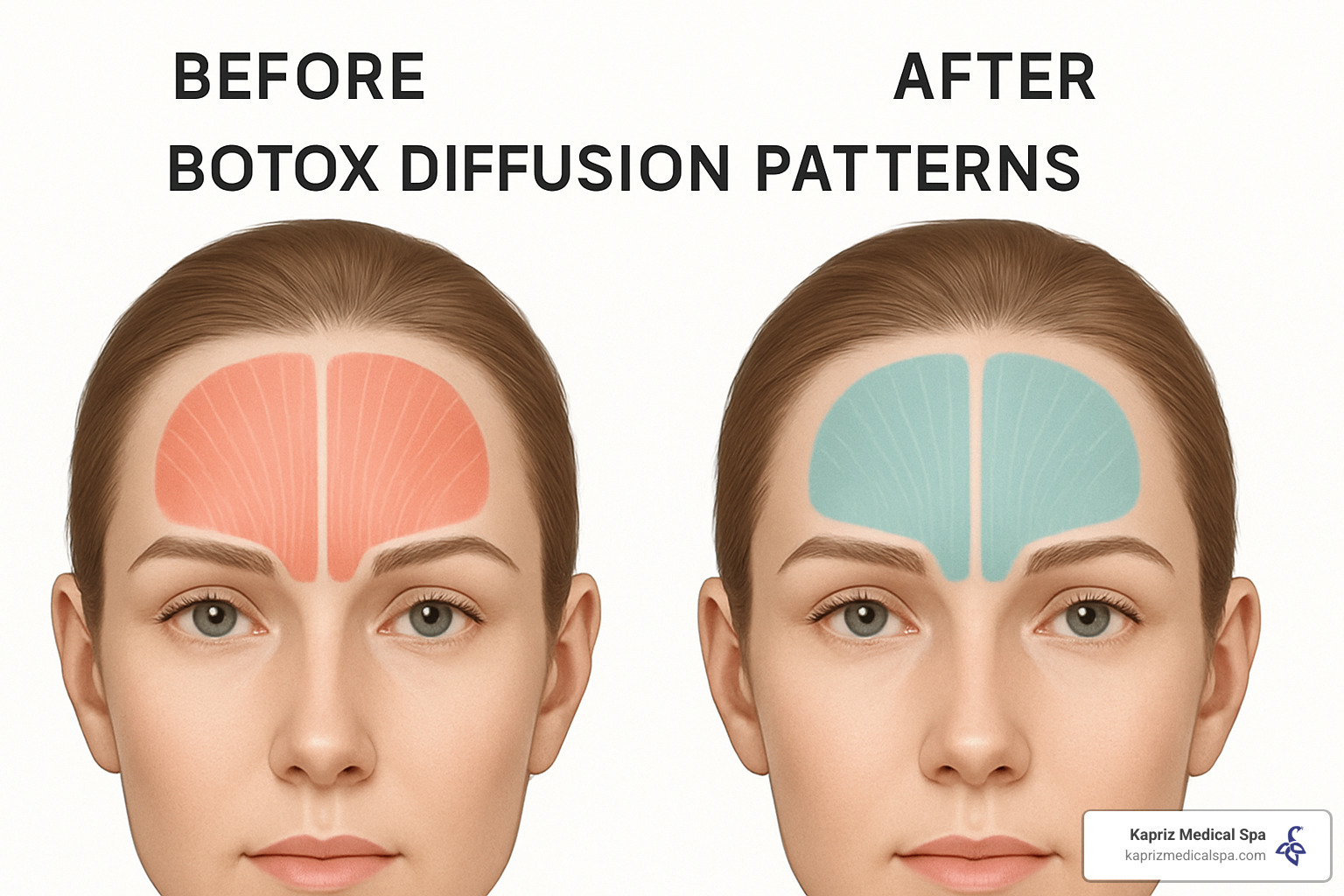
Diffusion control makes the difference between looking refreshed and looking surprised. Higher concentrations from knowing exactly how many botox units in 1 ml syringe stay put where we inject them. Lower concentrations spread out more, which can be good or bad depending on what we’re trying to achieve.
The science is fascinating: when we use the right dilution, the toxin affects exactly the muscles we target. Get the math wrong, and it might wander to muscles we didn’t mean to treat.
Patient satisfaction comes from consistency. When you know exactly what to expect from your treatment, you can plan your social calendar and feel confident about your results. That’s why we’re obsessive about getting these calculations right every single time.
Risks of Incorrect Dilution or Dosing
Here’s what happens when the math goes wrong – and why we double-check everything:
Overcorrection turns confidence into concern. Too many units create that “frozen” look that screams “I had work done!” Nobody wants to lose their natural expressions or have their eyebrows stuck in permanent surprise mode.
Toxin spread is like spilled paint – once it happens, you can’t take it back. When we use too much dilution, the Botox can migrate to nearby muscles. This might cause your eyelid to droop or create unexpected asymmetry that takes months to resolve.
Under-treatment feels like wasted money. You’ve invested in looking and feeling better, but with too few units, you might barely notice a difference. This leads to frustration and the need for additional treatments sooner than expected.
Product waste affects everyone. Incorrect calculations mean throwing away expensive medication, which ultimately drives up costs for everyone. We believe in being good stewards of both your investment and the medication itself.
Indication-Specific Considerations
Different treatment areas require different approaches to how many botox units in 1 ml syringe, and here’s why:
Cosmetic facial treatments work best with our standard 2.5 mL dilution. This gives us precise control over exactly where the Botox goes and how much muscle relaxation we achieve. Your forehead wrinkles need a different approach than your crow’s feet.
Spasticity treatments for medical conditions often need higher concentrations to penetrate deeper, larger muscles effectively. The math changes because we’re treating different anatomy for different goals.
Bladder treatments require the 10 mL dilution to safely cover the large surface area of the bladder wall. This is medical Botox at its most precise – there’s no room for guesswork.
Dose limits keep everyone safe. Adults shouldn’t exceed 400 units per 3-month period across all treatments. This is why we track your treatment history and coordinate with any other providers you might see.
At Kapriz Medical Spa, we believe that understanding these details helps you feel confident in your treatment choices. When you know we’re getting the science right, you can focus on enjoying your results.
Frequently Asked Questions about Units per mL
Let’s tackle the most common questions we hear about how many botox units in 1 ml syringe calculations. These come up regularly in our practice, and getting the answers right makes all the difference in treatment success.
How long can reconstituted Botox be stored?
Once you’ve mixed that powder with saline, you’re working against the clock. Reconstituted Botox stays potent for up to 24 hours when stored properly at 2-8°C (that’s about 36-46°F – basically refrigerator temperature).
Here’s the thing though – after 24 hours, the potency starts dropping and contamination risk goes up. We always label our vials with the exact date and time of reconstitution. It’s like that carton of milk in your fridge – you need to know when it expires.
The good news? Most practitioners use their reconstituted Botox within a few hours anyway, so the 24-hour window gives plenty of flexibility for scheduling multiple patients.
Can I use bacteriostatic saline instead of preservative-free?
Absolutely not – and this is a mistake that can really mess up your results. Bacteriostatic saline contains preservatives that interfere with Botox potency and can cause nasty reactions in patients.
The preservatives essentially “fight” with the botulinum toxin, reducing its effectiveness. You might think you’re giving the right number of units based on your how many botox units in 1 ml syringe calculation, but the actual potency could be significantly lower.
Always stick with preservative-free 0.9% sodium chloride. It’s specifically designed for this purpose and won’t compromise your results. Think of it as the difference between using the right key versus trying to force the wrong one – only one actually works.
What if my syringe shows “insulin units”?
This confuses a lot of people, but insulin syringes are actually measuring volume, not Botox units. The “units” marked on insulin syringes refer to insulin dosing, not our botulinum toxin units.
Here’s the conversion that matters: 5 insulin units equals 0.05 mL, 10 insulin units equals 0.1 mL, 50 insulin units equals 0.5 mL, and 100 insulin units equals 1.0 mL.
To figure out how many botox units in 1 ml syringe, you still need to know your dilution ratio first. If you reconstituted with 2.5 mL of saline, then that 1.0 mL syringe (marked as “100 insulin units”) contains 40 Botox units.
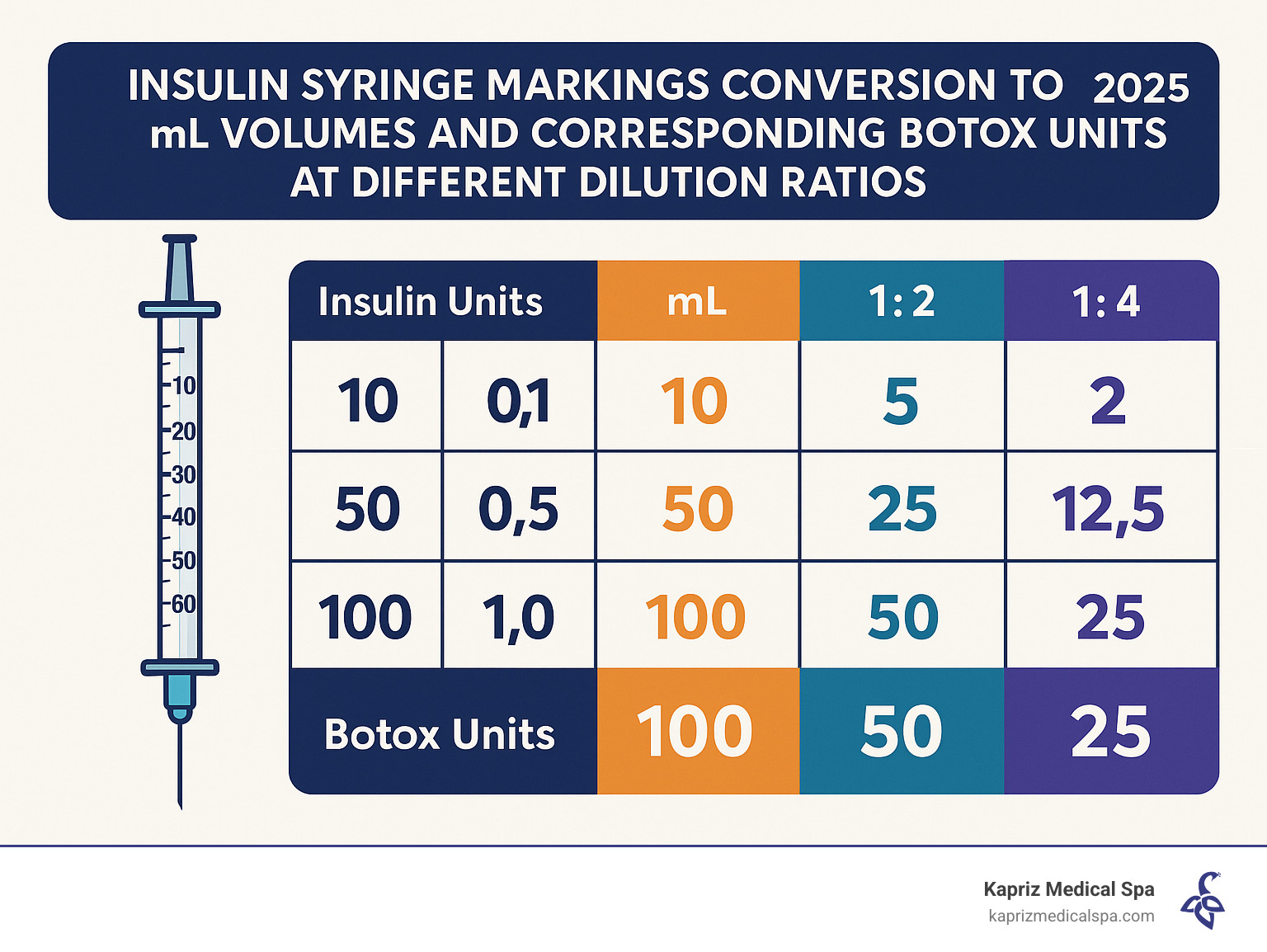
The key is remembering that insulin syringes are just measuring tools – they don’t change the actual Botox concentration you created during reconstitution. It’s like using a ruler marked in inches to measure something that exists in centimeters – you need to do the conversion, but the thing you’re measuring hasn’t changed.
Conclusion
Getting how many botox units in 1 ml syringe right isn’t just about math – it’s about your safety, your results, and your peace of mind. Whether you’re receiving treatment or simply want to understand what’s happening during your appointment, knowing these basics empowers you to make informed decisions.
The key insight? Precision equals results. When practitioners understand that a 100-unit vial mixed with 2.5 mL of saline gives exactly 40 units per 1 mL syringe, they can deliver consistent, predictable outcomes. When patients understand these fundamentals, they can have more meaningful conversations with their providers about their treatment goals.
But here’s what matters most: the human touch behind the science. At Kapriz Medical Spa, we’ve seen how taking time to explain these details transforms the entire treatment experience. When you understand why your practitioner chooses a specific dilution or why they measure so carefully, you feel more confident and comfortable.
Our approach centers on building lasting relationships through education and exceptional care. We believe you deserve to understand your treatment completely – from the initial consultation through your follow-up appointments. This isn’t just about delivering beautiful results (though we’re proud of those too). It’s about creating an experience where you feel heard, understood, and genuinely cared for.
The science of how many botox units in 1 ml syringe might seem complex at first, but it’s really about one simple principle: doing things right. Whether that’s using the correct dilution ratio, maintaining proper storage temperatures, or taking the time to answer your questions – these details matter because you matter.
Ready to experience what happens when scientific precision meets personalized care? We’d love to show you the difference that attention to detail can make. Learn more about our comprehensive approach and explore our Botox cost Jacksonville FL options.
Remember: your safety and satisfaction aren’t just about getting the math right – they’re about working with people who care enough to get everything right. Because when it comes to your face and your confidence, you deserve nothing less than excellence.